Car Repair SEO is the process of making your auto repair shop visible on Google Search, Google Maps, and AI tools like ChatGPT and Gemini when nearby drivers search for services you offer. A well-built strategy produces calls, booked bays, and repeat customers from organic search, with no cost per click.
This guide covers every layer of that strategy: keyword research, Google Business Profile optimization, service page architecture, technical SEO, citation building, review systems, and AI citation strategy. We built this from our work managing local SEO campaigns for auto repair businesses across competitive US and Middle East markets. Every tactic here comes from campaigns we have run, not theory we borrowed from someone else.
If your shop is not ranking in the top three on Google Maps or the first page of local search results, this guide gives you the exact framework to fix that.
The Search Behavior That Makes Auto Repair SEO Different
Car Repair SEO works differently from most local industries because urgency drives the query. Drivers searching for auto repair are not comparing options over a few days. They have a problem, a car they cannot drive, and a deadline measured in hours. That urgency shapes every ranking factor that matters for your shop.
A driver searching "transmission repair near me" is not window shopping. They have already decided they need a shop. They are choosing which one. That single difference makes organic search one of the highest-converting marketing channels available to any auto repair business.
No paid ad, no mailer, and no social post can replicate the moment someone actively searches for exactly what you do. Search captures buyers in real time. Understanding that reframes the entire investment case for Car Repair SEO.
Three Types of Auto Repair Searches (and the Intent Behind Each)
Drivers search in three distinct modes, and each mode requires a different page type on your website.
- Emergency searches carry the highest urgency and the highest conversion rate. Examples include "car won't start near me," "brakes failing mechanic open now," and "engine overheating shop nearby." These searches happen on phones, often from the side of the road. Google Maps results dominate this search surface. Your Google Business Profile is the primary asset here.
- Maintenance searches are planned but still local and commercial. Examples include "oil change near me," "tire rotation cost [city]," and "brake inspection [neighborhood]." These searches favor both Map Pack results and well-optimized service pages. Pricing transparency on your service pages converts these searchers faster than anything else.
- Research and trust searches happen before a driver has an urgent problem. Examples include "best mechanic in [city]," "ASE certified auto repair near me," and "honest car repair shop [city]." Review depth, certifications, and content quality determine who wins here. These searches also appear heavily in AI tools like ChatGPT and Gemini when drivers ask for shop recommendations.
The Two Ranking Surfaces That Drive Car Count
Google returns two distinct surfaces for auto repair searches. Both require separate, deliberate optimization.
- The Local Pack (the map with three business listings) appears above all organic results for location-based queries. Drivers searching from phones see this almost exclusively. Your Google Business Profile controls this surface.
- Organic results appear below the Local Pack and rank based on your website's service pages, blog content, and technical foundation. Long-tail service searches, vehicle-make queries, and symptom-based content primarily rank here.
In 2026, a third surface matters: AI Overviews and conversational AI tools. We cover that separately in this guide because it requires a specific content strategy most shops have not built yet.
Keyword Strategy for Auto Repair Shops: The Three-Bucket Matrix
Auto repair keyword research follows a matrix: service type crossed with vehicle make crossed with city. Shops that build pages for the right cells in that matrix capture queries no competitor has targeted. Most shops stop at broad terms like "auto repair [city]" and leave the rest uncovered.
Here is the full three-bucket system.
The Auto Repair Keyword Matrix
Bucket 1: Location + Service Terms (Highest Converting)
These are your primary revenue keywords. They combine a specific service with a city, neighborhood, or proximity modifier. Every term in this bucket has a driver who has already identified their need and their location.
Examples:
- "brake repair in [city]"
- "transmission shop [city] open now"
- "oil change near [neighborhood]"
- "check engine light [city]"
- "AC recharge [city] same day"
- "wheel alignment [city]"
Each of these terms maps to a dedicated service page on your website, not your homepage and not a general services page. A single page trying to rank for brakes, transmissions, and alignments at the same time typically ranks for none of them.
Bucket 2: Vehicle Make + Service Terms (Mid-Funnel Specialty)
These terms come from drivers who want a shop familiar with their specific vehicle, not just a generalist. The volume on individual make+service terms is lower, but the conversion rate is higher because the searcher is already committed.
Examples:
- "BMW oil change [city]"
- "Toyota transmission repair near me"
- "Ford F-150 diesel mechanic [city]"
- "Honda brake repair [city]"
- "Subaru head gasket shop [city]"
Shops that specialize in European vehicles, domestic trucks, or specific manufacturer brands should build dedicated make pages (e.g., /bmw-repair-[city]/). Generalist shops can build make+service combo pages for their highest-volume vehicle types.
Bucket 3: Symptom and Diagnostic Terms (Top-of-Funnel, High Volume)
This bucket covers searches from drivers who have a problem but have not yet named the service they need. These are the highest-volume keywords in auto repair SEO, and most shops completely ignore them.
Examples:
- "why are my brakes squeaking"
- "check engine light came on what to do"
- "car shaking at highway speeds"
- "transmission slipping when shifting"
- "why is my car overheating"
These terms belong on blog posts and diagnostic content pages, not service pages. The job of symptom content is to capture the driver early in their decision process, explain the problem, and route them to your relevant service page. This content also feeds AI Overviews, which we cover in the AEO and GEO section.
Urgency Modifier Terms (Overlooked, High Commercial Value)
A separate sub-bucket exists inside each of the three buckets above. Urgency modifiers attached to any service term shift the intent from research to immediate action.
Examples:
- "mechanic open now"
- "auto repair near me open Saturday"
- "emergency car repair [city]"
- "same-day transmission repair [city]"
These terms should appear in your Google Business Profile service descriptions, homepage meta description, and any page targeting emergency-intent queries.
Fleet vs. Consumer: The Split Most Shops Miss
Independent shops that service both consumer vehicles and commercial fleet accounts operate in two separate keyword universes. Mixing them on one homepage dilutes both.
Fleet customers search differently: "fleet vehicle maintenance [city]," "commercial auto repair account billing," "multi-vehicle service contracts." Consumer customers search by service and urgency.
If your shop runs a meaningful fleet operation, build a dedicated fleet services page. It speaks to fleet managers in their language (preventive maintenance scheduling, priority lanes, account billing, vehicle downtime) and keeps your consumer pages focused on the searches that drive walk-in traffic.
Google Business Profile Optimization for Auto Repair Shops
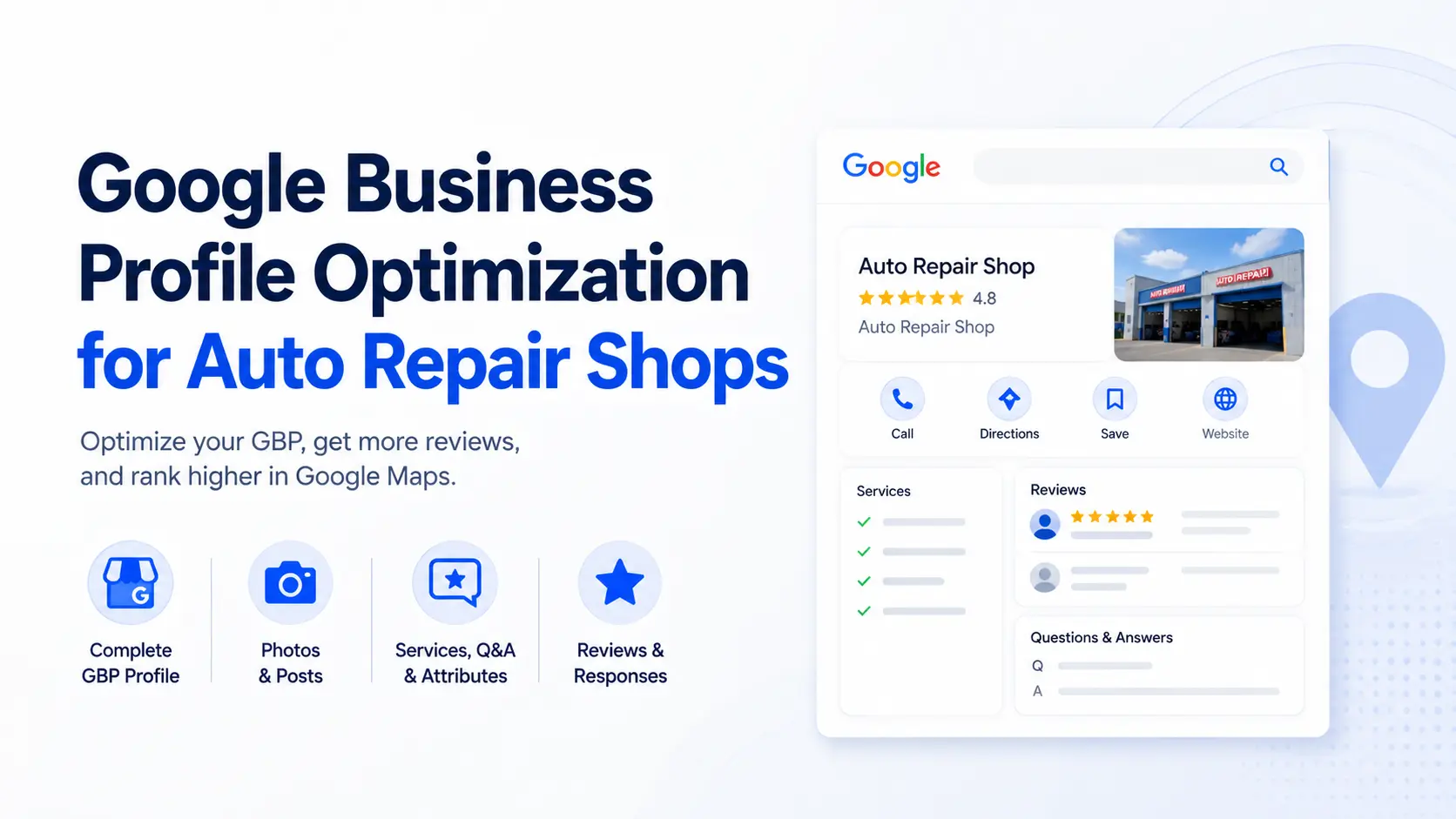
The Google Business Profile (GBP) is the single most powerful asset in Car Repair SEO. GBP optimizations typically move Local Pack rankings within 4 to 8 weeks, faster than any other SEO tactic.
Most shops claim their profile and stop there. The shops that dominate Google Maps treat GBP as an active, ongoing ranking system, not a one-time setup task.
Category Selection and Business Description
Your primary GBP category should be "Auto Repair Shop." Do not deviate from this unless your shop is a true specialist (tire shop, brake repair shop, transmission shop). Secondary categories let you add: Brake Shop, Oil Change Service, Transmission Shop, Wheel Alignment Service, Auto Electrical Service.
Your business description gets 750 characters. Use the first sentence to state your primary service and city clearly. Include your core specialties and 2 to 3 keyword phrases naturally. End with a trust signal, such as years in business, ASE certification, or a warranty statement. Do not stuff keywords. Write for the driver reading it, and the keyword signals will follow.
Services, Attributes, and the Q&A Section
GBP lets you add individual services beyond your primary category. Add every major service your shop performs: brakes, transmission, oil change, AC repair, wheel alignment, diagnostics, timing belt, and any others. Each service entry becomes a signal Google uses to match your profile to specific service queries.
Attributes tell Google and customers more about your shop. Fill in every applicable attribute: ASE Certified, Women-Owned, Veteran-Owned, Wheelchair Accessible, Online Estimates Available, and Appointment Required (or not).
The Q&A section is a free keyword field most shops leave empty. Pre-populate it with the 8 to 10 questions your front desk answers every day. "Do you work on Saturdays?" "Do you offer free diagnostics?" "Do you service diesel trucks?" Each answer is indexed by Google and can trigger profile features in search results.
Photos and Posts: The Two Ranking Signals Shops Ignore
GBP profiles with 100 or more photos consistently outrank profiles with fewer in competitive local markets. Stock photos of generic engines do not produce the same ranking signal as real photos of your shop, your technicians, and actual work being performed.
Photo priority list:
- Exterior photos (multiple angles, all hours)
- Interior shop photos
- Technicians actively working on vehicles
- Before and after photos of completed jobs
- ASE certifications and awards displayed on-site
- Team member headshots with names and credentials
Posts work the same way. Profiles that go quiet for 60 to 90 days lose Map Pack positions to shops that post weekly. One post per week covering a service, a completed job, a seasonal tip, or a promotion keeps the profile active. Each post is a signal that your business is operating and engaged.
Review Strategy: Velocity, Recency, and Response Rate
Reviews are both a local ranking factor and a conversion driver. Google's local algorithm uses review count, recency, response rate, and the content of review text as inputs for Local Pack rankings.
A shop with 350 recent reviews at a 4.8-star average almost always outranks a shop with 50 reviews at the same rating. Review velocity (a steady stream of new reviews over time) matters more than a one-time burst.
The most effective review request method: send an SMS with a direct link to your Google review page immediately after invoice close, the same day the vehicle leaves your bay. Requests sent 48 to 72 hours later get meaningfully lower response rates. The experience is freshest the day of service.
The Automated Review Request Loop
Respond to every review within 24 hours. For positive reviews, use the response to include your service name and city naturally (this creates keyword-rich indexed content around your profile). For negative reviews, acknowledge the issue, offer resolution, and move the conversation offline. Prospective customers read negative reviews and your responses. A professional, specific response to a complaint converts skeptical visitors more than any marketing copy.
Want us to audit your Google Business Profile?
Identify exactly what is costing you Local Pack rankings. Request a free GBP audit from A1 Technovation.
Website Architecture for Auto Repair SEO
The most common auto repair website mistake is the "everything on one page" services section. A single page listing brakes, transmissions, oil changes, alignments, tires, and diagnostics typically ranks for none of those services because Google cannot determine which specific search that page is meant to answer.
The fix is straightforward: one dedicated page per service, each targeting its own keyword cluster.
Auto Repair Service Page Structure
The Service Page Architecture
Here is the minimum viable service page structure for a single-location auto repair shop:
| Page URL | Primary Target Keyword | Minimum Content |
|---|---|---|
/brake-repair-[city]/ |
brake repair [city] | 800–1,200 words + FAQ + schema |
/transmission-repair-[city]/ |
transmission shop [city] | 800–1,200 words + FAQ + schema |
/oil-change-[city]/ |
oil change near me | 600–800 words + pricing + schema |
/check-engine-light-[city]/ |
check engine light [city] | 800+ words + symptom list |
/ac-repair-[city]/ |
car AC repair [city] | 800+ words |
/wheel-alignment-[city]/ |
wheel alignment [city] | 700+ words |
/tire-services-[city]/ |
tire shop [city] | 800+ words |
/engine-repair-[city]/ |
engine repair [city] | 1,000+ words |
Each service page needs real photos of that service being performed in your shop, not stock images. Real photos reduce bounce rate, build trust, and give Google unique image content to index.
Every service page closes with a primary CTA: call now, book online, or request a quote. Place the CTA above the fold on mobile, where most auto repair searches happen.
Make-Specific Pages for Specialist Shops
If your shop specializes in European vehicles, domestic trucks, or a specific manufacturer brand, build dedicated make pages. A BMW specialist should have /bmw-repair-[city]/ with content covering BMW-specific services, common model issues (e.g., N54 turbo problems, oil leaks on E90s), and your technicians' BMW experience.
Make-specific content captures drivers who want a specialist, and these pages rank in lower-competition keyword spaces than broad "auto repair" terms.
Symptom Content That Routes Traffic to Service Pages
Symptom blog posts are the top-of-funnel content that pulls in high-volume traffic and routes it to your converting service pages.
Structure every symptom post the same way:
- Name the symptom clearly in the H1 (e.g., "Brakes Squeaking When Stopping")
- Give a direct 40-word answer in the opening paragraph
- List the most common causes
- Explain the diagnostic process
- State when the problem requires a shop visit
- Link internally to the relevant service page (e.g.,
/brake-repair-[city]/) - End with a CTA to schedule a diagnostic appointment
This structure also feeds Google AI Overviews. We cover that in full in the AEO section.
Multi-Location Architecture
Shops with more than one location need a separate, unique page for each location. Never duplicate content across location pages. Google filters near-duplicate local pages aggressively.
Each location page needs:
- Unique opening paragraph referencing the specific neighborhood or area served
- Location-specific services (if the locations differ in capabilities)
- The location's individual Google Maps embed
- That location's specific NAP (name, address, phone number)
- Local community references: neighborhoods served, major roads nearby, local landmarks as directional signals
On-Page SEO for Auto Repair Service Pages
Title Tags and Meta Descriptions
Every service page needs a unique title tag under 60 characters with the primary keyword near the front. A strong formula: Service + City + Trust Signal.
Examples:
- "Brake Repair in Austin, TX | ASE Certified Shop"
- "Transmission Repair [City] | Same-Day Diagnostics"
- "Oil Change [City] | Quick Service, No Appointment Needed"
Meta descriptions run under 160 characters. Lead with the customer's problem or need, follow with your solution, close with a specific action. Never copy the title tag into the meta description.
Header Hierarchy and Keyword Placement
Your H1 gets one job: state clearly what the page is about with the primary keyword included. "Brake Repair in [City]: Fast Service, Honest Pricing" covers both the keyword and the value proposition.
H2s structure the page into meaningful sections: what the service covers, common symptoms that lead to this service, cost transparency, the repair process, trust signals, and FAQ. H3s support each H2 with specific sub-points.
Place your primary keyword in the first 100 words of body copy, in the H1, and naturally 2 to 3 more times across the page. Do not repeat it mechanically. Use related terms: brake pads, rotors, brake caliper, brake fluid for a brake page. These semantic co-occurrences signal topical depth to Google.
Content Structure That Converts, Not Just Ranks
A service page that ranks but does not convert produces call volume but not booked appointments. Build every service page in this order:
- Hook: State the problem the driver is trying to solve
- Service explanation: Specific, precise, not generic
- Cost transparency: Price ranges, what affects cost, no surprises
- Process: Steps from drop-off to pick-up, how long it takes
- Trust signals: ASE certifications, warranty, years in business, review count
- FAQ block: 5 to 7 questions with direct answers
- CTA: Phone number, booking link, or contact form
Cost transparency is the single most-underused trust signal in auto repair content. Shops that include honest price ranges on service pages consistently see higher click-to-call rates than shops that hide pricing behind "call for a quote."
Internal Linking Map
Every service page should link to at least 2 to 3 related pages on your site. The goal is to keep a driver who landed on your brake page also seeing your wheel alignment page, your tire page, and your diagnostic content.
For auto repair-specific examples, link from service content to Car Repair SEO services, then reinforce it with the broader SEO services page.
| Source Page | Links To | Anchor Text |
|---|---|---|
| Homepage | All primary service pages | Service name + city |
| Brake repair page | Wheel alignment page, tire services page | Natural service relationship |
| Symptom blog post | Relevant service page | Problem-to-solution anchor |
| All service pages | Contact / booking page | "Schedule your appointment" |
Technical SEO for Auto Repair Shops
Technical SEO is the foundation that determines whether your service pages and GBP work can actually produce rankings. Three technical issues appear more often in auto repair sites than almost any other local business category.
Mobile Speed: More Important Here Than Almost Anywhere
Emergency auto repair searches happen on phones, often in poor signal conditions. A service page that takes 4 seconds to load on a mobile connection loses the driver before they ever read your content.
Core Web Vitals targets for auto repair service pages:
- Largest Contentful Paint (LCP): under 2.5 seconds
- Cumulative Layout Shift (CLS): under 0.1
- Interaction to Next Paint (INP): under 200ms
Real shop photos are essential for trust, but they are the biggest source of page speed problems. Compress all images to WebP format, lazy load images below the fold, and set explicit dimensions on every image to prevent layout shift.
Schema Markup for Auto Repair Shops
Structured data tells Google and AI systems exactly what your page covers, who you are, and what your customers say about you. Shops without service-specific schema are frequently categorized as generic mechanics, losing visibility for high-value specialty queries.
Required schema for auto repair websites:
LocalBusiness schema (on every page):
{
  "@context": "https://schema.org",
  "@type": "AutoRepair",
  "name": "[Shop Name]",
  "address": {
    "@type": "PostalAddress",
    "streetAddress": "[Street]",
    "addressLocality": "[City]",
    "addressRegion": "[State]",
    "postalCode": "[ZIP]"
  },
  "telephone": "[Phone]",
  "url": "[Website URL]",
  "openingHours": ["Mo-Fr 08:00-18:00", "Sa 08:00-14:00"],
  "priceRange": "$$",
  "aggregateRating": {
    "@type": "AggregateRating",
    "ratingValue": "[Rating]",
    "reviewCount": "[Count]"
  }
}
Service schema (one block per service page):
{
  "@context": "https://schema.org",
  "@type": "Service",
  "serviceType": "Brake Repair",
  "provider": {
    "@type": "AutoRepair",
    "name": "[Shop Name]"
  },
  "areaServed": {
    "@type": "City",
    "name": "[City]"
  },
  "description": "[Specific description of your brake service]"
}
FAQPage schema (on every page with Q&A):
{
  "@context": "https://schema.org",
  "@type": "FAQPage",
  "mainEntity": [
    {
      "@type": "Question",
      "name": "How long does a brake job take?",
      "acceptedAnswer": {
        "@type": "Answer",
        "text": "A standard brake pad replacement typically takes 1 to 2 hours per axle. Full rotor replacement adds another 30 to 60 minutes. Most brake jobs are completed same day."
      }
    }
  ]
}
Crawlability and Indexation
Your XML sitemap should include every service page, every location page, and every blog post. Submit it through Google Search Console and check it monthly for errors.
Set canonical tags on location pages that share similar service content to prevent self-cannibalization. Use no-index tags on thank-you pages, admin pages, and tag/archive pages that produce no search value.
A1 Technovation manages technical SEO for auto repair shops across US and Middle East markets. See our technical SEO services and how we build the foundation that makes content campaigns work.
Local Citations and Directory Strategy
Local citations are online mentions of your shop's name, address, and phone number (NAP). For auto repair businesses, citations on automotive-specific directories carry more ranking weight than general business directories because they signal category relevance alongside geographic relevance.
Fix your existing citations before adding new ones. Many shops have conflicting NAP information across platforms from name changes, phone number updates, or address corrections. Conflicting signals reduce the trust weight Google assigns to your location data.
For a broader foundation, see our SEO services page and the Local SEO service page for how these tactics connect to a full local growth plan.
Tier 1 Priority Citations (Fix These First)
- Google Business Profile
- Yelp
- Apple Maps
- Bing Places
- Better Business Bureau
- Yellow Pages
- RepairPal
- AutoMD
- CarFax Service
These platforms receive the most traffic from drivers actively searching for repair shops and carry the most weight in local ranking algorithms.
Tier 2 Automotive-Specific Directories (Competitive Advantage)
- NAPA AutoCare directory
- Technet Professional Automotive Service
- AAA Approved Auto Repair program
- ASE technician and shop locators
- Manufacturer referral programs: Michelin, Duramax, regional brand locators
- Insurance company preferred repair network listings
Most shops stop at Tier 1. Tier 2 listings give you automotive-specific authority signals that general competitors and chain shops rarely have on their local profiles.
NAP Consistency: The Rule and the Real Reason
Your business name, address, and phone number must appear identically across every citation source. "Joe's Auto Repair" on one platform and "Joe's Auto Repair Shop" on another creates conflicting signals. Google's local algorithm assigns lower confidence to locations with inconsistent NAP data, which directly reduces Map Pack rankings.
The address format matters too. "123 Main St" and "123 Main Street" are inconsistencies. Pick one format and apply it everywhere.
Local Link Building for Auto Repair Shops
Local links from relevant, nearby sources carry significantly more Local Pack ranking weight than generic national directory links. The strongest local link sources for auto repair shops:
Google's own guidance on local visibility is a useful baseline, especially the Google Business Profile guidelines and LocalBusiness structured data documentation.
- Tow company partnerships produce some of the best local links available. Tow companies refer high-intent customers in volume. A reciprocal listing and a referral page on each other's websites creates a link and a genuine business relationship that compounds over time.
- Local Chamber of Commerce membership produces a local authority link and gets your business listed in community directories.
- ASE, ASA, and AAA certification listings often include directory entries with links. Manufacturer certifications (BMW, Volvo, and similar) come with locator pages on the manufacturer's website, some of the strongest authority links available in this category.
- Community involvement generates local press mentions and event listings. Sponsoring a school sports team, participating in a charity drive, or partnering with a local business creates real community signals that generic shops cannot replicate with link-building tools.
AEO and GEO for Auto Repair Shops: Getting Cited by AI Search Engines
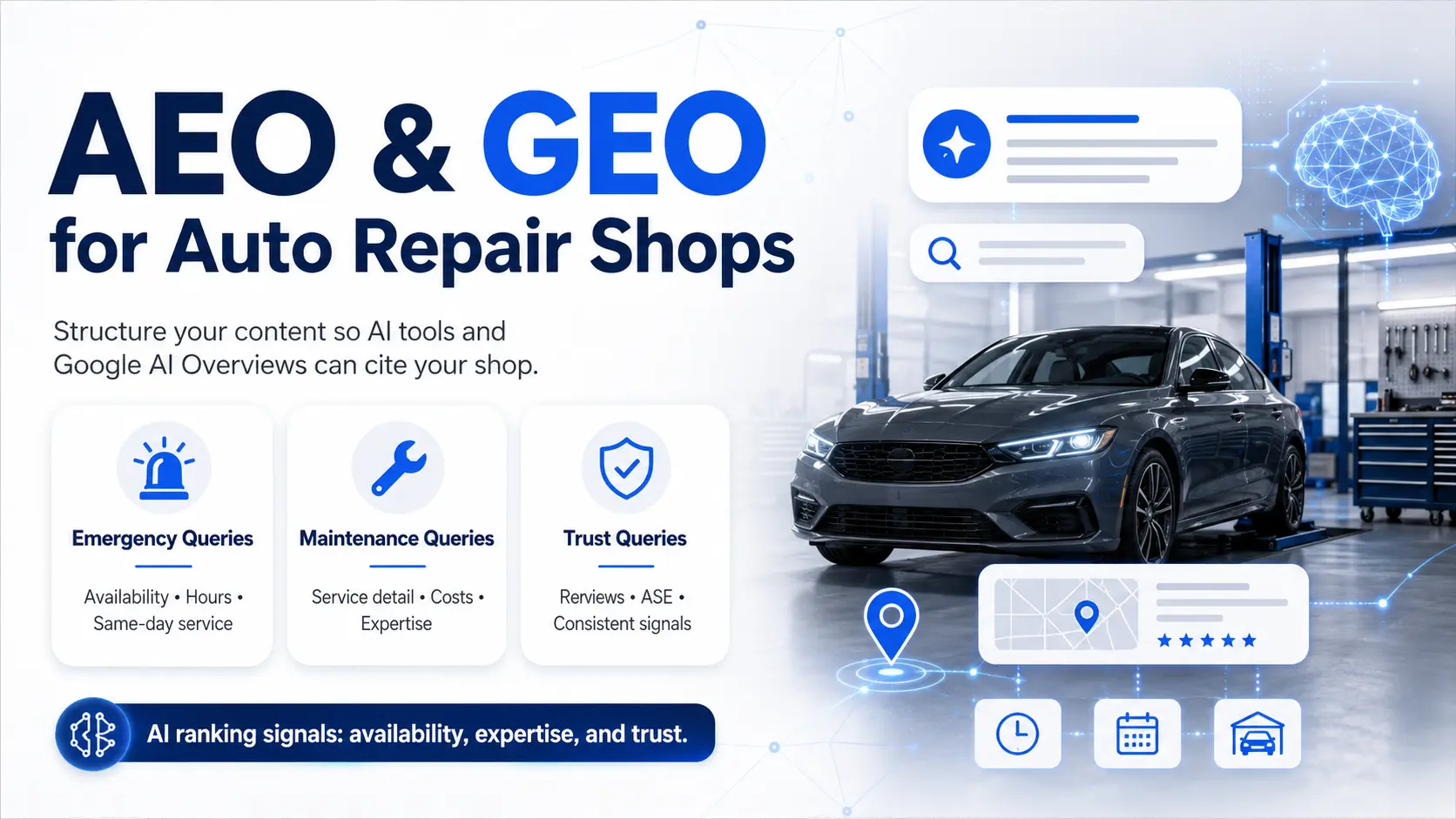
AEO (Answer Engine Optimization) for auto repair shops is the strategy of structuring your website content so that AI tools, including ChatGPT, Gemini, and Perplexity, cite your shop or your content when a driver asks a repair-related question. GEO (Generative Engine Optimization) extends that to Google AI Overviews, which now appear above the Local Pack for many auto repair queries.
No competitor guide currently covers this at depth. Most shops have no AEO or GEO strategy at all. That gap is your opportunity.
The Three Categories AI Systems Use for Auto Repair Queries
AI search tools categorize auto repair queries by urgency level. Each category produces different ranking signals:
- Emergency queries ("car won't start," "brake failure," "smoke from engine") trigger proximity and real-time availability weighting. Google's AI Overview for these queries surfaces businesses with complete, up-to-date GBP profiles and clear hours of operation. AI tools look for explicit availability signals in your content: "open 7 days," "same-day service available," "emergency appointments welcome."
- Scheduled maintenance queries ("oil change near me," "tire rotation cost") trigger expertise and review signals. AI tools cite shops that show specific service knowledge on their pages, not generic descriptions. A page that explains the difference between a full synthetic and conventional oil change, includes a cost range, and names the specific filter brands used signals more expertise than a page that just says "we do oil changes."
- Research and trust queries ("best mechanic in [city]," "ASE certified shop near me") trigger EEAT signals heavily. AI tools cross-reference review platforms, directory listings, certification databases, and your website content to form a recommendation. Consistent entity signals across all of these sources are the key ranking factor.
The Four AI Citation Signals for Auto Repair Shops
AI search systems prioritize auto repair businesses based on four specific signals that most shops have not built yet.
- Verified certifications documented on-site. ASE technician certifications, AAA Approved status, manufacturer training credentials. These must appear on your website, not just on your GBP profile. AI tools read your website content and use certification mentions as authority signals.
- Service-specific schema. Shops without Service schema for each repair type get categorized as generic auto repair. Shops with properly implemented schema for brake repair, transmission service, and diagnostics appear in AI results for those specific service queries.
- Current, on-page pricing data. AI tools pull pricing from website content, not from outdated training data. A brake service page that states "brake pad replacement typically costs $150 to $300 per axle depending on vehicle make and pad quality" gives an AI tool a specific, citable answer. A page that says "contact us for pricing" gives the AI tool nothing.
- Visual documentation of complex work. AI systems increasingly weight visual evidence of expertise. Engine teardown photos, alignment before-and-after documentation, and step-by-step repair process images give AI tools content to reference when confirming your shop's capability for high-ticket repairs.
Content Structure for AI Citation
AI tools extract answers from specific content patterns. Use this structure for every FAQ and informational section on your site:
- H3 phrased as the exact question a driver would ask
- Direct answer in the first sentence (40 to 60 words)
- Supporting detail in the following 2 to 3 sentences
- Specific numbers, costs, timeframes, or part names wherever possible
Example of the correct format:
How long do brake pads typically last?
Brake pads typically last 30,000 to 70,000 miles, depending on driving habits, vehicle type, and pad material. City driving with frequent stops wears pads faster than highway miles. A technician can measure pad thickness during any service visit and give you an accurate estimate of remaining life.
That format is exactly what Google extracts for AI Overviews and featured snippets. The direct answer comes first, the supporting context follows, and the sentence structure is clean enough for any AI system to quote directly.
Entity Consistency Across Platforms
AI tools cross-reference multiple sources before citing a business. Your shop name, category, primary services, and location must appear with consistent descriptions across your website, GBP, Yelp, RepairPal, and every major directory.
If your GBP says you specialize in European vehicles but your website has no European vehicle content and RepairPal lists you as a general shop, AI tools receive conflicting signals and default to a more consistent competitor.
Symptom Content as an AI Citation Vehicle
Symptom blog posts are the content format AI tools cite most often for automotive queries. A driver asking ChatGPT "why are my brakes squeaking" gets an answer pulled from websites that have well-structured, direct-answer symptom content.
Every symptom post on your site becomes a potential AI citation. That citation links back to your service page. The driver reads the explanation, sees your shop's name as the source, and either books directly or searches for your shop by name.
Structure symptom posts for maximum AI citation probability:
- Title: the symptom as a question (e.g., "Brakes Squeaking When Stopping: Causes and Solutions")
- Opening: 40-word direct answer
- Causes: specific list with brief explanations
- Urgency signal: when the symptom is dangerous vs. minor
- DIY vs. shop: honest guidance on when it requires professional service
- Internal link: to the relevant service page
- CTA: "Schedule a brake inspection at [Shop Name]"
A1 Technovation builds AEO and GEO strategies specifically for local service businesses. See our AEO and GEO services to learn how we structure your content for AI citation from day one.
Measuring Car Repair SEO Performance
The wrong metrics lead to wrong decisions. Shops that track keyword rankings and website sessions as primary KPIs frequently misread whether their SEO is working.
The correct primary metrics for auto repair SEO performance are GBP call clicks, direction requests, and service page form submissions. These tie directly to car count.
The Three Metrics That Indicate SEO Produces Revenue
- GBP call clicks are the most direct available proxy for SEO-to-revenue attribution. Each call click represents a driver who found your shop in search and chose to contact you. Track month-over-month growth in this metric above everything else.
- Direction requests from Google Maps indicate a driver intending to visit your shop. For multi-location shops, compare direction requests per location to identify underperforming profiles.
- Service page form submissions and click-to-call events from your website show which service pages are converting, not just ranking. A page with high impressions and low conversions needs content or CTA work, not more traffic.
What to Track in Google Search Console
Open Search Console monthly and review three things:
- Impressions and click-through rate by service page. Low CTR on a high-impression page means your title tag or meta description is not persuading drivers to click.
- The queries triggering each page. This is where you find the next service page to build. If your brake page is triggering for "rotor replacement [city]" with high impressions but no dedicated page, that is your next content build.
- Core Web Vitals status per page. Any page flagged in the CWV report is losing ranking points it would otherwise earn.
Honest Timeline Expectations
- GBP Local Pack movement: 4 to 8 weeks from complete profile optimization and citation cleanup
- Organic service page rankings: 3 to 6 months for established domains, 6 to 9 months for newer sites
- Full topical authority (symptom content + service pages + link acquisition): 6 to 12 months
- AI citation appearance: 3 to 6 months after structuring content with direct-answer formats and correct schema
Shops in smaller markets move faster on all these timelines. Shops in major metros (Los Angeles, Chicago, New York) face more competition and require more consistent execution before rankings stabilize.
How A1 Technovation Manages SEO for Auto Repair Shops
We manage local SEO campaigns for auto repair businesses across the US and Middle East, including shops in competitive multi-shop markets where every ranking position represents real revenue.
Our process starts with a technical and citation audit before any content work begins. Adding new service pages on top of a broken technical foundation produces slower results. We fix the base first.
From the audit, we build the keyword matrix specific to your city, your service specialties, and your existing competitive gaps. No two markets are identical. A brake specialist in a suburban Texas market needs a completely different page architecture than a European vehicle shop in a major metro.
We build service pages, symptom content, and GBP optimization in parallel because Google rewards consistent activity across all surfaces. We also integrate AEO and GEO structure into every piece of content from day one, not as an afterthought at publication.
Every month, you receive a report that translates ranking data, GBP metrics, and traffic trends into plain language tied to car count. We show you which tactics are producing calls and which need adjustment.
FAQ: Car Repair SEO
How long does Car Repair SEO take to show results?
GBP Local Pack movement typically appears within 4 to 8 weeks of complete profile optimization and citation cleanup. Organic service page rankings take 3 to 6 months of consistent on-page work and content publishing before significant traffic gains appear. Full competitive authority in a major market takes 6 to 12 months.
Do I need a separate page for each auto repair service?
Yes. A single services page listing brakes, transmissions, oil changes, and alignments typically ranks for none of those services. Each major service needs its own dedicated page targeting its own keyword cluster. A minimum viable auto repair website has 6 to 8 individual service pages before organic rankings become realistic.
Is the Google Business Profile more important than my website for local SEO?
For Map Pack (Google Maps) rankings, the GBP is the primary ranking asset. For organic search results below the Local Pack, your website service pages are the primary asset. Both work together. A strong GBP with a weak website produces Local Pack visibility but low organic rankings. The combination produces the broadest search coverage.
How many reviews does my auto repair shop need to rank in the Local Pack?
There is no fixed number, but in competitive markets, shops ranking consistently in the top three of the Local Pack typically have 200 or more reviews with a 4.5-star rating or above, combined with review recency (new reviews appearing regularly). Velocity matters more than total count. A shop receiving 10 new reviews per month outperforms a shop with 500 total reviews and no new reviews in 60 days.
Can I do auto repair SEO myself or do I need an agency?
GBP optimization, citation cleanup, and basic on-page title tag improvements are manageable in-house if you have 4 to 6 hours per month to dedicate to them. Technical SEO audits, service page content at scale, and competitive link building in crowded markets produce the most reliable results with specialist help. The right decision depends on your market's competition level and how quickly you need to close the gap.
How does AI search affect my auto repair shop's visibility?
AI tools like ChatGPT, Gemini, and Perplexity increasingly answer auto repair questions directly, often recommending specific local shops. Shops that structure their website content with direct-answer passages, correct service schema, and consistent entity signals across platforms appear in these AI recommendations. Shops without this structure are invisible to AI tools regardless of their Google rankings.
Should I create pages for specific vehicle makes like BMW or Toyota?
If your shop specializes in a make or services a high volume of a specific brand, yes. Make-specific pages (e.g., /bmw-repair-[city]/) capture mid-funnel searches from drivers who want a specialist. These pages rank in lower-competition spaces than broad "auto repair" terms and convert at higher rates because the searcher already trusts a specialist over a generalist.
What does NAP consistency mean and why does it affect rankings?
NAP stands for Name, Address, and Phone Number. Consistent NAP means your business appears with the exact same name, address format, and phone number across every platform where it is listed. Inconsistent NAP creates conflicting location signals that reduce Google's confidence in your business data, which directly suppresses Local Pack rankings. Audit and correct NAP consistency before building new citations.
Ready to Rank Your Auto Repair Shop?
Ready to get your auto repair shop ranking on Google Maps and getting cited by AI search tools? Contact A1 Technovation for a free Car Repair SEO audit. We review your GBP, citations, service page architecture, and technical foundation, then give you a specific action plan.
Get a Free Car Repair SEO Audit →