
Executive Summary
A luxury automobile dealership in Canada had a strong offline business, a premium vehicle inventory, and hundreds of pages on its website.
The problem was not a lack of products.
The problem was that the website did not clearly communicate its inventory structure, vehicle categories, model relationships, pricing information, and market relevance to search engines.
A1 Technovation developed an SEO strategy around the dealership's real business structure.
We focused on:
The result was a significant increase in organic search visibility.
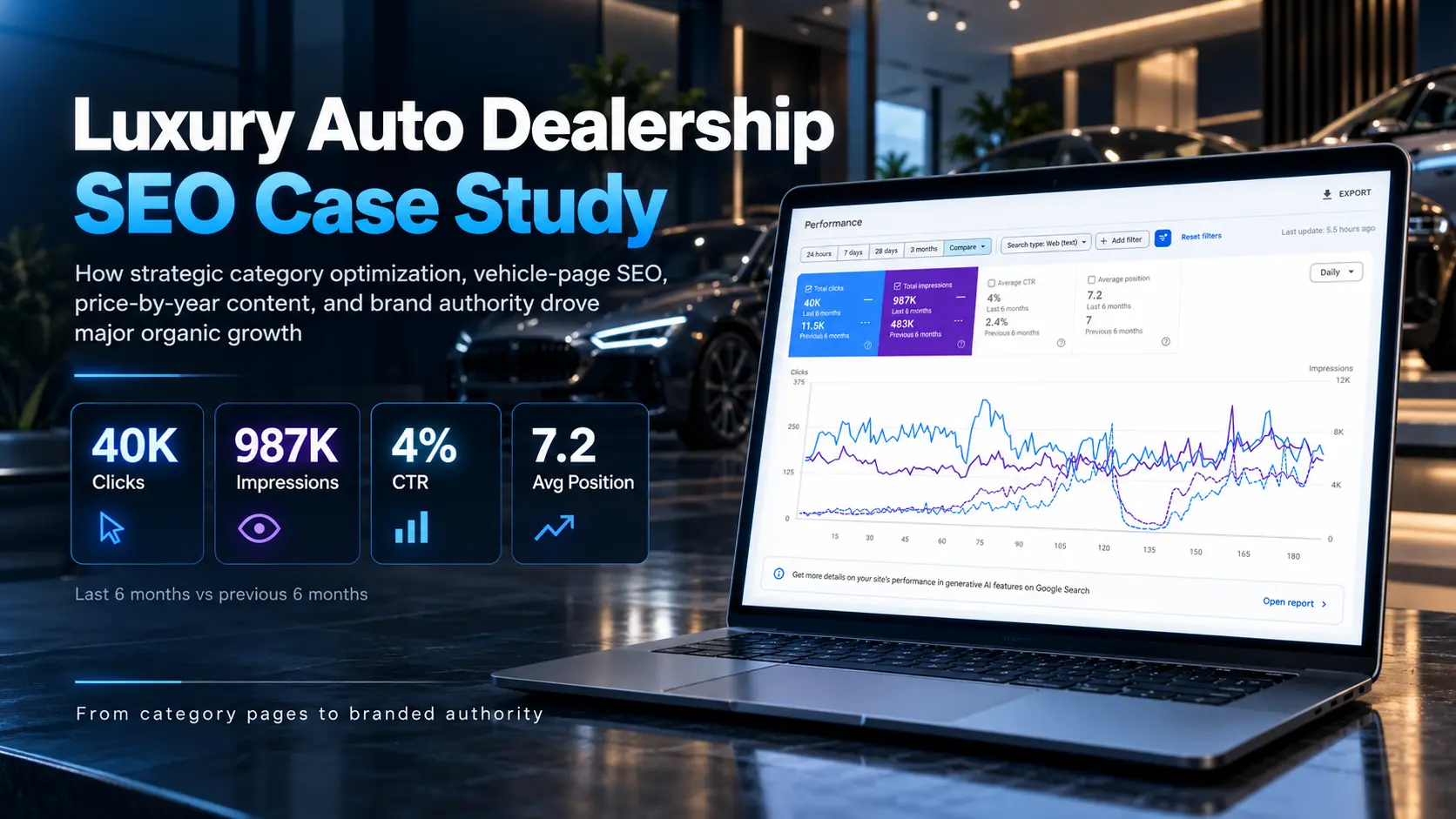
Verified Google Search Console Results
| Metric | Previous 6 Months | Latest 6 Months | Growth |
|---|---|---|---|
| Organic Clicks | 11.5K | 40K | +247.8% |
| Search Impressions | 483K | 987K | +104.3% |
| Average CTR | 2.4% | 4.0% | +66.7% |
| Average Position | 7.0 | 7.2 | Maintained strong visibility |
Key Insight: Scale Without Rank Degradation
The most important takeaway was not simply the increase in clicks. The website more than doubled its impressions while maintaining an average position close to seven. That showed us that the site was gaining visibility across a much broader range of relevant search queries.
About the Client
The client operates a luxury automobile showroom and dealership serving customers in Canada.
The dealership offers a wide range of vehicles across multiple categories, including:
The business already had the most important foundation.
- It had real inventory.
- It had a showroom.
- It had customers.
- It had recognizable automotive brands.
- It had a growing product catalog.
However, its online visibility did not match its offline business strength. That was the main challenge.
The SEO Problem We Found
At first glance, the website looked like it had a lot of content.
- There were many vehicle pages.
- There were different categories.
- There were product descriptions.
- There were images and specifications.
But once we reviewed the site from an SEO perspective, we found that the pages were not supporting one another strongly enough.
The problem was not the number of pages.
The problem was the relationship between the pages.
Google could find many of the URLs. But the website did not clearly explain:
This created an important SEO gap.
The dealership had inventory. But the search architecture around that inventory was weak.
Our Main SEO Goal
Our goal was not simply to increase traffic.
We wanted to increase relevant organic visibility around searches that had a direct connection to the dealership's inventory.
We wanted Google to understand the business at several levels. For example:
- SUV
- Sedan
- Hatchback
- Off-road vehicle
- BMW • Mercedes-Benz
- Audi • Lexus
- Land Rover • Porsche
- Other premium brands
- BMW X5
- Mercedes-Benz GLE
- Audi Q7
- Range Rover Sport
- Inventory models
Instead of trying to rank individual pages independently, we wanted to build a connected automotive SEO ecosystem.
Phase 1: Search Intent and Category Analysis
The first major decision we made was to improve the category strategy.
A standard dealership might organize its inventory like this:
- Sedan
- SUV
- Hatchback
- Off-road
That structure is logical for users. But it does not fully capture the commercial searches people make on Google.
We therefore aligned the most important category pages with more specific search intent. Examples included:
This created a stronger bridge between the inventory and the way potential buyers searched.
Why We Focused on Price-Based Category Searches
Car buyers frequently use price-oriented searches because price is one of the strongest purchase considerations.
A user searching: SUV price in Canada is not simply researching what an SUV is. That person is likely comparing options. The search has commercial value.
Similarly: Sedan price in Canada shows stronger purchase intent than a generic search for "sedan." That made these category pages important SEO assets.
Phase 2: Building Better Category Pages
We did not want the category pages to function as thin product archives.
We wanted them to become useful commercial landing pages.
Each important category was improved with relevant information. Depending on the category, the content included:
This made the category pages useful to both users and search engines.
We Avoided Treating Category Pages as Keyword Containers
A common SEO mistake is to create a category page, add the target keyword several times, and expect rankings to improve. That was not our strategy.
The category page needed to answer a user's commercial questions. For example, a strong SUV category should help a buyer understand:
- Which SUVs are available
- Which brands are available
- What price ranges exist
- Which models are premium
- Which options fit different needs
- Which individual vehicles are currently listed
That is much more useful than simply repeating "SUV price in Canada."
Phase 3: Individual Vehicle Page Optimization
Once the main category structure was stronger, we moved deeper into the inventory.
This part required a more systematic approach. A dealership may have hundreds of vehicles. If every product page uses a different structure, Google receives inconsistent signals.
We therefore focused on improving the most commercially important vehicle pages.
What We Optimized on the Vehicle Pages
SEO Titles
We improved page titles so they better reflected:
- Manufacturer
- Model
- Model year
- Vehicle type
- Commercial intent
The goal was to make each title clear and relevant.
Meta Descriptions
We improved meta descriptions to better communicate:
- Vehicle name
- Model year
- Important selling points
- Availability
- Dealership relevance
We avoided generic descriptions that added no value.
Vehicle Descriptions
Some product pages on dealership websites contain only a few words or specifications. That limits search relevance.
We improved descriptions so the pages contained useful information about the actual vehicle. Where relevant, this included:
- Vehicle positioning
- Performance
- Features
- Interior
- Technology
- Comfort
- Safety
- Driving use
- Buyer suitability
The content remained focused on the specific vehicle.
Phase 4: Improving Vehicle Specifications
Specifications are especially important in automotive SEO. Car buyers search by attributes. They want to know things like:
We made sure the most important information was clear and consistently presented. This improved page usefulness and made each vehicle easier to understand.
Phase 5: Better Product Categorization
One of the most important changes involved categorization. Every important vehicle needed to sit inside the correct hierarchy.
That gives search engines a clearer relationship between broader and narrower entities. The same principle applied across other vehicle categories.
Phase 6: Improving Tags and Page Relationships
We also reviewed how tags and attributes were used. Tags can help organize inventory. But uncontrolled tagging can create:
- Thin pages
- Duplicate archives
- Weak URLs
- Unnecessary crawl paths
- Keyword cannibalization
We focused on tags that represented meaningful vehicle attributes.
The objective was not to create as many tag pages as possible. The objective was to make product relationships clearer.
Phase 7: Vehicle Image Optimization
Automobile websites depend heavily on photography. Images influence both user behavior and page quality.
We improved the way vehicle images were handled. This included attention to:
- Image filenames
- Alt text
- Page relevance
- Image context
- Consistent vehicle naming
- Image quality
We avoided stuffing keywords into alt text. The alt text needed to describe the actual image.
"Black 2025 BMW X5 luxury SUV front exterior view"
Accurately describes the visual entity."SUV price Canada luxury SUV best SUV Canada"
Spammy repetition flagged by algorithms.The first one describes the image. The second one is keyword stuffing.
Phase 8: Standardizing Manufacturers, Models, and Vehicle Names
Consistency became another important part of the project.
Imagine the same vehicle being described as:
- BMW X5
- BMW X5 SUV
- BMW SUV X5
- 2025 X5
- BMW X-5
These inconsistencies can create unnecessary noise.
We standardized the way important automotive entities appeared throughout the website. That included:
- Manufacturer
- Model
- Model year
- Body style
- Category
- Trim where applicable
- Vehicle naming
This made the site easier to understand.
Then We Found a Much Bigger Content Opportunity
The category pages were important. The product pages were important.
But while researching search behavior around popular models, we found another major opportunity.
People were not only searching for the latest model. They were searching by year. For example:
- BMW X5 price in Canada 2026
- BMW X5 price in Canada 2025
- BMW X5 price in Canada 2024
- BMW X5 price in Canada 2023
- BMW X5 price in Canada 2022
This pattern appeared across multiple vehicles. That changed our content strategy.
Phase 9: Building Historical Price Content
Instead of publishing generic automotive articles, we created content around the dealership's top-selling and high-interest models.
The central idea was simple.
If users search for vehicle prices by year, we should provide useful information covering those years. For selected vehicles, we built content covering approximately six or seven years of pricing information.
Example Content Structure
A page could look like:
Content Cluster Outline: BMW X5 Price in Canada by Year
We Did More Than Publish Price Numbers
A list of prices alone would not provide enough value. So where relevant, we added useful context. This could include:
- Trim changes
- Engine updates
- Technology upgrades
- Facelift years
- Feature changes
- Model refreshes
- Used-market trends
- Depreciation considerations
- Buyer comparison points
This helped the content serve users at several stages of the buying process.
Why Price-by-Year Content Worked
This strategy captured several types of users:
Someone searching for: 2026 BMW X5 price in Canada may be considering a newer model.
Someone searching: 2021 BMW X5 price Canada may be researching pre-owned vehicles.
Someone searching: BMW X5 price by year may be comparing several model years before choosing one.
Someone wanting to know whether paying more for a newer model or trim update is worthwhile.
This means one content cluster can support several stages of the customer journey. That makes the strategy commercially useful.
Phase 10: Connecting Informational Content With Inventory
This was another major part of the campaign.
We did not want blog traffic to remain isolated from the commercial side of the website.
A visitor reading BMW X5 Price in Canada by Year should be able to move naturally to:
- Available BMW X5 vehicles
- BMW inventory
- SUV inventory
- Luxury SUV inventory
- Related models
This created stronger conversion pathways.
Our Internal Linking Structure
A typical relationship could look like this:
That is much stronger than publishing unrelated articles and hoping visitors eventually discover the dealership's products.
We Built Content Around the Business
This was an important principle throughout the campaign.
We did not want traffic from topics that had no commercial connection to the dealership.
For example, an article about "History of automobile manufacturing" might attract traffic. But it may not help sell a luxury vehicle.
Instead, we prioritized topics closer to the dealership's products. Examples included:
- Vehicle pricing
- Model years
- Model differences
- Luxury SUV options
- Sedan pricing
- Vehicle specifications
- Related model comparisons
This kept the content strategy closer to commercial intent.
Phase 11: Directory and Business Listing Strategy
Once the on-site structure improved, we focused more heavily on external authority.
The dealership was a real local business. Its external presence needed to reflect that.
We worked on relevant listings across:
- Local directories
- Automotive directories
- Classified websites
- Vehicle listing platforms
- Business portals
- Relevant local websites
We Did Not Chase Directory Volume
A common off-page SEO mistake is to submit a website to hundreds of random directories. We did not take that approach.
A listing mattered more when:
- The website was legitimate
- The listing was relevant
- The platform matched the automotive industry
- The platform served the local market
- The business information was accurate
Quality and relevance mattered more than quantity.
Phase 12: Classified Listings
Classified and vehicle listing websites played another role in the campaign.
These platforms helped create additional external references to:
- The dealership
- Vehicles
- Inventory
- Categories
- Contact details
- Business location
This supported the dealership's wider online presence. It also created additional discovery opportunities outside traditional organic search.
Phase 13: Business Information Consistency
We paid attention to consistency across listings. Important information included:
- Business name
- Website URL
- Phone details
- Location
- Business type
- Vehicle dealership category
- Business descriptions
When the same company appears consistently across relevant websites, its digital footprint becomes clearer.
Then We Found Another Gap
At this stage, Google was seeing more evidence related to:
- Vehicles
- Categories
- Models
- Prices
- Inventory
- Dealership listings
Organic visibility was improving. But we noticed something important.
The website was becoming stronger around topics. The brand itself still needed more independent authority.
This led to the next stage.
Phase 14: Local Press and Brand Authority
The dealership already had a real business story. That gave us something valuable.
Instead of publishing artificial press releases created only to earn backlinks, we focused on legitimate business news. Possible angles included:
- New luxury inventory
- Business expansion
- New services
- Company milestones
- Local market observations
- Luxury car buying trends
- Dealership developments
- Community involvement
The strongest stories were distributed to relevant local publications.
Why Local Press Was Important
A company's own website will naturally describe itself positively. That is expected.
But when independent publications mention a business, it creates external validation. The dealership could now appear across:
- Its own website
- Automotive websites
- Business directories
- Classified platforms
- Vehicle marketplaces
- Local media
That created a stronger brand footprint.
The Combined SEO Structure
By this stage, the site no longer looked like a collection of independent vehicle pages. It started to look like a connected automotive ecosystem.
This made the website easier for users and search engines to understand.
The Results
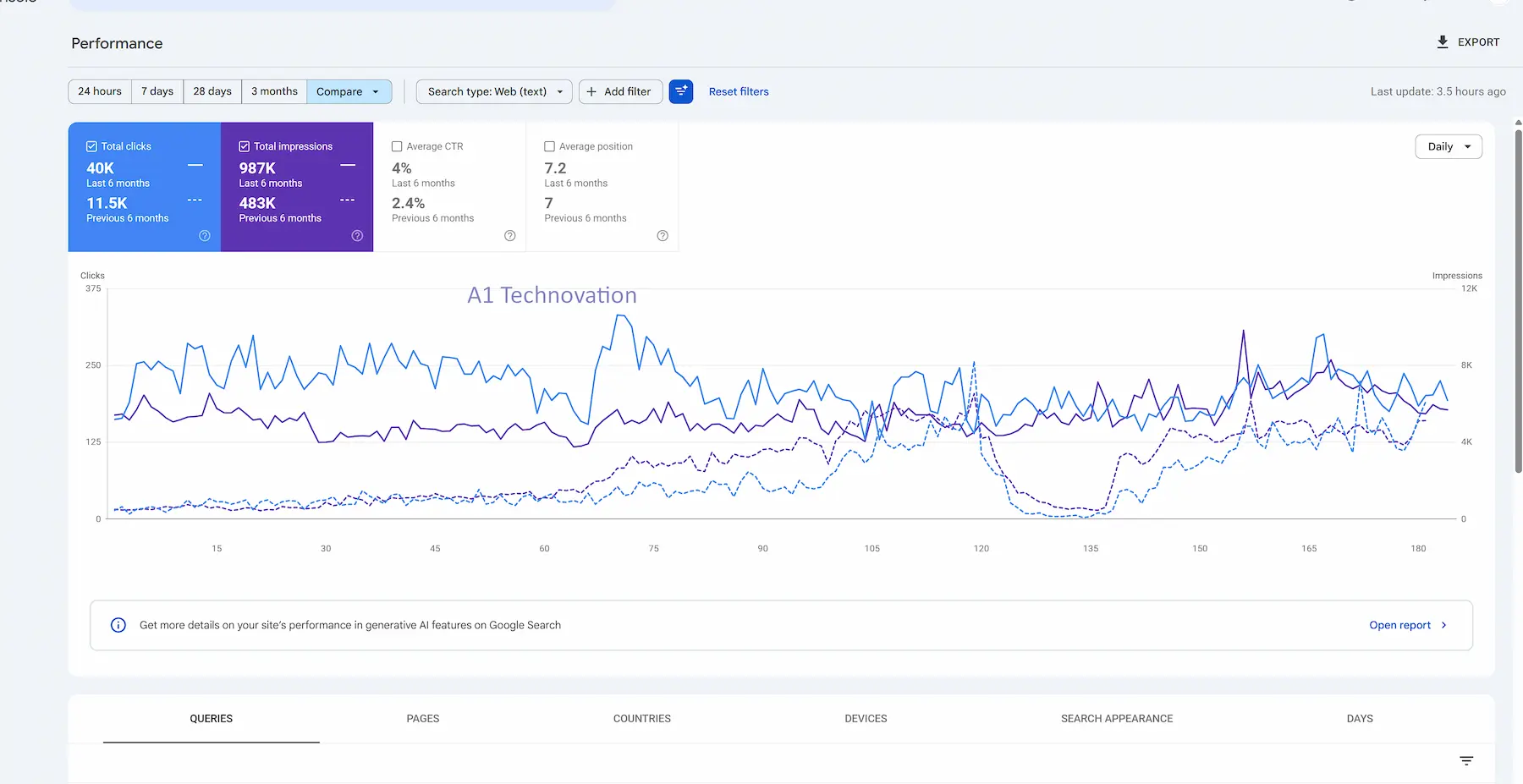
The Google Search Console comparison showed strong growth.
Organic Clicks
- Previous Six Months: 11,500 clicks
- Latest Six Months: 40,000 clicks
- Growth: +247.8%
The dealership generated approximately 3.48 times as many organic clicks.
Organic Impressions
- Previous Six Months: 483,000 impressions
- Latest Six Months: 987,000 impressions
- Growth: +104.3%
The website more than doubled the number of times it appeared in Google Search. That was a major signal that the site's query coverage had expanded.
Organic Click-Through Rate
- Previous Six Months: 2.4% CTR
- Latest Six Months: 4.0% CTR
- Improvement: Approximately 66.7%
This meant the dealership was not only receiving more search visibility. More users were choosing its search listings.
Average Position
- Previous Six Months: 7.0
- Latest Six Months: 7.2
At first, this number may seem less impressive. But this metric actually tells an important story.
Average ranking remained almost unchanged while:
- Clicks increased by almost 248%
- Impressions increased by more than 104%
- CTR improved by approximately 67%
This means the website expanded into a much larger set of queries without sacrificing its overall search position significantly.
Why the Average Position Metric Matters
Suppose a website ranks for 500 search queries with an average position of seven.
Now suppose the same website expands to thousands of relevant queries and still maintains an average position close to seven.
The average position barely changes. But the website's organic footprint becomes much larger.
That is why average position should never be analyzed by itself. The combination of:
provides a much clearer picture.
The Organic Search Footprint Expanded
The website became relevant to more searches involving:
- Vehicle categories
- Car prices
- Manufacturers
- Models
- Model years
- Specifications
- Used vehicle research
- New vehicle research
- Commercial vehicle searches
- Long-tail automotive queries
That expansion was one of the most important outcomes of the campaign.
A Realistic Customer Journey
Automotive SEO rarely works like this:
Cars are high-consideration purchases. Customers research. They compare. They return. They evaluate the dealership.
A more realistic journey may look like this:
2022 BMW X5 price in Canada
Discovers our historical pricing and trim guide.
Browses available BMW X5 showroom stock.
Opens broader luxury SUV category to compare.
Compares 2-3 specific vehicle listings.
Searches dealership brand directly days later.
Submits test drive / financing inquiry.
The journey looks like:
Information Search → Pricing Guide → Category → Vehicle → Brand Research → Return Visit → Inquiry
That is why automotive SEO should support the whole buying journey.
Why This Strategy Worked
Several factors contributed to the growth.
1 We Improved Search Intent Alignment
Pages were aligned with the searches potential buyers actually used.
2 We Improved Site Structure
Vehicle categories, manufacturers, models, and content were more clearly connected.
3 We Increased Commercial Relevance
Content focused on vehicles the dealership actually sold.
4 We Built Historical Search Coverage
Price-by-year content captured additional long-tail demand.
5 We Improved Internal Links
Informational content supported inventory and category pages.
6 We Improved Entity Consistency
Manufacturers, models, years, and categories used clearer naming.
7 We Strengthened External Authority
Directories and classified platforms reinforced the business entity.
8 We Built Independent Brand Mentions
Local press coverage created additional third-party references.
What We Did Not Do
This project is also important because of what we avoided.
We did not rely on:
Every major part of the strategy needed to connect back to the real business.
Why This Matters for Automotive SEO
Automotive SEO is different from many other industries.
- Inventory constantly changes.
- Vehicles sell.
- New models arrive.
- Model years change.
- Prices change.
- Manufacturers release facelifts.
- Specifications change.
This creates a challenge. If a dealership relies entirely on individual inventory pages, organic visibility can become unstable.
That is why permanent SEO assets are important.
Permanent SEO Assets for a Car Dealership
These can include:
These pages can continue to generate search visibility even when individual inventory changes.
The Role of Category Pages
Category pages became one of the strongest foundations of the strategy.
Individual vehicles may leave inventory. The category remains.
For example: SUV Price in Canada can continue serving users even when individual SUVs are sold and replaced. That gives the website a stable commercial landing page.
The Role of Model-Year Content
Automotive searches are unusually sensitive to years. A buyer may specifically want: 2022, 2023, 2024, 2025, or 2026.
Each year can have different:
- Pricing
- Equipment
- Engine options
- Technology
- Exterior design
- Interior design
- Safety features
- Resale value
That creates valuable long-tail search demand.
The Role of External Authority
A dealership is not simply a website. It is a physical business.
That means external validation matters. A legitimate dealership should naturally appear across several types of websites. For example:
- Automotive marketplaces
- Business directories
- Classifieds
- Local press
- Industry platforms
- Local business websites
This helps create a more believable and verifiable online presence.
The Role of Brand Search
Another long-term objective of this type of campaign is stronger branded search behavior.
A customer may first discover a dealership through: BMW X5 price Canada.
Then later search: [Dealership Name].
That progression matters. Generic discovery creates brand discovery. Brand discovery can eventually create direct inquiries.
How We Measure Automotive SEO Success
Rankings are important. But they are not enough.
For dealership SEO, we look at several signals:
This gives a much more complete picture than tracking one keyword.
Key Results From This Campaign
The verified Google Search Console performance showed:
- 40K Organic Clicks: Up from 11.5K.
- 987K Search Impressions: Up from 483K.
- 4% Average CTR: Up from 2.4%.
- 7.2 Average Position: Maintained close to the previous 7.0 average while overall visibility expanded significantly.
Key Takeaway
The dealership did not need more random content.
It needed a better search ecosystem.
The winning combination was:
Once those pieces began supporting each other, the website became much stronger.
What This Case Study Shows
The most important lesson is simple.
A car dealership website should not be treated as a collection of product pages.
It should be treated as an interconnected automotive entity.
The website needs to explain:
- What the dealership sells
- Where it operates
- Which vehicle categories it covers
- Which brands it sells
- Which models it carries
- Which years it covers
- What those vehicles cost
- How those vehicles differ
- Why the dealership is a legitimate source
When all of these signals work together, the website has a much stronger foundation for organic search growth.
How A1 Technovation Approaches Automotive SEO
At A1 Technovation, we do not start with a fixed list of keywords and force every client into the same SEO template.
We look at the business first. For an automobile dealership, that means understanding:
- Inventory
- Categories
- Manufacturers
- Models
- Locations
- Pricing
- Search demand
- Buyer behavior
- Existing authority
- Competitive landscape
Then we build the SEO structure around the real business. Our automotive SEO work can include:
SEO for Luxury Car Dealerships
Luxury dealerships face another challenge.
Customers usually conduct more research before making a decision. They compare:
- Brands
- Models
- Features
- Years
- Pricing
- Financing
- Depreciation
- Dealership reputation
That means a luxury dealership needs visibility throughout the research process.
The website should not only appear when someone searches: luxury car dealership near me.
It should also appear during earlier research. For example:
- BMW X5 price Canada
- Range Rover Sport price Canada
- best luxury SUV Canada
- Mercedes GLE price by year
This gives the dealership more opportunities to enter the customer's consideration set.
SEO for Used and Multi-Year Inventory
Historical pricing content becomes especially useful when a dealership carries pre-owned inventory.
A buyer researching a 2021 model is very different from a buyer researching a 2026 model.
The search intent changes. The pricing changes. The expectations change.
A strong automotive content strategy should account for those differences.
What We Would Continue Improving
SEO does not stop after one growth period. The next phase would focus on expanding the parts of the site already showing potential. That could include:
- More model-level pages
- More historical pricing guides
- Category content updates
- Better manufacturer hubs
- Stronger internal links
- More inventory relationships
- Additional local authority
- New press opportunities
- Improved CTR on high-impression queries
- Refreshing outdated price information
The objective is to strengthen the same ecosystem rather than constantly starting new disconnected campaigns.
Final Result
The dealership already had a strong business. Our job was to translate that real-world strength into a structure Google could understand.
We connected:
The result was a much broader organic search presence.
- From: 11.5K clicks to: 40K clicks
- From: 483K impressions to: 987K impressions
- From: 2.4% CTR to: 4% CTR
- while maintaining an average Google position close to seven.
That is the kind of growth we aim for at A1 Technovation.
Not traffic for the sake of traffic. Search visibility connected to the actual business.
Need SEO for Your Car Dealership?
If your dealership has hundreds of vehicles but organic traffic does not reflect the size of your inventory, the problem may not be your products. The problem may be how search engines understand your website.
At A1 Technovation, we help automobile businesses build stronger organic visibility through: Dealership SEO, Automotive SEO, Local SEO, Vehicle SEO, Category SEO, Content strategy, Technical optimization, Authority building, and Digital PR.
Whether you operate a luxury showroom, used-car dealership, vehicle importer, automotive marketplace, or multi-location dealership, we can develop an SEO strategy around your actual inventory and target market.