
Forty-six percent of all Google searches carry local intent. That means nearly half of every search made on Google is someone looking for a product, service, or business in a specific location. If your business does not appear in the Local Pack for those searches, you are invisible to a massive pool of buyers who are ready to act.
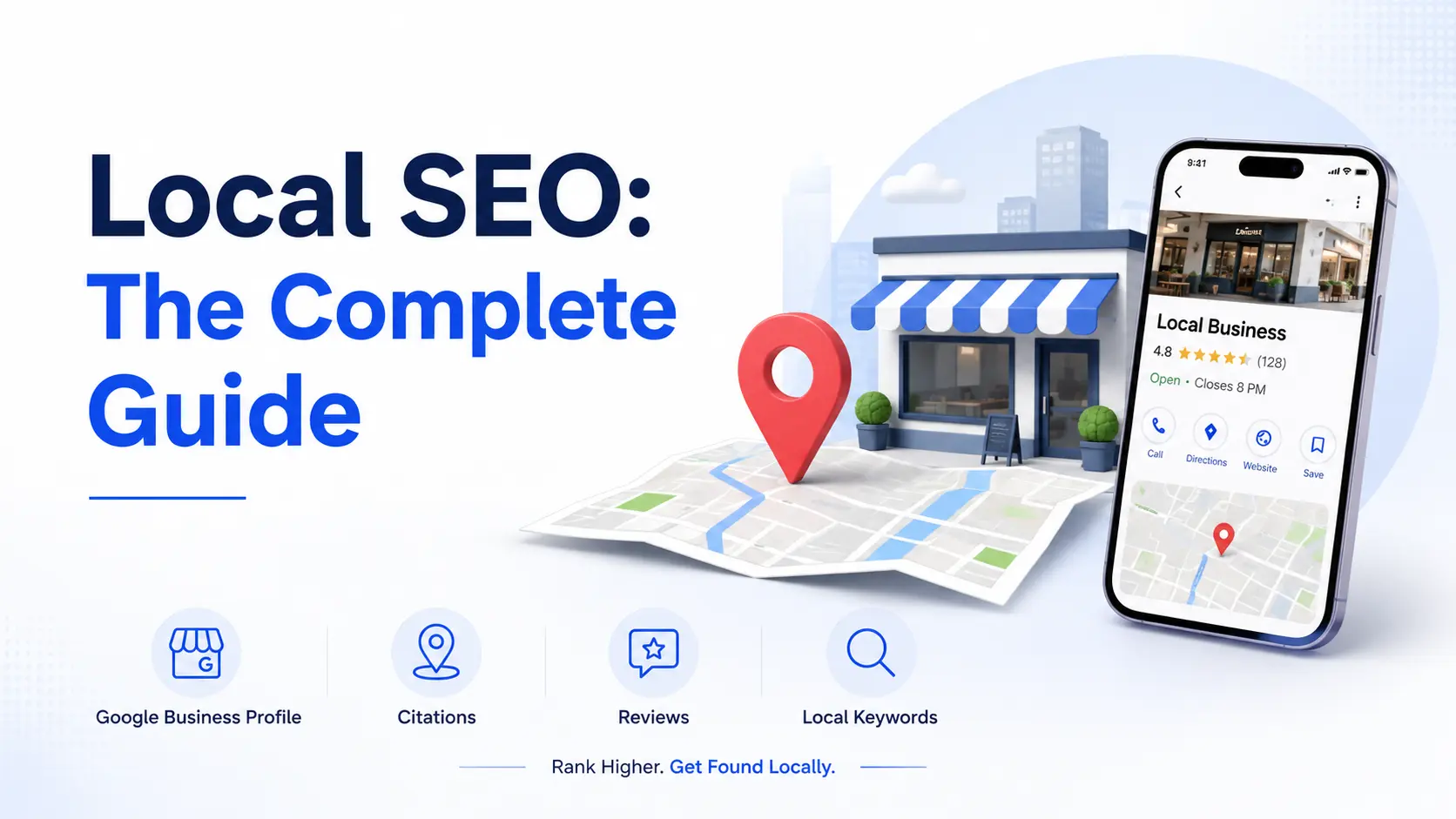
Local SEO is the process of optimizing your online presence so your business appears in Google's local search results, including the Local Pack (the map and top 3 business listings), when people nearby search for your products or services. It uses a separate ranking algorithm from standard organic SEO, one that weighs your Google Business Profile, citation consistency, reviews, and website signals to decide who gets those three coveted map pack spots.
This guide covers every ranking signal, every optimization step, and the 2026 AI search layer that most businesses have not touched yet. You will walk away with a complete system, not a checklist.
Local SEO vs. Regular SEO: The Key Difference
Most guides treat this as an intro throwaway. It is not. Understanding this distinction changes every decision you make.
Standard SEO and local SEO share many principles, but they target different algorithms and different result types. Getting clear on the difference saves you from applying the wrong tactics to the wrong problem.
Google Runs Two Separate Algorithms for Local Results
Google serves local results through two distinct systems. The Local Pack algorithm scores businesses based on Relevance, Distance, and Prominence. The local organic algorithm functions closer to standard organic ranking, weighing backlinks, content quality, and on-page signals.
A business can rank #1 in the Local Pack but sit at position #15 in organic results directly below it. The reverse is also possible. Both placements drive different types of clicks and traffic, so understanding each algorithm is the starting point for any effective local strategy.
| Factor | Local SEO | Standard SEO |
|---|---|---|
| Primary signal | Google Business Profile | Backlinks + content quality |
| Result type | Local Pack / Maps | Organic blue links |
| Key intent | "Near me" / location queries | Any keyword intent |
| Geographic scope | City / radius | National / global |
| Citation importance | High | Low |
| Review signals | Ranking factor | Trust factor only |
The Local Pack Is the Prime Target
The Local Pack, those three business listings with a map at the top of local search results, appears in 23% of all Google searches. It sits above organic results for location-intent queries, which means it gets seen first. BrightLocal's 2026 data shows that 42% of Local Pack results receive a click, compared to significantly lower rates for organic results on the same page.
Appearing in the Local Pack means your business name, star rating, phone number, and address are visible before a searcher reads a single word of organic content. That visibility drives calls, direction requests, and website visits at a rate that organic positions below position three rarely match for local queries.
The 6 Local SEO Ranking Factors That Actually Matter in 2026
Local SEO ranking factors in 2026 break down into six signal groups: Google Business Profile signals (32%), on-page signals (19%), review signals (16%), link signals (15%), behavioral signals (8%), and citation signals (7%). The data comes from the Whitespark 2026 Local Search Ranking Factors survey, the most comprehensive annual study on the local algorithm.
These percentages tell you exactly where to put your time. Most businesses spend zero effort on behavioral signals and waste months chasing citations while their GBP sits half-finished.
2026 Local Search Ranking Factors
| Signal Group | Ranking Weight | Primary Action |
|---|---|---|
| GBP Signals | 32% | Profile completeness, category accuracy, active posts |
| On-Page Signals | 19% | Local keywords, LocalBusiness schema, city landing pages |
| Review Signals | 16% | Review velocity, star rating, response rate |
| Link Signals | 15% | Local backlinks from relevant local sources |
| Behavioral Signals | 8% | Clicks, calls, direction requests from GBP |
| Citation Signals | 7% | NAP consistency across directories |
GBP Signals (32%) — The Highest-Leverage Factor
Your Google Business Profile carries more ranking weight than any other signal. Businesses with 100% complete profiles get 7x more clicks than incomplete ones. The profile completeness score rewards every filled field: business name, category, description, hours, services, attributes, photos, and Q&A.
Category selection matters more than most businesses realize. Your primary category is the single most important GBP decision you will make. It tells Google exactly what type of business you are. A BrightLocal category study found that businesses using four additional categories alongside their primary had an average Local Pack rank of 5.9, compared to weaker positions for single-category profiles.
One thing to avoid: keyword stuffing in your business name. Google's 2026 GBP policy enforcement actively suspends profiles that include service keywords or location names in the business name field when they do not appear in the legal business name.
On-Page Signals (19%) — Your Website Feeds the Algorithm
Your website is the second signal group by weight, and it directly feeds Google's understanding of what you do and where you do it. A Google Business Profile without a strong supporting website limits your Local Pack ranking ceiling.
Location-specific title tags and meta descriptions tell Google the service and city combination you are targeting. LocalBusiness schema (covered in detail below) gives Google machine-readable confirmation of your address, phone, hours, and service type. Dedicated landing pages for each city or service area you target allow Google to match specific queries to specific pages instead of sending every local searcher to your homepage.
NAP (Name, Address, Phone) placed on every page, clearly labeled with HTML context, reinforces your location signals across the entire site.
Review Signals (16%) — Volume, Velocity, and Recency All Count
Reviews are both a ranking factor and a conversion factor. In 2026, 87% of consumers read online reviews before choosing a local business. Google factors in your overall star rating, total review count, review recency, and the keywords that appear naturally in your review text.
Recency carries significant weight. A business with 200 reviews but nothing new in the past three months can get outranked by a competitor with 80 reviews that are steadily arriving each week. Google reads consistent review velocity as a sign that a business is active, trusted, and serving customers right now.
Businesses below a 4.0 star average face a measurable conversion penalty even when they do appear in the Local Pack. The rating shows in the listing before a user clicks anything, so a low average suppresses click-through regardless of ranking position.
Link Signals (15%) — Local Authority Still Runs on Backlinks
Link building for local SEO follows different logic than link building for standard organic. The geographic relevance of a linking domain carries weight in the local algorithm. A link from a local newspaper, city chamber of commerce, or neighborhood business association often outperforms a link from a high-authority national site that has no local context.
Quality still beats quantity. One link from a relevant local source drives more local ranking signal than ten links from offshore directories with no local relevance.
Behavioral Signals (8%) — Actions Google Tracks in Real Time
Behavioral signals are the actions users take after finding your business in local results. Clicks to your website, phone calls initiated from your GBP listing, and direction requests all feed into Google's understanding of how valuable your business is to local searchers. GBP actions increased 41% year-over-year between 2025 and 2026, confirming that Google is expanding GBP as a primary user interaction surface.
A complete, visually compelling GBP profile with strong photos, clear hours, accurate categories, and regular posts drives more of these actions. The profile itself is the behavioral signal generator.
Citation Signals (7%) — Consistency Builds Trust
Citations are online mentions of your business name, address, and phone number (NAP) on directories, review sites, and social platforms. They confirm to Google that your business is real, located where it says it is, and has a consistent identity across the web.
Inconsistency kills citation value. BrightLocal research found that 63% of consumers would stop trusting a local business if they found incorrect details online. Even small variations, "St." versus "Street," or an old phone number on one directory, suppress citation trust signals and lower your Local Pack ranking potential.
Step 1 — Set Up and Optimize Your Google Business Profile
Your GBP carries 32% of your local ranking weight. This is where most businesses win or lose their Local Pack position before they ever think about backlinks or content.
The Anatomy of an Optimized GBP Listing
Claim and Verify Your Profile
Go to google.com/business and either create a new profile or claim an existing one. Google generates automatic listings for businesses it finds evidence of online, so your business may already have an unverified profile waiting.
Verification methods include postcard (5-14 days), phone or SMS, video verification (increasingly common in 2026), and instant verification for some business categories tied to Google Search Console. Start the verification process immediately after claiming your profile, as your listing will not appear fully in the Local Pack until verification is complete.
Every Field You Must Fill In, and Exactly How
Leaving any core field blank weakens your profile completeness score and reduces your Local Pack visibility. Fill in every field from day one.
- Business name: Match your legal business name exactly. No added keywords, no location modifiers.
- Primary category: Choose the most specific category that matches your core service. This is the most impactful single field in your entire GBP.
- Additional categories: Add up to 9 additional categories that reflect secondary services.
- Business description: Use all 750 characters. Include your primary service, city, and one specific differentiator. No links. No promotional language.
- Hours: Accurate regular hours, plus holiday hours and special hours for events.
- Service areas: For service-area businesses (SABs) that go to the customer, set your service areas instead of a physical address if you do not serve customers at your location.
- Services and products: List every service with a description and price range where possible. Google surfaces these in queries for specific services.
- Attributes: Accessibility features, payment methods, WiFi, parking, appointment availability. Each relevant attribute adds to your completeness score.
Photos and Videos That Actually Drive Clicks
Businesses with photos in their GBP get 42% more direction requests and 35% more website clicks than those without. Add photos across every category: cover photo, logo, interior, exterior, team, work samples or products, and recent project images.
Upload new photos regularly. A profile with photos only from its setup date signals inactivity. Set a monthly reminder to add 3-5 new images, even simple ones from your phone.
Video can be up to 30 seconds and 75MB. A short walk-through of your location or a team introduction adds an authenticity signal that photos alone cannot.
GBP Posts — The Feature Most Businesses Ignore
GBP posts appear directly in your listing and in some local Knowledge Panel results. Most businesses set up their profile once and never post again.
Post at least twice a month. Use the Update post type for news and tips, the Event type for promotions or events, and the Offer type for discounts. Include a clear CTA button, one relevant image, and keep the copy under 300 words for best performance. Update posts expire after 7 days, so regular posting is not optional.
Q&A Section — Seed It Before Customers Do
Google lets anyone, including competitors, ask or answer questions on your GBP listing. If you do not seed your own Q&A section, you leave it open for inaccurate or off-brand answers.
Write 5-10 questions that customers actually ask your business. Answer them yourself from your business account. Then monitor the section weekly and answer any new questions within 24 hours.
Step 2 — Build NAP Consistency and Local Citations
Citations confirm your business identity to Google across the web. Inconsistency in how your NAP appears across different sources creates conflicting signals and suppresses your ranking.
NAP Consistency Is a Trust Signal
Choose one exact format for your business name, address, and phone number. Then use that format without variation on every platform, directory, social profile, and website where your business is listed.
Common mistakes include using "LLC" in some places but not others, abbreviated versus spelled-out street types, old phone numbers left on directories after a business moved, and address formatting inconsistencies between how Google lists the address and how the business website formats it.
The Core Local Citation Sources
Not all directories carry equal weight. Focus on the highest-authority and most relevant sources first.
Tier 1 (required for every local business):
- Google Business Profile
- Bing Places for Business
- Apple Maps (Apple Maps Connect)
- Yelp
- Facebook Business Page
Tier 2 (industry and category relevant):
- YellowPages, BBB, Foursquare
- TripAdvisor (hospitality and restaurants)
- Houzz (home improvement and contractors)
- Healthgrades, Zocdoc (medical and health)
- Avvo, Martindale (legal)
- G2, Clutch (B2B services and agencies)
Tier 3 (data aggregators that feed hundreds of directories):
- Data Axle
- Neustar Localeze
- Foursquare for Business
Getting your NAP correct on Tier 3 aggregators multiplies your citation accuracy across dozens of downstream directories at once.
Managing Citations at Scale
Manual citation building is time-intensive but gives you full control over accuracy. Paid tools like BrightLocal, Moz Local, and Yext automate submissions and monitor for changes, which is valuable if you are managing multiple locations or a client portfolio.
Finding duplicate listings is equally important as building new ones. Duplicate GBP listings can split your review signals and confuse Google about your primary business profile. Use BrightLocal's citation audit or Google Maps search for your business name to identify and merge or delete duplicates.
Step 3 — Build a Locally Optimized Website
Your Google Business Profile gets you into the Local Pack. Your website determines how high you rank in it and whether you convert the clicks that come from it.
Location Landing Pages That Convert and Rank
One dedicated landing page per location is the non-negotiable foundation of local website SEO. A generic "Contact Us" page does not rank for local queries. Google needs a full page of location-specific content to match your business to location-intent searches.
A strong location landing page includes:
- H1 with the city name and primary service
- Opening paragraph with location context and specific service offering
- Services section describing exactly what you offer at that location
- Team or local context signals (staff names, neighborhood references, local landmarks)
- Customer testimonials specific to that location
- Google Map embed showing your exact location
- Clear NAP block, labeled with HTML context
- LocalBusiness JSON-LD schema (covered in the next section)
For service-area businesses that serve multiple cities without a physical office in each one, create unique pages for each city you target. Copied or spun pages get filtered out. Each page needs unique content, local context, and city-specific detail.
On-Page Local SEO Checklist
Every location page and key service page on your site should pass this checklist before it goes live.
- Title tag: Primary service + city keyword within 60 characters
- Meta description: Local value proposition with a CTA, under 160 characters
- H1: Includes the city and service keyword combination
- Body content: Natural mentions of neighborhoods, local landmarks, and local customer context
- Map embed: Google Maps iframe showing your business location
- Mobile optimization: 76% of local searches happen on mobile devices; Google's mobile-first index means your mobile experience directly affects your local rankings
- Page speed: LCP under 2.5 seconds, INP under 200 milliseconds, CLS under 0.1
LocalBusiness JSON-LD Schema Example
The machine-readable signal that powers Local Pack inclusion
{
  "@context": "https://schema.org",
  "@type": "LocalBusiness",
  "name": "Your Business Name",
  "address": {
    "@type": "PostalAddress",
    "streetAddress": "123 Main Street",
    "addressLocality": "Your City",
    "addressRegion": "Your State",
    "postalCode": "00000",
    "addressCountry": "US"
  },
  "telephone": "+1-555-000-0000",
  "url": "https://yourdomain.com",
  "openingHours": [
    "Mo-Fr 09:00-17:00",
    "Sa 10:00-14:00"
  ],
  "geo": {
    "@type": "GeoCoordinates",
    "latitude": "40.7128",
    "longitude": "-74.0060"
  },
  "priceRange": "$$",
  "aggregateRating": {
    "@type": "AggregateRating",
    "ratingValue": "4.8",
    "reviewCount": "87"
  },
  "sameAs": [
    "https://www.google.com/maps/place/YOUR_GBP_URL",
    "https://www.facebook.com/yourbusiness",
    "https://www.yelp.com/biz/yourbusiness"
  ]
}
LocalBusiness Schema — The Technical Signal Competitors Skip
LocalBusiness schema is JSON-LD structured data that gives Google machine-readable confirmation of your business details. It lowers Google's cost of understanding your page and increases your eligibility for rich results and AI citation.
The sameAs array is particularly powerful for AI citation. It grounds your business entity across platforms, making it easier for AI engines like ChatGPT, Gemini, and Perplexity to identify and cite your business when answering relevant local queries.
Validate your schema at Google's Rich Results Test (search.google.com/test/rich-results) before publishing.
Core Web Vitals and Mobile Speed
Google confirmed that page experience signals affect local organic rankings. While Core Web Vitals have a lighter direct impact on the Local Pack algorithm, they heavily influence your local organic rankings, which sit directly below the map pack and drive additional traffic.
Target these thresholds: LCP under 2.5 seconds (time to load your largest visible content), INP under 200 milliseconds (response time to user interactions), CLS under 0.1 (visual stability score). PageSpeed Insights and Google Search Console's Core Web Vitals report both show your current scores and flag specific issues to fix.

Step 4 — Build Your Local Review Strategy
Reviews carry 16% of your local ranking weight, but their impact on conversion is even greater than their ranking impact. Getting this system right compounds over time.
The Review Velocity Formula
Steady beats sporadic. A business collecting 5-10 new reviews per month consistently outperforms a business with a burst of 50 reviews followed by silence. Google reads consistent review velocity as a sign that a business is active, trusted, and serving customers right now.
Set a monthly target based on your transaction volume. Service businesses completing 20-30 jobs per month should aim for at least 5 new reviews per month. High-volume businesses should push toward 10-20. The goal is a steady, natural-looking stream, not an artificial spike.
The Right (and Wrong) Ways to Get More Reviews
The most effective review acquisition systems are the simplest ones.
Tactics that work:
- Send an SMS or email after every completed service with a direct link to your Google review page
- Add a QR code at your point of sale or on your invoice that links directly to the review form
- Train your team to ask satisfied customers directly at the end of a service interaction
- Add a "Leave a Review" CTA in your email signature and follow-up communications
Tactics to avoid:
- Incentivizing reviews with discounts or gifts (violates Google's review policies and can result in suspension)
- Creating fake reviews from staff accounts or review farms
- Review gating: showing the review link only to customers who say they had a positive experience. Google's 2026 guidelines explicitly prohibit this practice.
Responding to Reviews — the Signal Most Businesses Miss
Google rewards engagement. Responding to every review, positive and negative, signals that your business is active and attentive. Profiles with consistent response behavior rank higher than comparable profiles that never respond.
For positive reviews: thank the customer, mention the specific service they used, and include a natural reference to your city or service. Keywords in responses reinforce your local relevance signals.
For negative reviews: acknowledge the experience, apologize for the inconvenience without admitting liability, and offer to resolve the issue offline. A professional response to a negative review can build more trust with prospective customers than a dozen five-star ratings. It shows you take quality seriously.
Review Signals Beyond Google
Google dominates local reviews, but Yelp, Facebook, TripAdvisor, and industry-specific platforms (Houzz, Healthgrades, G2, Clutch) all feed Google's broader prominence signals. Diversifying your review presence across relevant platforms strengthens your overall local authority and reduces dependence on any single platform's algorithm.
Step 5 — Local Link Building That Actually Moves Rankings
Links still matter for local SEO, but the logic is different from standard organic link building. Geographic relevance often outweighs domain authority in the local algorithm.
Local Backlinks Carry More Relevance Weight Than General Links
A link from a local newspaper, a city government resource page, or a neighborhood business directory tells Google that your business is genuinely embedded in your local market. That geographic signal carries relevance weight that a generic high-DA link cannot replicate.
This does not mean national links are worthless for local SEO. It means local links should be a deliberate, separate part of your link building plan, not an afterthought.
6 Proven Local Link Building Tactics
- Local business directories and chamber of commerce listings. Claim your profile on your local Chamber of Commerce website and every city-specific business directory. These links are often free and carry genuine local relevance.
- Sponsor local events, charities, or sports teams. Sponsors typically receive a backlink from the event or organization's website. These links carry local and topical relevance simultaneously.
- Local press and news. Pitch newsworthy stories to local journalists and bloggers. An acquisition, a community initiative, a notable client result, or an expert opinion on a local issue can earn natural press coverage with links.
- Partner pages with complementary local businesses. A law firm and an accounting firm in the same city can cross-link to each other on their respective "resources" or "referral partners" pages.
- Guest posts on local industry blogs and community sites. Local business journals, neighborhood association sites, and city-focused industry blogs accept contributor content. One relevant guest post earns both a link and brand visibility in your target market.
- HARO / Connectively for expert quotes. Responding to journalist requests as a local expert earns media links that signal authority to both Google and AI engines like Perplexity, which heavily references news and editorial content.
Broken Link Building for Local SEO
Find local resource pages, community guides, and city directories that contain broken links pointing to old or closed businesses. Offer your relevant page as a replacement. Ahrefs and Screaming Frog both identify broken links on target sites. This tactic works well in established local markets where older businesses have closed and their linked pages have gone dark.
Step 6 — Local Content Strategy That Builds Authority
Content strategy for local SEO gets skipped in most guides. It should not. The businesses that dominate local search in competitive markets are almost always the ones with the most relevant, location-specific content on their sites.
Locally Relevant Blog Content Drives Citations and Links
Hyper-local blog content earns links and citations organically because it provides value that no national publication can replicate. A post titled "The 7 Most Common HVAC Issues in Houston's Humid Climate" is more relevant to Houston searchers than any generic HVAC maintenance article, and local HVAC forums, neighborhood Facebook groups, and local news sites are far more likely to link to it.
Content ideas with strong local link-earning potential:
- Neighborhood or city-specific service guides ("best time to schedule a roof inspection in Chicago")
- Local case studies with real before-and-after results
- Local event coverage with expert commentary
- City-specific data or research your business can generate
- "Best [service] in [city]" roundups where your business earns a citation
Location-Based Content vs. Service-Based Content
These two content types serve different purposes and target different queries. Both belong in your local content strategy.
| Content Type | Keyword Format | Intent | Expected SERP Placement |
|---|---|---|---|
| Service pages | "plumber in Austin" | Transactional | Local Pack + organic |
| Location blog posts | "how to choose a plumber in Austin" | Informational | Organic + PAA |
| City landing pages | "plumbing services Austin TX" | Commercial | Local Pack + organic |
| Neighborhood pages | "plumber in South Austin" | Transactional | Local Pack for hyperlocal |
Building Topical Authority in Your Local Niche
Covering every question a local customer might ask about your service builds topical authority over time. A plumbing company in Denver that has 30 pages of Denver-specific plumbing content, from water heater installation guides to emergency drain tips, is not just ranking for more keywords. It is telling Google through consistent depth and coverage that it is the most authoritative plumbing resource in Denver.
Internal linking connects these pages into a coherent authority cluster. Every blog post should link to at least one relevant service or location page. Every location page should link to relevant blog posts. This network of links concentrates relevance signals and makes each page stronger by association with the others.
Local SEO and AI Search — The 2026 Layer Every Business Needs
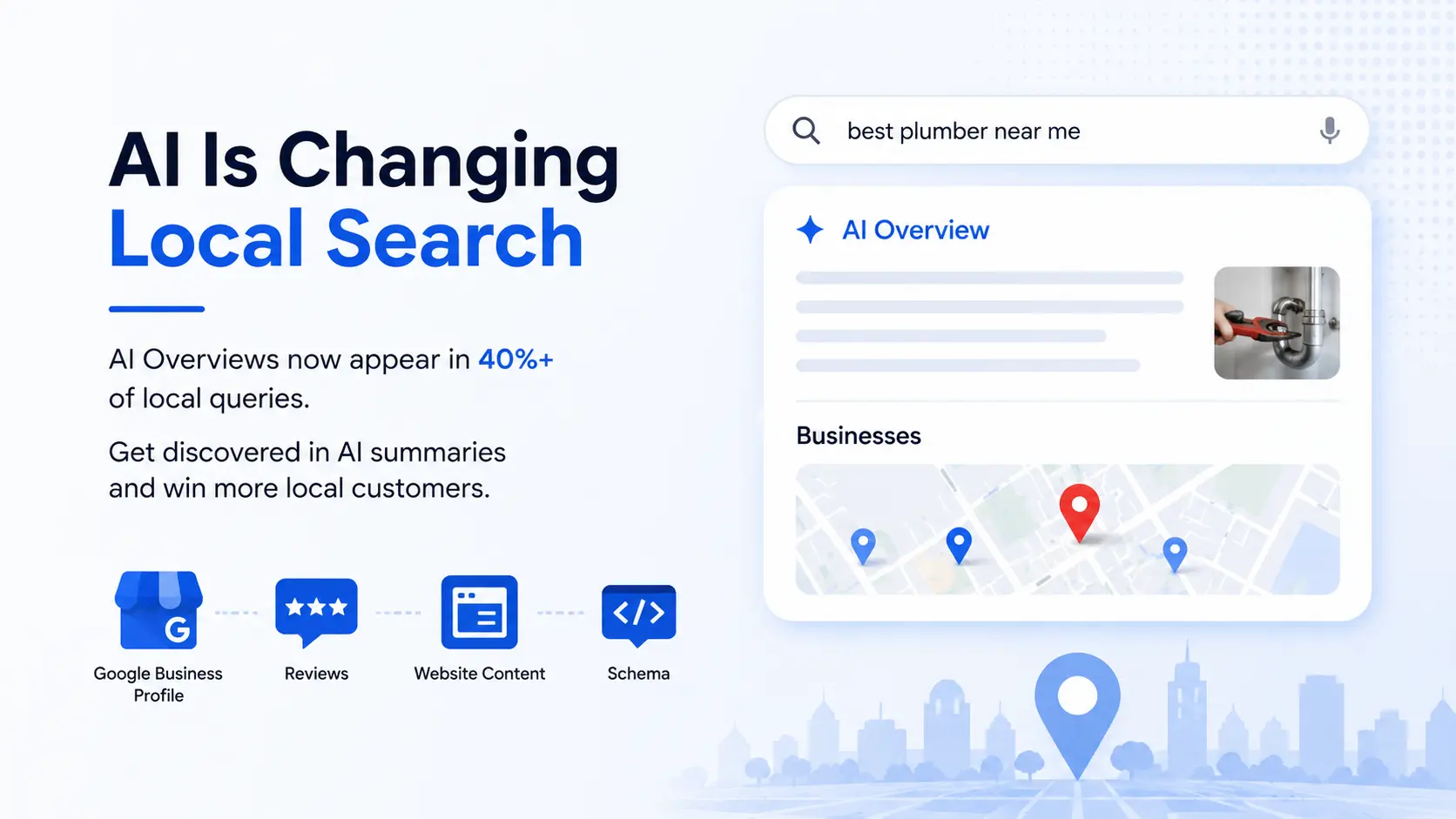
This is the section most local SEO guides do not cover. AI Overviews, ChatGPT, Gemini, and Perplexity are now active participants in how local businesses get discovered. Ignoring this layer means leaving a growing share of local discovery traffic on the table.
AI Overviews Now Appear in 40%+ of Local Queries
Google's March 2026 Core Update pushed AI Overviews deeper into local search results. Queries like "best [service] near me," "top-rated [service] in [city]," and "affordable [service] [city]" now frequently trigger AI-generated summaries above or within the Local Pack.
These AI summaries pull directly from your GBP description, your review content, your website copy, and your schema data. Businesses with entity-clear, well-structured profiles and websites appear in these summaries. Businesses with incomplete profiles or generic copy do not.
Three Ways to Get Your Business Cited in AI Search Results
Getting cited by AI engines requires the same clarity and structure that makes content rank well in search, but optimized for machine extraction rather than human reading.
- Optimize your GBP description for entity clarity. Your GBP description should state your service, your city, and one specific differentiator in the first two sentences. "We provide emergency plumbing services in Austin, TX, specializing in water heater replacement and drain repair for residential properties." That sentence is extractable, citable, and specific.
- Use LocalBusiness schema with a complete sameAs array. Linking your website schema to your GBP URL, Facebook, Yelp, and industry directory profiles grounds your business entity across sources that AI engines trust and cite. The more consistent and interconnected your entity profile, the more likely AI engines are to surface your business as a cited answer.
- Earn mentions on trusted local sources. AI engines, especially Perplexity, prioritize recently published, editorially vetted content. Local news coverage, chamber of commerce mentions, and reviews on authoritative industry platforms all feed into AI citation probability. A business cited in the Austin American-Statesman is more likely to appear in a Perplexity local answer than a business that exists only in directories.
Structured Content That AI Engines Extract and Cite
AI retrievers work at the passage level, not the page level. Each section of your location pages and service pages should be a self-contained, direct-answer block that makes sense without the rest of the page.
For every location page, include a direct-answer passage in the first 60 words: "A1 Technovation provides SEO services in New York City, including local SEO, technical SEO, and Google Business Profile optimization. We have served 150+ global clients since 2018 and specialize in getting businesses into the Local Pack and cited by AI engines."
FAQ sections on location pages directly feed Google's People Also Ask boxes and AI retrieval models. Structure each FAQ as a question followed by a 40-80 word direct answer. Write the answer so it makes complete sense on its own, without any context from the surrounding page.
Voice Search and Local SEO
Voice search remains heavily local in nature. Queries like "find a plumber near me," "best coffee shop open now," and "dentist accepting new patients in [city]" all carry voice-first patterns with specific intent signals.
Voice search favors conversational, complete-sentence answers over keyword-dense text. FAQ-format content matches voice query structures more closely than standard paragraph content. Speakable schema marks specific passages on your site as voice-search ready, signaling to Google and AI assistants which sections are appropriate for voice responses.
Local SEO Tools Worth Using in 2026
The right tools save time. The wrong ones create false confidence. Start with free tools, add paid tools when you are managing at scale or competing in a high-stakes market.
Google's Free Tools First
- Google Search Console shows how your local pages perform in search: which queries trigger impressions, what your average position is for local keywords, and whether your pages are properly indexed. Use the Performance report filtered by location-based queries to measure Local Pack and local organic progress.
- Google Business Profile Insights shows the behavioral signals Google is tracking on your profile: searches that triggered your listing, the number of website clicks, calls, and direction requests, and how users found you (direct search vs. discovery queries).
- Google Analytics 4 tracks the traffic and conversion behavior of visitors arriving from local searches. Set up a segment for organic traffic landing on location pages to measure local content performance separately from your overall organic channel.
Paid Tools for Serious Local SEO
| Tool | Best Use Case | Starting Price |
|---|---|---|
| BrightLocal | Citation management, review monitoring, local rank tracking | ~$39/month |
| Semrush | Keyword research, competitor gap analysis, local pack tracking | ~$140/month |
| Whitespark | Citation building, local link prospecting, GBP audits | ~$33/month |
| Moz Local | Automated NAP sync across directories | ~$14/month |
| Ahrefs | Backlink analysis, content gap identification | ~$129/month |
BrightLocal is purpose-built for local SEO and is the tool we recommend most to local business clients. Its citation audit, review monitoring, and local rank grid tracking (which shows your ranking at different physical locations within your city) address the three areas where most local campaigns need the most data.
Local SEO Mistakes That Cost Rankings
Most local SEO failures come from a short list of recurring errors. Fixing these before building anything new is always the fastest path to ranking improvement.
8 Local SEO Mistakes We See Most Often
- Incomplete Google Business Profile. Leaving categories, services, or the business description blank directly lowers your profile completeness score and reduces Local Pack visibility. Fill every field on day one.
- NAP inconsistency across directories. "Ave" versus "Avenue" or an old phone number on one directory creates conflicting signals. Audit your top 20 citation sources and fix every inconsistency before building new citations.
- No dedicated location landing pages. A single "Contact Us" page does not rank for "[service] in [city]" queries. Every city or service area you target needs its own dedicated page with unique, locally-relevant content.
- Ignoring review responses. Profiles that never respond to reviews signal low engagement. Respond to every review within 48 hours. For negative reviews, a professional response reduces the reputational damage and sends a positive engagement signal to Google.
- Keyword stuffing in the GBP business name. Adding service keywords or city names to your business name field when they do not appear in your legal name triggers GBP policy enforcement in 2026. Profile suspensions from this mistake can take weeks to resolve.
- Building irrelevant links from offshore link farms. Generic links from unrelated websites provide no local relevance signal. Worse, low-quality link profiles can trigger quality penalties that suppress both local and organic rankings.
- No LocalBusiness schema on location pages. Schema is free to add and directly improves Google's confidence in your location data. Skipping it leaves a clear technical signal on the table.
- Treating all local queries the same. A "near me" mobile query from someone two miles away, a "best [service] in [city]" desktop query from a researcher, and a voice query for "open now" trigger different ranking signals and different SERP features. Understanding intent differences within local search lets you build content and profile elements that match each query type.
Local SEO Timeline — Realistic Results by Stage
We set realistic timelines with every client we take on. Unrealistic expectations are the single biggest source of local SEO campaign frustration. Here is what typical progress looks like across four stages of a properly executed campaign.
The Local SEO Timeline Roadmap
| Stage | Timeframe | Expected Results |
|---|---|---|
| Foundation | Weeks 1-4 | GBP verified and fully complete, NAP consistent across Tier 1 and 2 citations, LocalBusiness schema live, review request system launched |
| Initial Traction | Months 2-3 | Local Pack appearances for lower-competition service + city queries, first new reviews arriving, GBP behavioral signals increasing |
| Growth | Months 4-6 | Top 5 Local Pack positions for primary service keywords, measurable organic local traffic increase, review base growing past 20-30 |
| Authority | Months 7-12 | Consistent Local Pack top 3 for core keywords, AI citation appearances beginning, review base over 50, local backlink profile building |
In our work with service businesses, the GBP optimization alone, completing every field, correcting NAP consistency, and launching a simple review request SMS, moved several clients into the Local Pack for their primary service keywords within 60-90 days. No new backlinks required.
The clients who see the fastest results are the ones who treat the foundation phase as seriously as the growth phase. A complete, verified, fully-populated GBP plus consistent NAP is a competitive advantage in most markets because the majority of businesses never finish their profile.
Frequently Asked Questions About Local SEO
What is local SEO?
Local SEO is the process of optimizing your online presence so your business appears in Google's local search results, including the Local Pack (the map and top 3 business listings), when people nearby search for your products or services.
How is local SEO different from regular SEO?
Local SEO differs from regular SEO because it targets a specific geographic area using signals like Google Business Profile, NAP citations, proximity to the searcher, and review velocity — signals that standard organic SEO does not use.
How long does local SEO take to show results?
Most businesses see Local Pack appearances within 60-90 days of completing a full GBP optimization. Sustained top-3 positions typically take 4-6 months depending on market competitiveness and review velocity.
How much does a Google Business Profile cost?
A Google Business Profile is free to create and manage. The cost of local SEO comes from the time invested or agency fees for optimization, citation building, content creation, and link building.
How does Google rank local businesses?
Google ranks local businesses using three primary signals: Relevance (does your business match the search query?), Distance (how close are you to the searcher?), and Prominence (how well-known and trusted is your business based on GBP, reviews, links, and web presence?).
What are local citations in SEO?
Local citations are online mentions of your business name, address, and phone number (NAP) on directories, review sites, and social platforms. They confirm your business identity to Google and carry 7% of the local ranking signal weight. Citation consistency, meaning your NAP appears identically everywhere, is more important than citation volume.
What is the Local Pack in Google search?
The Local Pack shows the top 3 business listings with a map at the top of local search results. It appears for 23% of all Google searches and receives 42% of clicks on local result pages. Appearing in it is driven primarily by GBP signals (32% of ranking weight), on-page signals (19%), and review signals (16%).
How does local SEO work with AI search in 2026?
AI Overviews now appear for over 40% of local queries in 2026. Businesses with complete GBP profiles, LocalBusiness schema with sameAs links, and entity-clear website copy are most likely to get cited in AI-generated local results on Google, ChatGPT, Gemini, and Perplexity.
Keep building the full local visibility stack
These guides expand on the organic foundation, tracking setup, and small-business execution layer around local SEO.
Ready to rank in your local market and turn searches into leads?
A1 Technovation builds local SEO campaigns that connect Google Business Profile optimization, citation cleanup, location-focused content, and AI-ready entity signals. We have helped 150+ clients globally since 2018, and every campaign starts with a free local SEO audit tailored to your market.
Get your free local SEO audit from A1 Technovation →