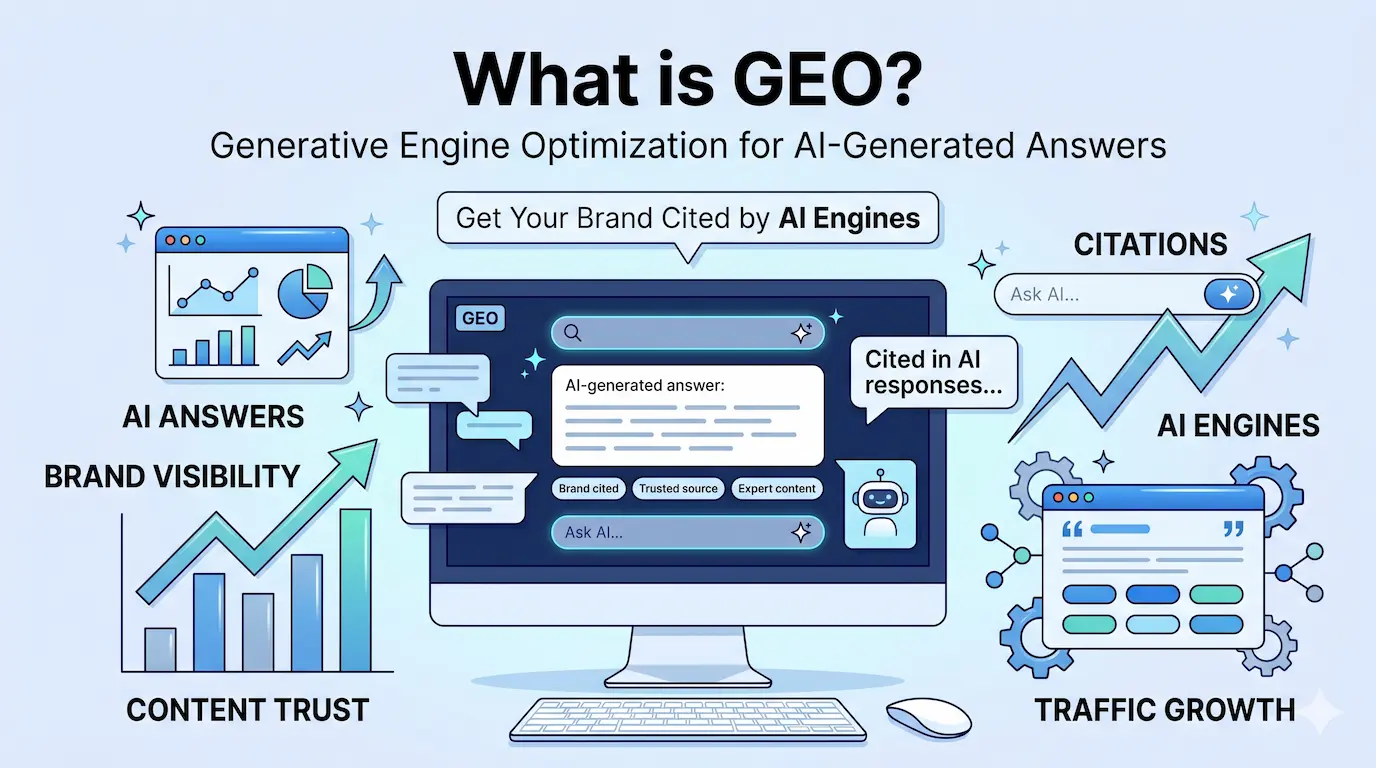
Google is no longer the only door users walk through to find answers. Millions of people now open ChatGPT, Perplexity, or Gemini before they ever type a search query. If your brand does not appear in those AI-generated answers, it does not exist for those users, no matter how well you rank on Google. That is the problem generative engine optimization (GEO) solves.
GEO is the strategy of getting your content, brand, and expertise cited inside AI-generated responses. This guide covers exactly how it works, how it differs from traditional SEO, and the specific steps that make AI engines choose your content over everyone else's.
GEO Defined
Generative Engine Optimization (GEO) is the process of structuring content, schema markup, and entity signals so that AI engines, including ChatGPT, Google AI Overviews, Perplexity, and Gemini, select your content as a cited source in their generated answers. The goal is not a ranked position on a results page. The goal is a named citation inside an AI-generated response.
The Search Shift That Makes GEO Necessary
Search behavior changed faster between 2023 and 2026 than it did in the previous decade. The pace of that shift created a visibility gap most businesses have not addressed yet.
The 2026 Search Traffic Shift
AI Adoption vs. Traditional Search Volume Trends
Gartner's 25% Drop Prediction and What It Means
Gartner predicted that traditional search engine volume will drop 25% by 2026, with organic search traffic expected to fall more than 50% as AI-powered search adoption grows. That is not a fringe forecast. It is a structural change in how people find information.
For businesses that built their entire discovery strategy around Google rankings, this number signals a real revenue risk. Rankings on page one still matter. But they no longer guarantee the same share of attention they did two years ago.
ChatGPT, Gemini, and Perplexity Are Now Discovery Channels
ChatGPT reached 180.5 million weekly active users. Perplexity AI's search volume grew 658% in a single year, reaching approximately 10 million active monthly users. According to recent data, 79% of consumers are expected to use AI-enhanced search within the next year, and 70% already trust the results AI tools provide.
These are not supplementary research tools people use after a Google search. For a growing segment of buyers, they are the first stop. A user asking Perplexity "best SEO agency for e-commerce" and getting three named recommendations never opens Google at all.
Getting Ranked vs. Getting Cited, Two Different Outcomes
A ranked position gives you a URL in a list. A citation gives your brand name inside a generated paragraph written by an AI engine that millions of users trust.
Cited brands receive something more valuable than a click, they receive implicit endorsement from the AI model itself. The model is telling the user: this source is reliable enough to reference by name. That trust transfer happens before the user ever visits your site.
GEO vs. SEO, The Core Differences
GEO and SEO share the same foundation. High-quality content, topical authority, and E-E-A-T (Experience, Expertise, Authoritativeness, Trustworthiness) serve both strategies. The difference is in the destination and the structural requirements for getting there.
| Factor | SEO | GEO |
|---|---|---|
| Goal | Rank in Google's blue links | Get cited in AI-generated answers |
| Primary channel | Google Search | ChatGPT, Perplexity, Gemini, AI Overviews |
| Key ranking signal | Backlinks, relevance, authority | Passage quality, entity clarity, factual density |
| Visibility format | Position 1 to 10 in SERP | Named citation inside a generated response |
| Content format | Full articles optimized for keywords | Self-contained, direct-answer passages |
| Schema importance | Helpful | Critical, machine-readable signals required |
| Measurement | GSC rankings, organic traffic | Citation frequency, brand mentions in AI outputs |
Same Foundation, Different Destination
Both SEO and GEO reward content that is accurate, thorough, and written by someone with real expertise. Neither rewards thin content, vague claims, or keyword stuffing. The difference appears at the structural level: GEO requires passage-level engineering, not just page-level optimization.
A page optimized only for SEO might rank well but produce no AI citations because its answers are buried in paragraph four, its schema is missing, and its entities are too vague for an AI retriever to extract and attribute. If you want the traditional search foundation first, read our What Is SEO? guide.
GEO Does Not Replace SEO, It Runs Alongside It
Brands that earn Google rankings and AI citations own two high-trust discovery channels at the same time. The smartest strategy is not to choose between them. At A1 Technovation, the positioning we build for every client is simple: rank on Google and get cited by AI engines. For the answer-extraction side specifically, see our AEO guide.
The Four AI Platforms GEO Targets
GEO vs. AEO, Understanding the Distinction
AEO (Answer Engine Optimization) and GEO are closely related but target different channels with different mechanics.
| Factor | AEO | GEO |
|---|---|---|
| Full name | Answer Engine Optimization | Generative Engine Optimization |
| Primary target | Google AI Overviews, featured snippets | ChatGPT, Perplexity, Gemini Chat |
| Response mechanism | Extracted snippet pulled from a URL | AI-generated paragraph that cites a source |
| Content structure | Direct answer, FAQ format | Passage-level, entity-grounded content |
| User context | Google Search with an AI layer on top | Standalone AI chat interface, no Google involved |
The 2026 Search Visibility Hierarchy
The Overlap: High-Quality, Passage-Structured Content
Both AEO and GEO require the same core inputs: direct-answer passages, high factual density, entity-grounded language, structured data, and clear attribution signals. Run them together, not as sequential projects. Content built for GEO automatically strengthens AEO performance, and vice versa. For a deeper breakdown of the answer-engine side, see our What Is AEO? explainer.
See our AEO Optimization Services and GEO Optimization Services.

How Generative AI Engines Decide What to Cite
Understanding the mechanism behind AI citations removes the guesswork from GEO strategy. Each major AI engine uses a slightly different retrieval and ranking logic, but all of them share a common preference: clear, structured, authoritative content that answers a specific question without requiring the AI to work hard to extract the answer.
RAG Workflow: How AI Engines Retrieve Your Content
Retrieval-Augmented Generation (RAG), The Mechanism Behind Citations
RAG (Retrieval-Augmented Generation) is the system most modern AI engines use to pull live information from the web when generating answers. Instead of relying purely on training data, the AI retrieves a set of relevant passages from current sources and uses them to construct its response.
Content that wins under RAG is clearly structured, authoritative, passage-retrievable, and factually dense. If your page answers a question but buries the answer in a wall of text with no structural markers, the retrieval system skips it. If a competitor's page answers the same question in a clean 50-word passage at the top of an H2 section, their content gets cited.
What Google AI Overviews Wants
Google AI Overviews prefers content that is above the fold and directly answers the question. According to data from BrightEdge's Generative Parser, Reddit citations in AI Overviews fell 85.71% while citations from established publications like PC Magazine increased 49% and Forbes increased 39%. User-generated content without editorial authority is losing ground fast.
Google wants quotable content that is immediately accessible, not buried three paragraphs deep. The question must be directly answered in the first response, not after a long preamble about the history of the topic.
What Perplexity Wants
Perplexity focuses heavily on academic and research-style citations. Source authority is the primary filter. Content that reads like a reference document, specific, attributed, structured, fact-dense, performs significantly better than conversational content that lacks named sources.
Perplexity increased its traffic referrals by 31% in a measured period precisely because it sends users back to the sources it cites. That referral traffic only flows to pages that made the citation cut in the first place.
What ChatGPT/Search Wants
ChatGPT does not require exact direct-answer formatting the way Google AI Overviews does. It digests content and rephrases it in its own language. The primary filter is source authority and factual density. ChatGPT Search shows a clear preference for content from established publishers, major industry publications, official documentation, and brands with a strong entity footprint.
Specific named entities, verifiable statistics, and attributed claims all increase the probability that ChatGPT selects your content as a source.
What Gemini Wants
Gemini is deeply integrated with Google's Knowledge Graph and entity-grounding systems. Content with proper JSON-LD schema markup, named entity references, and machine-readable structure performs significantly better in Gemini citations than identical content without those signals.
Gemini's multimodal architecture means it processes content for structured meaning, not just keyword presence. The more precisely your content maps to established entities and their attributes, the more likely Gemini is to retrieve and surface it.
The 7 Core GEO Tactics That Drive AI Citations
These are the specific structural and strategic changes that move content from invisible to AI engines to frequently cited source.
The 7 Pillars of Generative Engine Optimization
Direct-Answer Passages
Every major H2 section should open with a 40 to 60 word passage that answers the section's core question completely.
Entity-Grounded Content
Named entities, specific facts, exact numbers, and proper nouns all make your content exponentially more citable.
Structured Data Schema
JSON-LD schema tells AI parsers what your content is, who wrote it, and lowers the cost of retrieval.
Topical Authority
AI engines cite sources that consistently cover a topic well across clusters, not just sources with a single strong article.
Citation Hooks
Outbound links to authoritative sources signal to AI retrievers that your content is well sourced and reference worthy.
Passage-Level Structure
Every H2 and H3 block must function as a standalone unit of knowledge that makes sense without surrounding context.
Demonstrate E-E-A-T
Content without clear authorship, first-hand experience, and verifiable credentials gets filtered out of AI citations.
GEO Implementation Roadmap
Follow these steps sequentially to move from invisible to frequently cited
1. Write Self-Contained, Direct-Answer Passages
Every major H2 section of your content should open with a 40 to 60 word passage that answers the section's core question completely. The AI retriever should not have to read further to get a clean, complete answer.
This is the single highest-impact GEO tactic. An AI engine scanning your page for a citable passage needs to find the answer immediately, in the opening lines of a clearly marked section, not at the end of a four-paragraph buildup.
2. Build Entity-Grounded Content
Named entities, specific facts, exact numbers, and proper nouns all make your content more citable. "A digital marketing agency in Asia" is nearly worthless to an AI retriever. "A1 Technovation, founded in 2018 in Dhaka, Bangladesh, serving 150 plus global clients" gives the AI specific entities it can extract, attribute, and verify.
Entity grounding means writing with precision at every level: brand names, people names, platform names, geographic locations, statistics with sources, and dates. Vague language does not get cited. Specific language does.
3. Use Structured Data, Schema Markup AI Engines Can Parse
JSON-LD schema such as Article, FAQPage, Organization, and Speakable tells AI parsers what your content is, who wrote it, and what it claims. Schema markup reduces what semantic SEO practitioners call cost of retrieval, the computational effort required for a machine to extract meaning from your page.
Lower cost of retrieval means your content competes more effectively in retrieval systems. A page with Article schema, an author entity, FAQPage markup, and Speakable designation on its key passages beats a structurally identical page without schema in nearly every AI retrieval context. Many of those signals are easiest to review once the site is connected in Google Search Console.
4. Earn Topical Authority Through Content Depth and Coverage
AI engines cite sources that consistently cover a topic well, not just sources that published one strong article. Topical authority signals to retrieval systems that your domain is a reliable, comprehensive source for a given subject area.
Building topical authority means covering the central entity of your topic and all its related sub-entities, attributes, and questions across multiple pieces of content. A single GEO-optimized article helps. A cluster of 15 to 20 GEO-optimized articles on the same topic makes your domain a consistently cited source for that topic across AI engines. That same cluster model is especially useful for service operators, which we outline in our small business SEO guide.
5. Place Citation Hooks, Outbound Links to Authoritative Sources
Outbound links to authoritative sources such as academic research, official documentation, government data, and industry reports serve a dual function: they strengthen E-E-A-T signals for Google, and they signal to AI retrievers that your content is well sourced and reference worthy.
Content that cites credible external sources gets cited more frequently by AI engines than content that makes unsourced claims. This mirrors how academic citation works, a paper that references strong sources carries more authority than one that cites nothing.
6. Structure for Passage Retrieval, Not Just Full Pages
Google began indexing and ranking individual passages within pages in 2021. AI retrieval systems operate the same way, they extract and evaluate passages, not full articles. Every H2 and H3 block in your content should function as a standalone unit of knowledge that makes sense without the surrounding context.
This means: open each section with the direct answer, provide the supporting detail, close the section with a logical conclusion or transition. Avoid writing sections that only make sense if the reader has consumed everything that came before.
7. Demonstrate E-E-A-T So AI Engines Trust Your Content
Experience, Expertise, Authoritativeness, and Trustworthiness remain the foundational quality signals for both Google and AI retrieval systems. Content without clear authorship, without first-hand experience signals, without verifiable credentials, gets filtered out of AI citations.
Practical E-E-A-T signals for GEO: a named author with a linked bio and demonstrated expertise in the topic, specific case-style language referencing real project experience, verifiable statistics from named sources, and organization schema that grounds your brand as a known entity. If you want the core organic trust layer explained separately, go back to our SEO guide.
Working with an e-commerce client whose product pages were generating zero AI Overview citations, the A1 Technovation team restructured the brand's blog content to include direct-answer passages, added Article schema with the founder's author entity, and inserted outbound citation hooks to Google's Search Essentials documentation. Within six weeks, Perplexity began citing the client's content for three target queries that previously returned only competitor results.
GEO in Practice, A Real-World Example
The difference between a page that gets cited and one that does not is almost always structural, not topical. Two pages covering the same subject can exist at the same domain authority level and receive completely different treatment from AI retrieval systems.
The Page That Doesn't Get Cited
A typical unoptimized page: 1,500 words on a topic, with the core answer appearing in paragraph three of the body copy. No schema markup. Author listed only as "Admin." No outbound links to authoritative sources. Entity language is vague ("our agency", "digital marketing services"). H2 headings describe topics but do not open with direct answers.
Result: an AI retriever scans the page, finds no clean extractable passage, finds no machine-readable structure to confirm what the content is or who produced it, and moves on to a competitor's page that provides a cleaner extraction target.
The Page That Gets Cited
Same topic, restructured for GEO: the first 60 words of every H2 section answer the section question completely. Article schema identifies the author as a named expert with a specific job title. FAQPage schema covers six high-frequency questions on the topic. Two outbound links reference Google's official Search documentation and a Gartner research finding. Entity language throughout is specific: named platforms, named people, specific statistics with sources.
Result: Perplexity extracts the direct-answer passage from the top of the most relevant H2. Google AI Overviews pulls the FAQ block. ChatGPT Search cites the article as a source.
Typical GEO Citation Timeline
What to expect after implementing GEO-structured content
GEO Metrics, Tracking AI Engine Visibility
GEO performance is measurable. It requires different tracking methods than traditional SEO, but the data is available and actionable.
Citation Testing Across ChatGPT, Perplexity, and Gemini
The most direct measurement method is manual citation testing. Once per month, query your target phrases directly inside ChatGPT, Perplexity, and Gemini. Log whether your brand, content, or URL appears in the generated response.
Target queries for testing: your brand name plus service category, commercial queries you want to own, and informational queries your content is designed to answer. Record results in a simple spreadsheet: date, platform, query, cited or not cited, competitor cited instead.
This data gives you a baseline. As GEO optimizations take effect, citation frequency across platforms increases, and you can see exactly which platforms and queries are responding first.
AI Overview Impressions in Google Search Console
Google Search Console now tracks impressions from AI Overview results separately from standard organic impressions. Filter by "AI Overview" in the Search Type dropdown to see how often your content appears in AI-generated search responses on Google.
Track this metric monthly alongside standard organic impression data. Growing AI Overview impressions with flat or declining standard organic impressions confirms that GEO optimizations are working even as traditional search behavior shifts.
Brand Mention Monitoring as a GEO Signal
Set up Google Alerts for your brand name and core service terms. Use Ahrefs brand mention monitoring to track unlinked references across the web. Conduct monthly manual checks inside major AI interfaces.
GEO success frequently shows up first as unlinked brand mentions, AI platforms referencing your brand in generated content without necessarily linking back. Those unlinked citations still drive brand awareness and trust, and they often precede an increase in direct traffic as users search specifically for your brand after seeing it cited.
Common GEO Mistakes Businesses Make
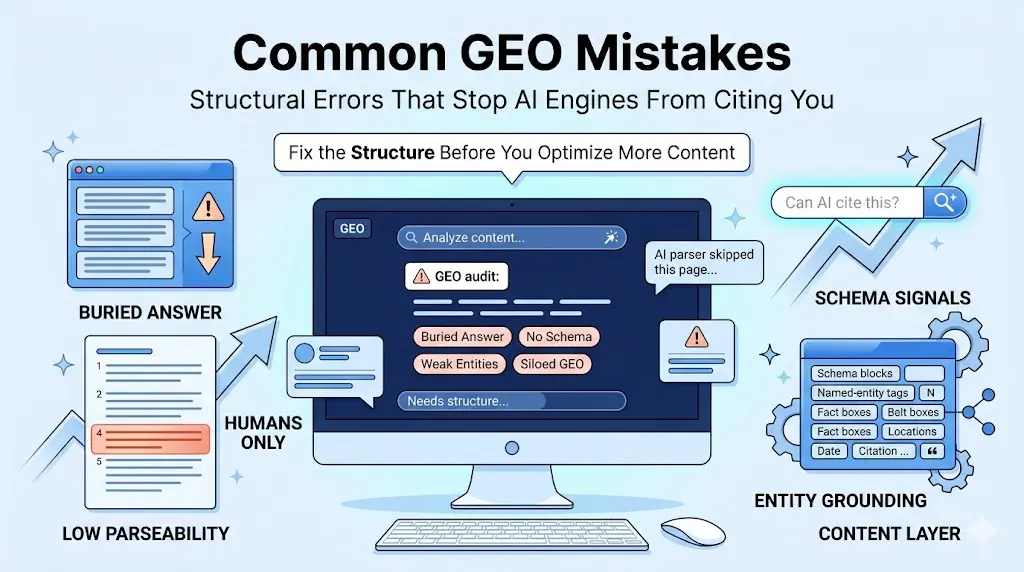
Most GEO failures come down to four repeatable structural errors, not topic selection, domain authority, or content length.
- Burying the answer. If the direct answer to the section's question appears in paragraph four or five, AI engines often skip the page entirely. The answer must appear in the first 50 to 65 words of the relevant section.
- Writing for humans only. Content without schema markup, without named entities, without structured data signals gives AI parsers no machine-readable hook. Both audiences must be served simultaneously.
- Ignoring entity grounding. Generic brand descriptions that lack specific facts, dates, locations, and attributable data do not get cited.
- Treating GEO as a separate project. GEO is not a separate content strategy that runs alongside your existing content calendar. It is a structural layer applied to every piece of content you produce.
Frequently Asked Questions
GEO vs. SEO: what's the difference?
SEO targets ranked positions in Google's blue-link results. GEO targets named citations inside AI-generated responses. Both use high-quality content as the foundation, but GEO requires passage-level structuring, schema markup, and entity grounding that traditional SEO alone does not address. A page can rank well on Google and produce zero AI citations if it lacks GEO structure.
Does GEO replace SEO?
No. GEO runs alongside SEO. Brands that rank on Google and get cited by AI engines gain visibility across two discovery channels at the same time. The goal is dual visibility: Google rankings plus AI citations.
How long does it take to see GEO results?
Most brands begin seeing AI citation appearances within 60 to 120 days of implementing GEO-structured content with correct schema and entity signals. Pages with strong existing domain authority and high-quality content often see citation appearances in 30 to 45 days after GEO restructuring.
Does schema markup help GEO?
Yes. JSON-LD schema such as Article, FAQPage, Organization, and Speakable provides machine-readable structure that AI engines can parse directly. Pages with schema markup are more consistently retrieved and cited than structurally identical pages without it.
Can small businesses benefit from GEO?
Yes. AI engines cite the most relevant, clearly structured sources, not necessarily the largest brands. A small business with high topical authority, direct-answer content, and proper schema markup can appear in AI-generated answers ahead of much larger competitors with poor content structure.

Likhon helps brands structure content for AI citations across Google AI Overviews, ChatGPT, Gemini, and Perplexity. He specializes in GEO, AEO, semantic SEO, and entity-driven content strategy.
View full profileExpand GEO into a broader visibility system
These guides connect AI citation strategy to the underlying SEO and answer-optimization layers that support it.
Start Getting Cited by AI Engines
GEO is not a future-state strategy. The businesses getting cited in AI-generated answers right now are building that citation advantage compoundly, month over month, query over query, platform over platform. A1 Technovation builds GEO and AEO strategy for businesses that want Google rankings and AI engine citations working together.
Request a Free GEO Audit →