
A server can have spare CPU, free memory, and a working network port while users in another region struggle to reach it. Adding more hardware at the same location may not solve that problem.
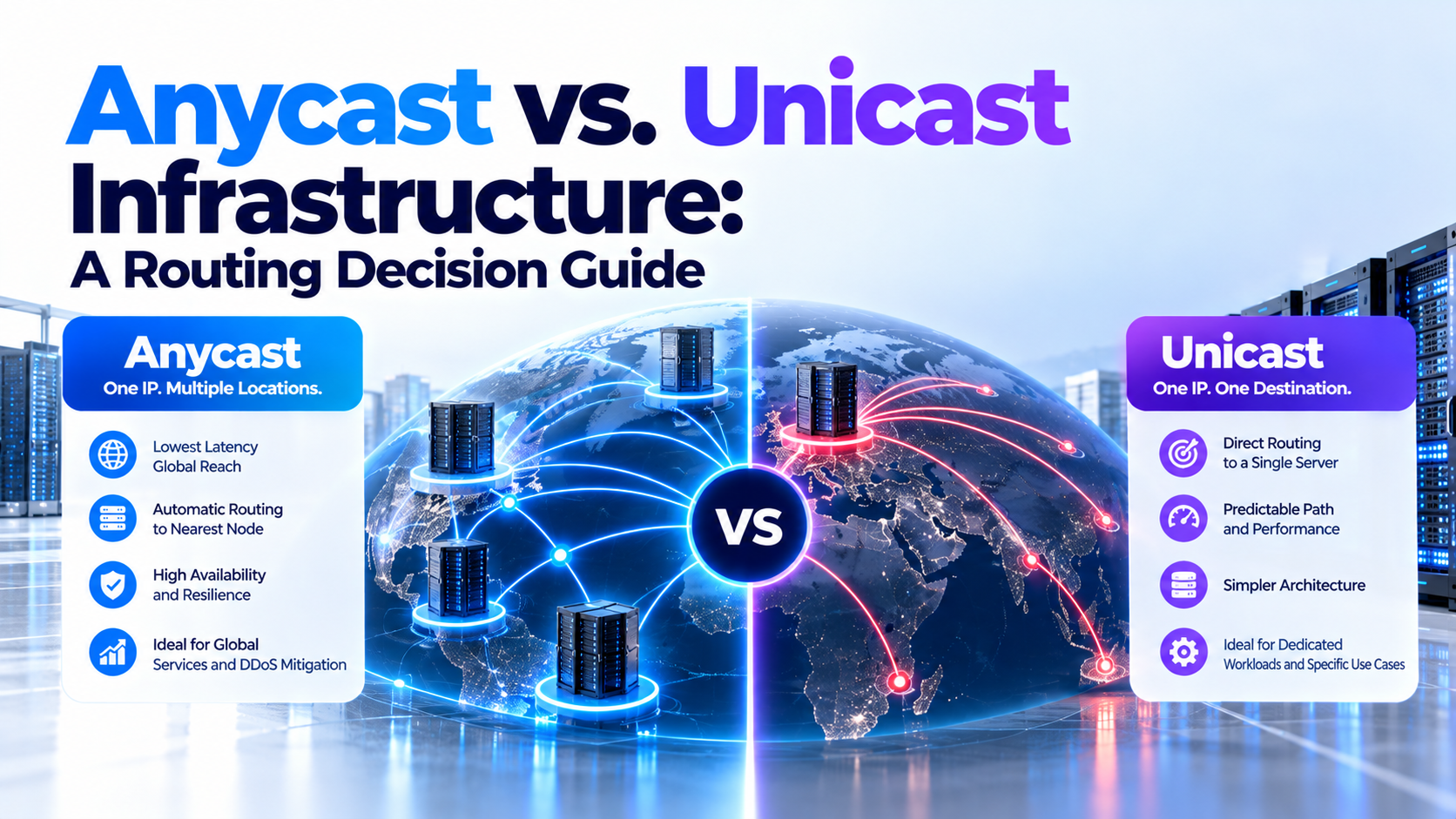
The choice between anycast vs unicast hosting starts with where traffic should enter the service. Unicast sends packets to a specific destination. Anycast makes the same service address reachable at several sites, and routing determines which site receives each packet.
Neither approach is always better. The right choice depends on user locations, application state, failure requirements, and the team's ability to operate the design.
For buyers considering Atal Networks, these details provide a basis for discussing IP resources, hosting locations, and routing responsibilities before ordering infrastructure.
Anycast vs. Unicast Hosting at a Glance
Unicast does not mean one physical server without redundancy. A unicast address can front a load balancer and several backend servers.
Anycast adds separate locations that serve the same address. It can distribute traffic, but it does not automatically balance server load or preserve active connections during a site change.
| Decision factor | Conventional unicast | Multi-site anycast | Anycast edge with unicast origins |
|---|---|---|---|
| Traffic destination | A specific service endpoint | One of several sites serving the same address | An edge site that forwards to a backend |
| Backend design | One server or a server pool | Service instances at several sites | Regional or central application origins |
| Availability | Depends on redundancy and failover design | Depends on healthy announcements and spare capacity | Depends on both edge and origin availability |
| Session handling | Usually simpler within one destination | Needs care if traffic changes sites | Requires a plan for both connection segments |
| Typical fit | Regional applications and fixed endpoints | DNS and suitable distributed services | APIs, web delivery, and security gateways |
| Operating effort | Often lower | Higher when self-operated | Depends on the managed service and backend design |
A dedicated server, a VPS, and an anycast address describe different parts of infrastructure. Choosing one does not determine the others.
Packet Ingress: Unicast vs Anycast vs Edge Hybrid
How Unicast Routing Works
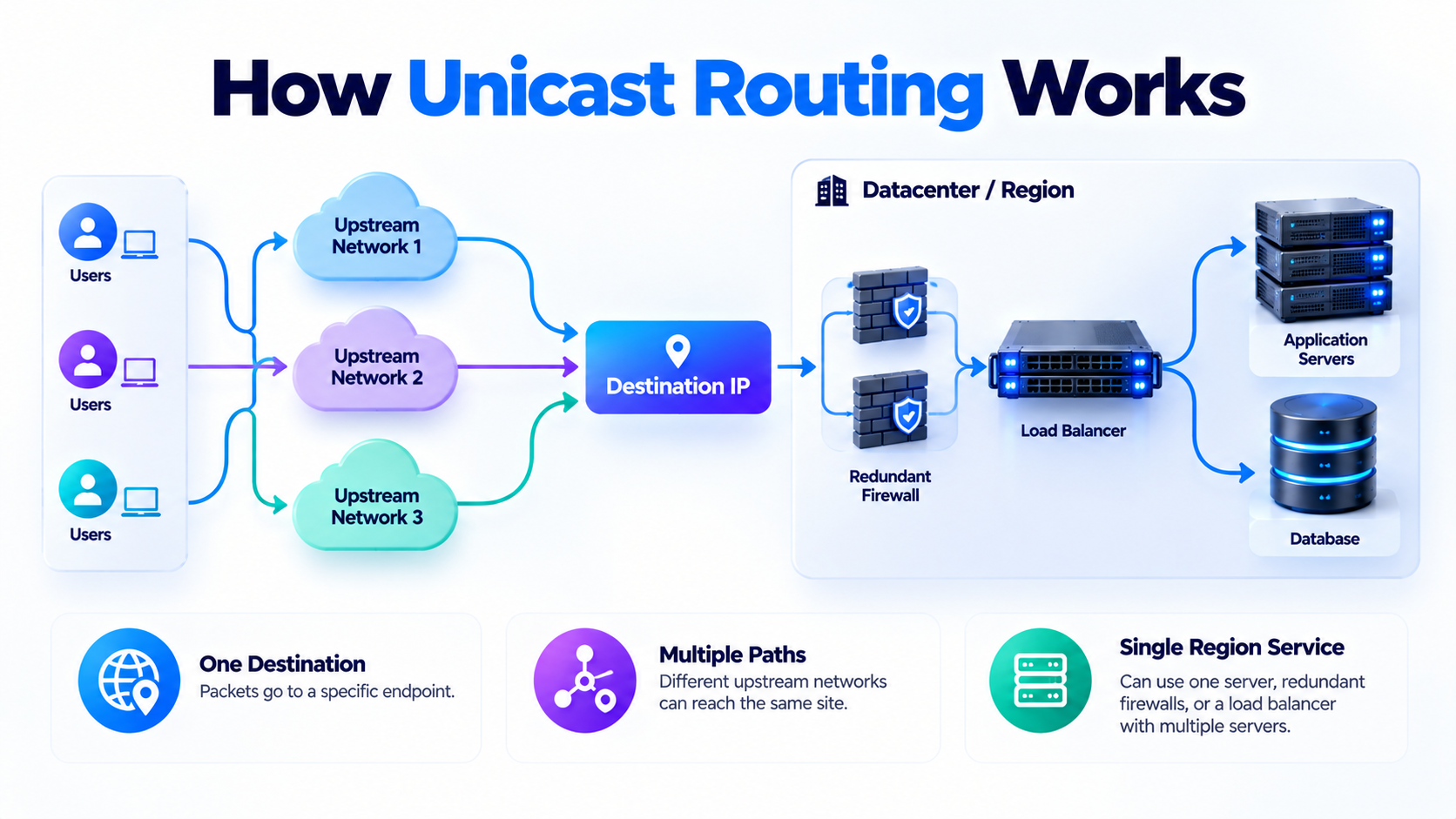
With unicast, the destination address identifies the endpoint the sender wants to reach. The network forwards packets toward that destination.
Behind the address, a service might use one machine, a redundant firewall pair, or a load balancer connected to several application servers. Multiple upstream networks can also provide different paths to the same site.
Consider a business application whose users and database are in one region. A nearby unicast endpoint with redundant servers may meet its response-time and availability targets.
Adding distant entry points will not necessarily help if every request must still reach the same database.
Unicast can also form part of a multi-region design. Separate regions use separate service addresses, while DNS or application logic selects a destination. Reliability depends on the full design, not the address model alone.
How Anycast Routing Works
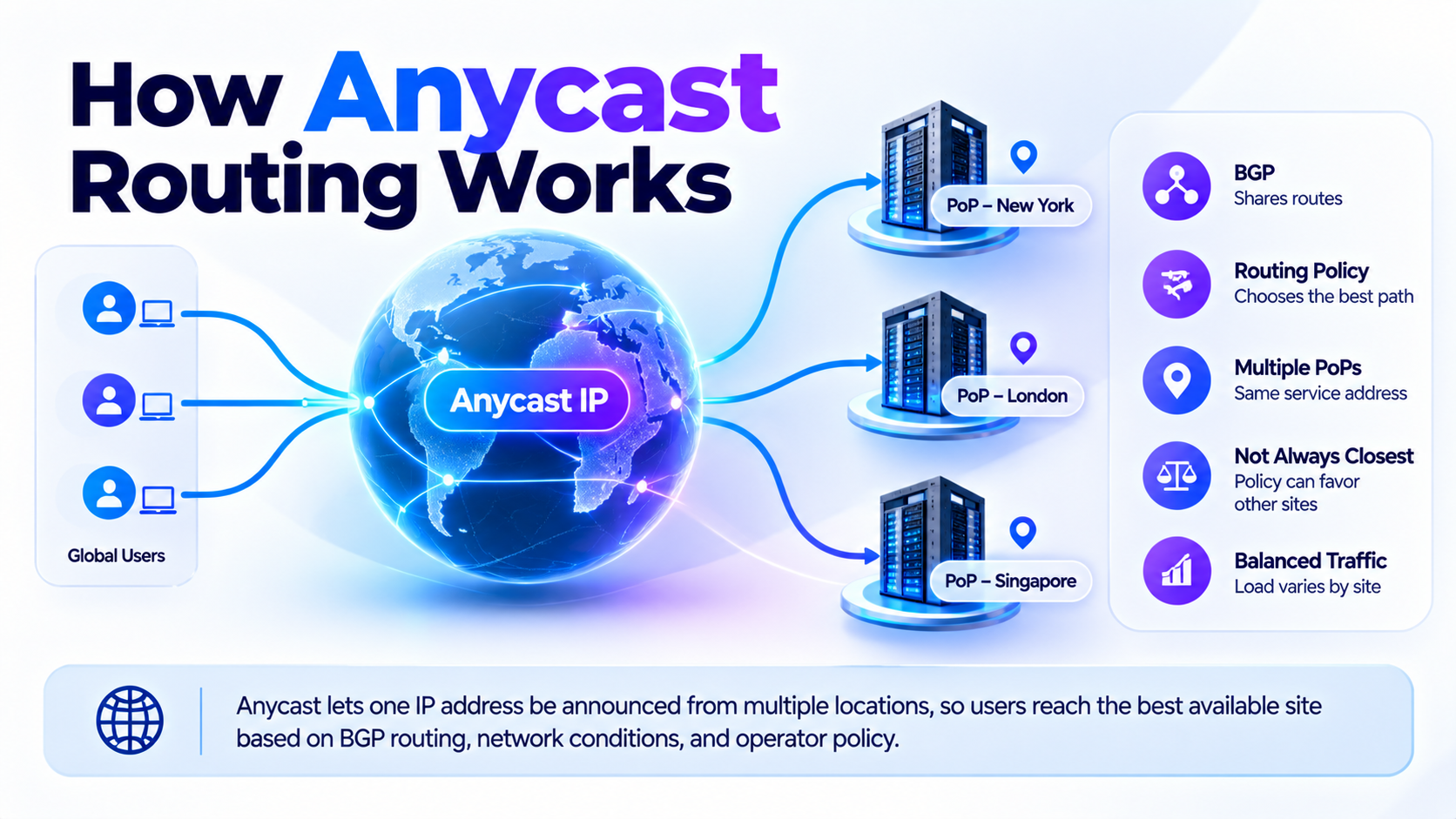
Public Internet anycast commonly uses Border Gateway Protocol, or BGP. BGP lets networks exchange information about reachable IP prefixes. A prefix is a block of addresses.
Several sites announce a route covering the same service address. Each receiving network applies its routing policy to choose a path.
A site is often called a point of presence, or PoP. The clients whose traffic reaches that site form its routing catchment.
The selected site is not necessarily the closest site on a map. Routing policy, network connections, and available paths affect the result. Ordinary BGP does not measure page-load time or inspect the application's CPU use.
A nearby site can receive less traffic than a distant one. One site can also carry much more load than another.
The IETF's anycast operating guidance treats routing, service availability, and monitoring as separate design concerns. Anycast supplies a way to reach distributed service instances. Operators still need to make those instances work correctly.
BGP Prefix Advertisement & Routing Catchments
BGP routes packets to the topologically closest site via AS-PATH policy, which may not always equal geographic distance.
Match the Routing Design to the Workload
Start with three questions:
- Where are the users?
- Where must the application process and store their data?
- What happens if an active request reaches a different site?
The answers narrow the design choices.
Conventional Unicast for a Regional Service
Unicast is a reasonable starting point when one region meets the service targets. It also suits applications that need a fixed endpoint or retain connection state on a particular system.
A regional database service, for example, gains little from a global entry layer if transactions still depend on one regional database.
Anycast for Services Available at Several Sites
Anycast becomes useful when multiple sites can provide the required service and distributed entry points solve a measured problem.
Public DNS is a common example. Several sites can answer for the same service address without requiring users to select a location.
Anycast Entry Points With Unicast Origins
A hybrid design accepts traffic at an anycast edge and forwards it to a selected backend.
This separates the client's entry point from the location that processes the request. AWS Global Accelerator illustrates this distinction: its anycast addresses bring traffic into an edge network, while additional service logic directs traffic toward application endpoints.
The buyer must assess the entire request path. A short connection to the edge does not prove a short response time from the application.
The Infrastructure Routing Decision Matrix
DNS, API, Security, and Content-Delivery Use Cases
DNS Services
Authoritative DNS servers answer for a domain's records. Recursive resolvers find and cache answers for clients. Either service can use anycast.
Authoritative sites need controlled zone updates. Operators should check actual answers, not just whether port 53 responds. DNS service tests should cover UDP and TCP.
Anycast DNS and GeoDNS perform different tasks. Anycast affects the route to a service address. GeoDNS changes DNS answers based on location or other selection rules.
Using anycast DNS does not make the website itself anycast. The returned address may still lead to a conventional unicast origin.
APIs and Web Applications
An API can use an anycast edge for connection handling or security checks, then forward requests to an origin.
The design still needs access to user data, consistent authorization, and safe retry behavior. A failed connection does not always mean that the server rejected the request.
For operations such as creating an order, use an application mechanism that prevents a retry from creating a duplicate. Routing cannot provide that protection by itself.
DDoS Protection
Anycast can spread incoming attack traffic across several entry points. The distribution depends on where the traffic originates and how networks route it.
A site can still run out of capacity. Effective protection also requires suitable filtering, enough network capacity, and a plan for overloaded locations.
Cloudflare's anycast explanation describes anycast within a wider DDoS defense. Buyers should assess filtering and capacity limits rather than treat the routing method as a security guarantee.
Check the origin as well. An exposed origin address may allow attackers to bypass the protected entry layer.
DDoS Blast Radius: Unicast Choke vs. Anycast Distribution
CDNs and Content Delivery
A content delivery network may use anycast to accept requests near users. Caching, origin fetches, and content updates remain separate functions.
Cached files may avoid a distant origin request. An uncached or personalized response may still require that trip.
Measure cache hits and origin-dependent requests separately. Combining them into one average can hide the slower path.
IPv4 and IPv6 Address Requirements
An anycast service address must sit within a prefix that the participating networks can route.
A single rented IPv4 address normally does not give the customer permission to announce its containing block from other locations.
For public deployments, /24 IPv4 and /48 IPv6 are common provider acceptance boundaries. They are not universal promises of global reachability. For example, Cloudflare Spectrum's BYOIP documentation lists these as its smallest supported prefixes.
Before selecting address space, check:
- Permission to announce the prefix from each planned site.
- Permission to use the proposed origin ASN or ASNs.
- Prefix lengths accepted by each upstream provider.
- Lease terms for multi-site use and provider changes.
- Responsibility for routing records and authorization changes.
Bring Your Own IP, or BYOIP, means using address space under the customer's authorized control with a provider's service. Support depends on that provider's rules.
Test IPv4 and IPv6 separately. A working IPv4 route does not prove that the IPv6 path works.
ASN and BGP Prerequisites
An Autonomous System Number, or ASN, identifies a network in interdomain routing.
A customer can operate BGP under its own ASN, or a provider can originate approved routes under an agreed design. Managed anycast services may not require the customer to obtain an ASN or run BGP sessions.
The operating model must identify who controls announcements and who can change them during an incident.
Three records commonly form part of the deployment process:
| Item | Purpose |
|---|---|
| Letter of Authorization, or LOA | Documents permission for a provider to perform specified routing actions |
| IRR route object | Records a prefix and origin relationship that networks may use when building filters |
| RPKI Route Origin Authorization, or ROA | Authorizes an origin ASN for a prefix within stated prefix-length limits |
These items serve different purposes. An LOA does not replace a ROA. RPKI origin checks do not prove the entire network path or application is safe.
Atal Networks' IP and ASN leasing options list IP resources, routing-related support, and optional dedicated or VPS hosting. Buyers should ask which parts apply to the proposed deployment and who maintains them.
Before launch, check every planned prefix, origin ASN, route filter, and authorization. Include any alternate origin intended for recovery.
Health Checks and Route Withdrawal
A router can remain online while the application behind it fails. BGP may continue to advertise the site unless a control process connects service health to routing.
A useful check should test what the customer needs. For DNS, that means an expected answer. For an API, it may mean a successful request that checks a required dependency.
Tools such as ExaBGP's health-check module can connect checks to route announcements. The deployment still needs suitable checks, thresholds, and ownership.
Route withdrawal removes an advertised path. Other networks then select among the paths that remain.
Recovery has several stages:
- Detect the fault.
- Decide whether to remove the route.
- Update routing.
- Allow affected networks to select another path.
- Let clients retry or reconnect where necessary.
This is why a single universal failover time is misleading.
Set a recovery hold period before returning a repaired site to service. Rapid withdrawal and return can move traffic repeatedly.
Also check the scope of each announcement. Withdrawing a prefix can affect several services inside that block. Keep management access outside the service path being changed.
The 5 Stages of Dynamic Route Withdrawal & Convergence
Total failover duration = Detection Time + Decision Delay + BGP Propagation Time + Client Reconnection Delay.
State Management and Session Considerations
Application data and connection state are different.
A shared database may allow two sites to recognize the same user. It does not automatically give both sites the state of an existing TCP or TLS connection.
If a route change sends packets to a different site, that site may not recognize the connection. RFC 7094 describes this risk for stateful transport protocols.
TCP can work with anycast. The concern is the behavior during route changes, especially for long-lived connections.
UDP also needs care. Game sessions, VPN tunnels, and QUIC connections can retain state despite using UDP.
Before deployment, answer four questions:
- Can clients reconnect without losing required work?
- Can the application safely retry incomplete requests?
- Does the platform keep an established flow on its selected backend?
- What happens if the edge site holding connection state fails?
Some managed services add flow handling beyond ordinary Internet routing. Assess those mechanisms directly. Do not assume that “supports TCP” means every active session survives a site failure.
RFC 7094: TCP Connection Reset During Anycast Route Flap
Monitor Regional Paths and Application Results
A test from one office or cloud region shows one view of the service.
Measure from networks that represent the customer base. Include several ISPs, IPv4 and IPv6, and busy periods.
Record both network and application results:
| Measurement | Question it answers |
|---|---|
| Serving-site identifier | Which site handled the request? |
| Round-trip time | How long did the network exchange take? |
| Packet loss | Did traffic fail to reach its destination? |
| Request error rate | Did the application complete the work? |
| p95 and p99 response time | How slow were requests near the slow end of the sample? |
| Site capacity use | Can this site accept more traffic after a failure? |
Traceroute and MTR can help inspect paths. Service probes test the actual operation. Route collectors and regional measurement platforms provide other views.
A successful ping alone does not prove healthy DNS answers, a working checkout, or access to the correct backend.
Keep site identifiers in logs so regional errors can be traced to the location that served them.
Failure Testing and Rollback Planning
A deployment should pass failure tests before carrying critical production traffic.
The following test plan is a starting point. Set pass limits from the service's requirements.
| Test | Required observation |
|---|---|
| Stop the application but leave BGP active | Health controls detect the service failure |
| Break a backend dependency | Checks identify whether the site can still serve useful responses |
| Remove one upstream connection | Traffic uses a working path where the design provides one |
| Withdraw one site | Remaining sites receive traffic within agreed error and capacity limits |
| Change a path during a persistent session | The measured session outcome matches the requirement |
| Break IPv6 reachability only | Monitoring detects the address-family-specific failure |
| Restore a repaired site | Traffic returns without repeated route changes or overload |
Record detection time, user-visible recovery time, error rate, connection resets, and remaining capacity. Keep route convergence time separate from application recovery time.
For a three-site deployment, do not assume a failed site's traffic divides evenly between the other two. Test the actual traffic shift.
Rollback should identify the person responsible, the last working configuration, and the healthy paths that must remain available. Preserve independent management access throughout the test.
Compare Costs and Simpler Alternatives
Self-operated anycast costs more than the extra servers alone.
The budget may include transit, address space, inter-site transfers, monitoring probes, support, and engineering time. Spare capacity must remain available for failures.
Compare that total with the problem being solved:
| Requirement | Option to assess first |
|---|---|
| Reliable public DNS | Managed anycast DNS |
| Faster delivery of cacheable files | CDN |
| Regional application availability | Redundant unicast hosting |
| Controlled selection of regional endpoints | DNS or application-based steering |
| Distributed service under one address | Managed or self-operated anycast |
A managed edge service may solve the entry-point problem without customer-operated BGP.
Choose the least complex design that meets the measured performance and recovery targets. More sites are useful only when the service can use them safely.
Questions to Discuss With Atal Networks
Atal Networks' published IP-resource and hosting offers provide a starting point for a technical discussion. A proposed anycast deployment still needs written confirmation of its supported locations and operating model.
Bring a short requirements sheet covering user regions, traffic peaks, protocols, connection duration, prefixes, and acceptable interruption.
Then ask:
- Which locations support the proposed routing design?
- Can the same prefix be announced from every required site?
- Who operates BGP, and which ASN originates each route?
- Do the address rights permit multi-site announcements?
- Who maintains the LOA, IRR records, and ROAs?
- Which application checks can trigger route withdrawal?
- How does the design handle active sessions during a site change?
- How much extra traffic can surviving sites carry?
- Which DDoS controls and capacity limits apply?
- Which regional tests and failure results can be reviewed?
- Who owns maintenance, incident response, and rollback?
- Which routing, support, and transfer charges apply?
This discussion should establish supported behavior. A list of server locations or IP blocks alone does not prove a completely managed anycast service.
Frequently Asked Questions
No. Performance depends on routing policy, network paths, site placement, and backend work. A nearby unicast endpoint can outperform a poorly placed anycast service. Compare application response times from the networks customers use.
Yes. Unicast services can use redundant servers, load balancers, multiple upstream paths, and regional failover. The design must address the failures that matter to the application.
Not always. A customer may operate its own ASN, while a provider may originate routes under another arrangement. Managed services can supply anycast without requiring customers to manage BGP.
They can, if the lease permits the planned announcements and the providers accept the routes. Confirm prefix control, origin authorization, and multi-site rights. Leasing one address does not normally grant those rights over a larger block.
Yes. Anycast can use IPv6 as well as IPv4. Check prefix acceptance, authorizations, route filters, and service health separately for each address family.
Yes, but session behavior needs testing. Route changes can send packets to a site without the existing connection state. The platform and application must handle that risk within the service's requirements.
No. Anycast DNS distributes the DNS service. The website address returned in a DNS response can still lead to one unicast origin or a separate delivery platform.
There is no fixed time for every deployment. Fault detection, routing changes, network convergence, and client recovery all contribute. Use measured results from the intended design.