
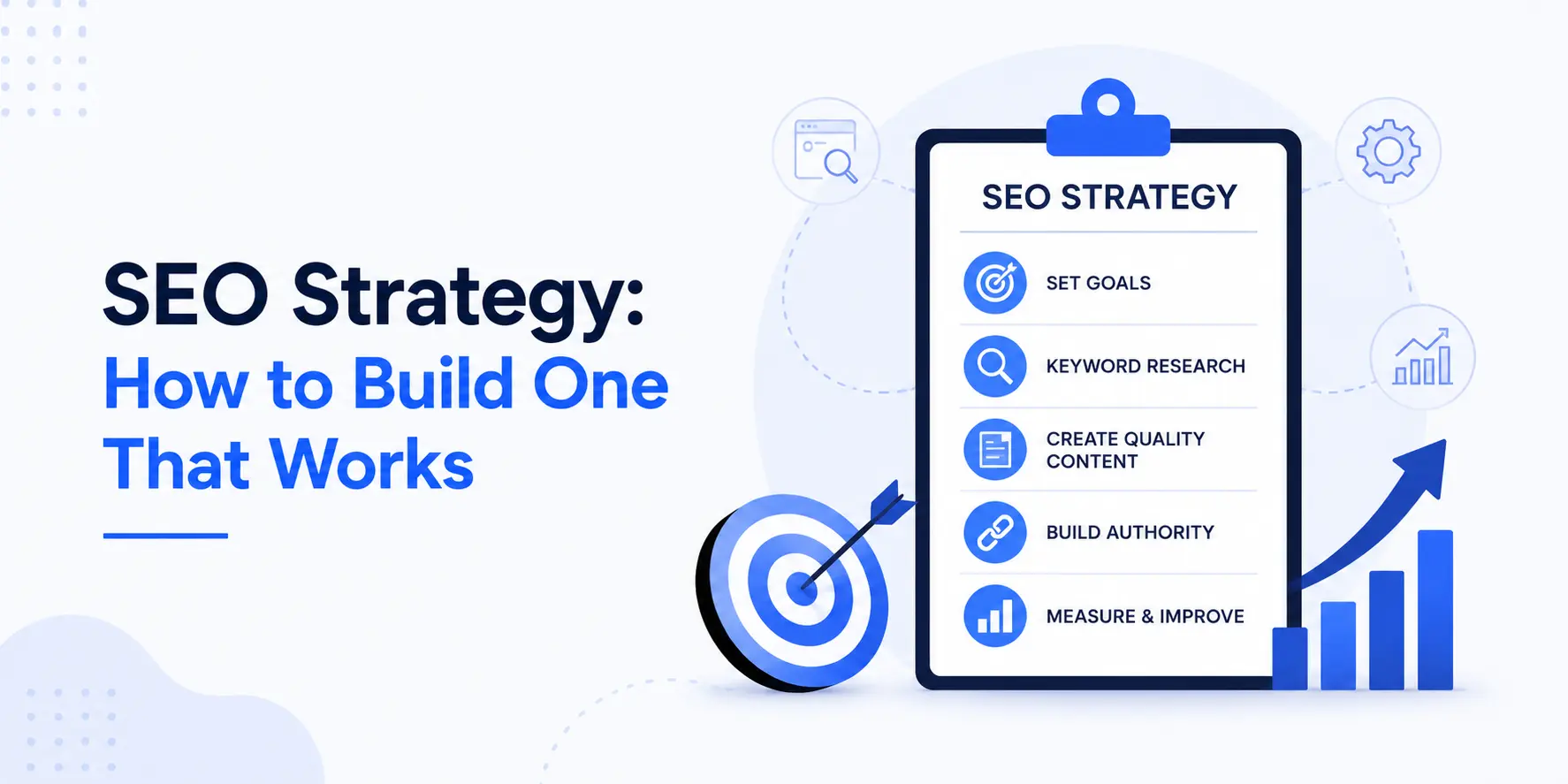
Most businesses do not fail at SEO because they lack effort. They fail because they confuse activity with strategy. A few blog posts, a keyword list, and some technical cleanup might look productive, but they do not create a system that compounds.
At A1 Technovation, we build SEO strategies that connect rankings to revenue, topical authority to conversions, and traditional search visibility to AI citation visibility. This is the framework we use when we want search to become a durable growth channel instead of an unpredictable experiment.
An SEO strategy is a coordinated system that connects business goals, search intent, technical SEO, content, links, and AI citation readiness so your site ranks on Google and gets found in answer engines.
What an SEO Strategy Actually Is
An SEO strategy is a long-term operating plan for how your website will earn visibility, traffic, trust, and leads from search. It tells you which topics to own, which pages to build, what technical barriers to remove, and how to measure real business movement from that work.
A tactic is a single task. Strategy is the sequencing logic behind the tasks. Without strategy, teams publish content that does not match intent, build links to weak pages, and fix technical issues that never impact revenue.
The Three Layers That Must Work Together
The 3-Layer Search Visibility Model
- Google layer: relevance, authority, crawlability, page experience, and internal linking.
- User layer: intent, objections, trust, and conversion friction.
- AI layer: entity clarity, direct-answer formatting, structured data, and citation-worthy passages.
Modern SEO requires all three. Ranking without conversion leaves money on the table. Strong content without AI-ready structure loses visibility on new answer surfaces.
Step 1: Define SEO Goals Around Business Outcomes
Do not start with rankings. Start with what organic search needs to produce for the business. A goal like "rank number one for SEO strategy" is weak because it does not define why that ranking matters. A goal like "generate 40 qualified organic leads per month within 12 months" creates accountability.
| SEO Metric | Business Meaning |
|---|---|
| Organic sessions by landing page | How much qualified audience each page is attracting |
| Keyword movement | Share of demand captured in your market |
| Organic CTR | How efficiently impressions turn into visits |
| Organic conversions | Revenue and lead impact from SEO investment |
| AI citations | Brand authority in answer engines |
Before keyword research, answer three questions: where search enters your funnel, what organic traffic currently converts into, and what 90-day, 6-month, and 12-month outcomes would justify the investment.
SEO Funnel Mapping
Step 2: Research Keywords as Topic Systems
Keyword research is not list building. It is topic architecture. We organize keywords into clusters so Google and AI systems can see that the site covers a subject comprehensively instead of randomly.
Use Three Term Types on Every Important Page
- Primary keyword: the main query the page exists to win.
- Secondary keywords: closely related questions or variations with the same intent.
- Entity terms: tools, concepts, brands, frameworks, and standards naturally tied to the topic.
A page about SEO strategy should naturally mention concepts like Google Search Console, Core Web Vitals, structured data, topical authority, AI Overviews, and internal linking. Their absence usually signals shallow coverage.
Map Search Intent Before Writing
- Informational: the user wants to learn.
- Commercial investigation: the user is comparing options.
- Transactional: the user is ready to act.
- Navigational: the user wants a specific brand or page.
The format of the page must match the intent. Service pages do not win informational queries well, and soft educational articles rarely convert on transactional queries.
Step 3: Fix the Technical Foundation First

Content and backlinks amplify what already exists. If the site is hard to crawl, slow to load, or structurally confusing, those investments underperform.
Technical priorities that matter most
- Core Web Vitals: improve LCP, CLS, and INP on important pages.
- Indexation: confirm important URLs can be found, crawled, and indexed.
- Architecture: keep valuable pages within a shallow click depth and connected through internal links.
- Schema: implement Article, FAQPage, BreadcrumbList, Organization, and other relevant types.
Technical SEO is not a one-time checklist. It needs regular review because plugins, code changes, templates, and tracking scripts continuously affect performance and crawlability.
Step 4: Create Content That Can Rank and Be Cited
Helpful content is no longer optional. Content needs to satisfy intent, demonstrate real expertise, and structure its ideas so both people and machines can extract value fast.
Apply EEAT deliberately
- Experience: use real observations, practical constraints, timelines, and examples.
- Expertise: explain nuances competitors skip and use precise terminology naturally.
- Authoritativeness: connect content to a real author, real brand, and relevant reputation signals.
- Trustworthiness: make claims that can be supported and keep business information consistent.
On-page checklist we use before publishing
- Primary keyword in the title, H1, first paragraph, meta description, and slug.
- H2 and H3 headings aligned with user sub-questions.
- 3 to 5 internal links with descriptive anchor text.
- One FAQ section supporting FAQPage schema.
- Images with specific alt text that supports the topic context.
Step 5: Build Authority With Links and Brand Signals
Backlinks still matter, but relevance matters more than raw volume. A link from a respected topically related source usually beats many links from generic or low-trust sites.
- Content-led link acquisition: publish resources others genuinely need to reference.
- Digital PR: contribute expert commentary, named insights, and useful data to publications.
- Strategic partnerships: collaborate with adjacent businesses that serve the same audience.
Brand mentions also matter more in 2026 because AI systems build confidence from cross-web signals, not only traditional backlink graphs.
Step 6: Add AEO and GEO Layers
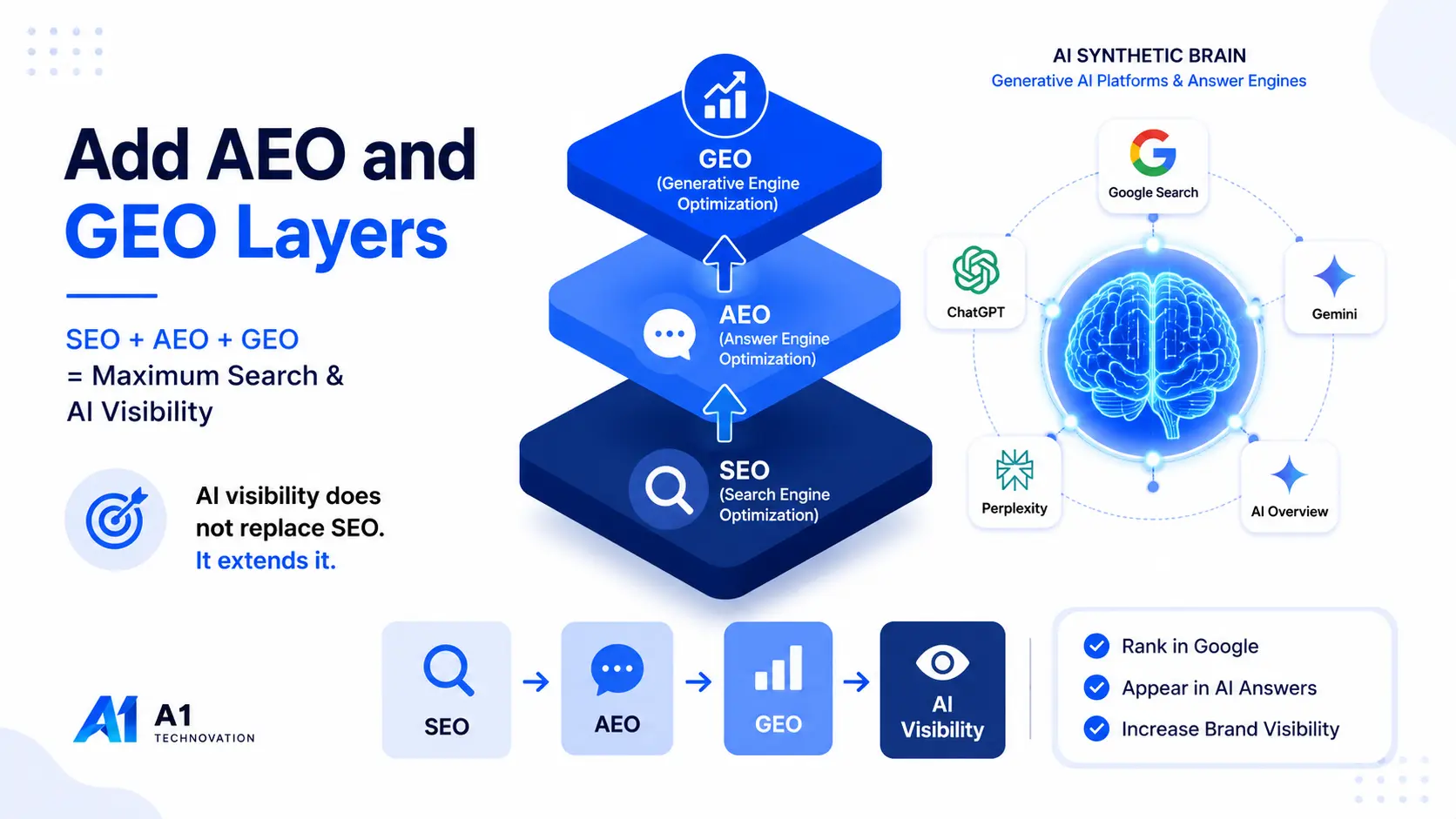
AI visibility does not replace SEO. It extends it. The same strong page can rank in Google and become a source for AI-generated answers if it is structured clearly enough.
AEO essentials
- Lead major sections with a direct answer, definition, or conclusion.
- Use FAQ blocks and validate FAQPage schema.
- Make paragraphs short and self-contained for passage extraction.
- Use tables and numbered processes where they improve clarity.
GEO essentials
- Build topic depth, not just one strong article.
- Keep brand entity data consistent across trusted external sources.
- Earn mentions from publications, directories, and communities AI systems commonly reference.
- Write quotable, specific sentences instead of generic statements.
Step 7: Measure, Iterate, and Compound
A strategy is only real if it has a feedback loop. We review rankings, traffic, conversions, technical health, backlinks, and AI visibility together because each one explains the others.
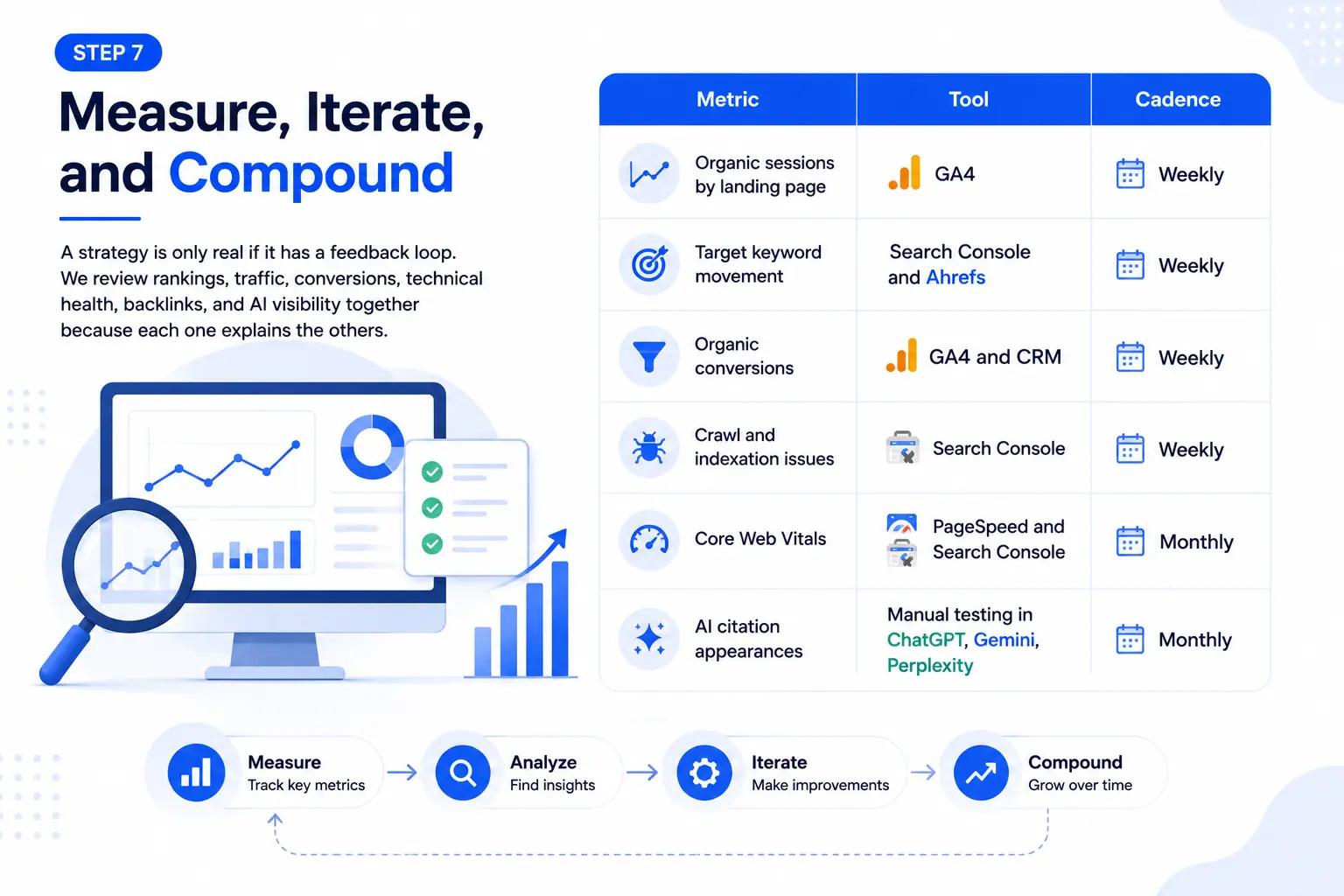
| Metric | Tool | Cadence |
|---|---|---|
| Organic sessions by landing page | GA4 | Weekly |
| Target keyword movement | Search Console and Ahrefs | Weekly |
| Organic conversions | GA4 and CRM | Weekly |
| Crawl and indexation issues | Search Console | Weekly |
| Core Web Vitals | PageSpeed and Search Console | Monthly |
| AI citation appearances | Manual testing in ChatGPT, Gemini, Perplexity | Monthly |
The Monthly SEO Review Loop
Refreshing existing pages is often faster than creating new ones. When rankings slip, CTR drops, or the SERP changes, a thoughtful refresh can produce faster gains than starting another article from zero.
Common SEO Strategy Mistakes
- Going after head terms too early: build depth around related long-tail clusters first.
- Mismatching intent: the wrong format kills performance before optimization can help.
- Treating technical SEO as finished work: sites drift constantly.
- Building links to weak pages: content quality should earn the authority being pointed at it.
- Ignoring AI optimization: answer surfaces are now part of search visibility.
- Measuring only traffic: qualified leads and conversions are the outcome that matters.
Frequently Asked Questions About SEO Strategy
How long does it take to see results from an SEO strategy?
Most teams see measurable ranking movement in 90 to 180 days. Compounding traffic and lead gains usually take 6 to 12 months.
Do I need a separate strategy for Google vs AI engines like ChatGPT?
No. The foundation is the same. AI visibility adds stronger answer formatting, entity clarity, structured data, and citation-focused off-page signals.
How many keywords should an SEO strategy target at once?
Focus on clusters, not raw counts. A smaller set of connected themes outperforms a long disconnected keyword list.
What is topical authority and why does it matter?
Topical authority comes from publishing connected, useful content that covers a subject deeply. It helps Google and AI systems trust your site as a source on that topic.
What is AEO?
AEO stands for Answer Engine Optimization. It improves your chances of being extracted into AI Overviews, featured snippets, and answer-driven search experiences.
Support the strategy with execution guides
These articles break the strategy into clearer foundations across organic search, on-page work, and authority development.
Build Your SEO Strategy With A1 Technovation
We build SEO systems that align rankings, conversions, topical authority, and AI citations so search becomes a reliable growth channel.
Request a Free SEO Consultation →