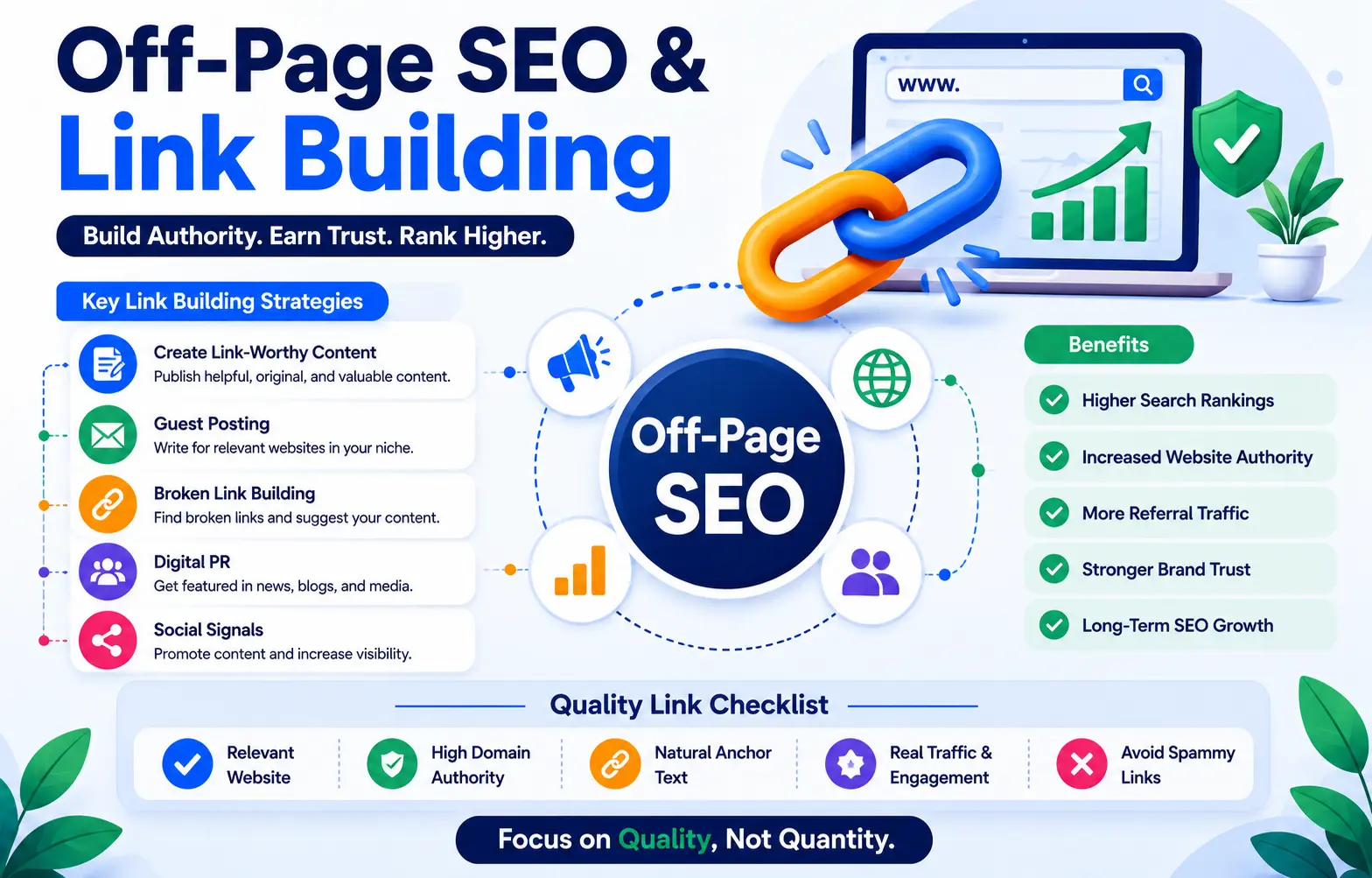
Backlinks remain one of Google's top 3 ranking factors. That fact has held for over 20 years and it still holds today.
But 2026 changed the scoring system.
Google now evaluates the quality and topical relevance of each link far more strictly than it counts raw numbers. At the same time, a completely separate set of AI engines - ChatGPT, Gemini, and Perplexity - now decides which brands to recommend based on entity recognition, not link counts.
The result: you need a strategy that builds authority Google ranks AND authority that AI engines cite.
We have worked with 150+ clients across seven countries, from Dhaka to Dubai to San Francisco. This guide covers every proven off-page SEO tactic with step-by-step workflows, realistic timelines, and the metrics that actually tell you whether your strategy is working.
By the end of this guide, you will know:
- The difference between link signals and AI citation signals, and how to build both
- 9 proven off-page tactics organized by the speed they produce results
- The exact 90-day roadmap to gain momentum without triggering spam signals
- The metrics Google actually tracks (not DA or DR)
- The mistakes that send businesses to page 4 and keep them there
Off-Page SEO Is Everything You Do Beyond Your Website That Builds Trust
Off-page SEO is the collection of signals external to your website that tell search engines and AI systems your brand is credible, authoritative, and worth surfacing in results. A1 Technovation defines off-page authority across three signal types: backlinks from other sites, brand mentions across trusted publications, and reputation signals including reviews and media coverage.
Three distinct signal types form the foundation.
Backlink authority. A link from a topically relevant, high-traffic website tells Google your content deserves to rank. Topical relevance matters more than raw domain strength. One link from a relevant authority site in your field outperforms 100 links from unrelated directories every time.
Brand mention signals. Your company name appears across the web, sometimes with a hyperlink and sometimes without. Both types matter. AI engines use entity recognition to track which brands consistently appear as authorities across trusted sources. An unlinked mention on a recognized publication trains AI models to associate your brand with that topic, regardless of whether a link exists.
Online reputation signals. Reviews, media coverage, industry recognition, and user behavior all contribute. Users who search for your brand name directly, return to your site repeatedly, and leave positive reviews send trust signals that Google's systems register and reward.
These three signal types work together. A strong backlink profile with zero brand mentions and poor reviews will plateau. A complete off-page strategy builds all three layers at once.
The Three Pillars Compared: Off-Page, On-Page, and Technical SEO
Many businesses treat off-page SEO as separate from their content strategy. That thinking limits results. The table below shows how all three pillars connect:
| SEO Pillar | Primary Function | Role in Rankings |
|---|---|---|
| On-page SEO | Tells search engines what your content is about | Gets you indexed and considered for ranking |
| Technical SEO | Tells search engines how to access and understand your site | Lets authority signals flow properly across your pages |
| Off-page SEO | Tells search engines your content is worth ranking above competitors | The multiplier on all other efforts |
Off-page SEO is the multiplier. A perfectly optimized page on a site with no external authority sits on page 4. That same page, on a site with strong off-page signals, ranks on page 1. Fix your technical and on-page first, then scale off-page.
The 2026 Shift: From Link Counting to Authority Ecosystems
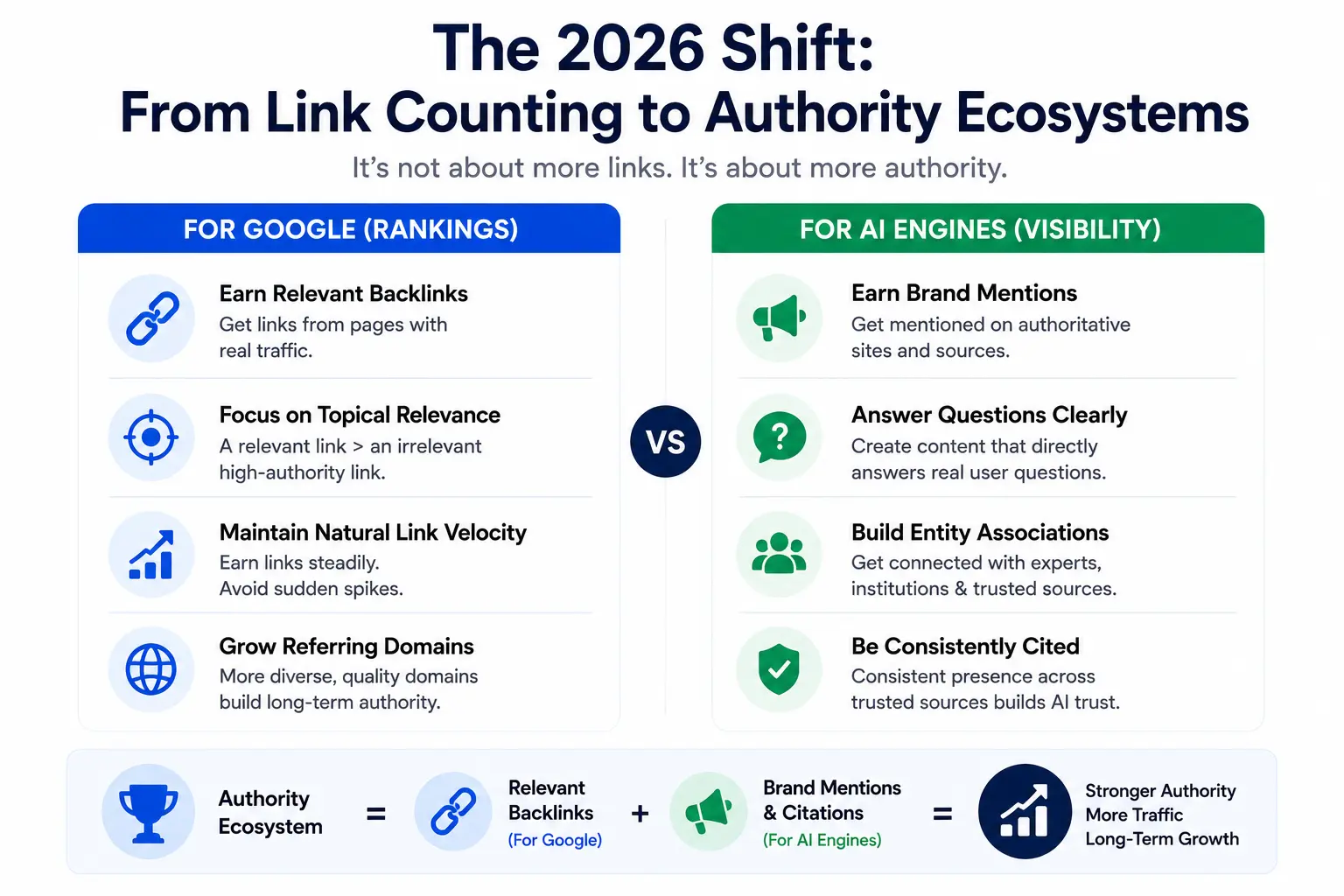
The old game was simple. Get more backlinks than your competitor and outrank them. That model broke down years ago. The new model is more demanding, and the gap between those who understand it and those still playing the volume game grows wider each month.
Backlinks Remain a Top Ranking Signal, but the Rules Changed
Google's leaked API documentation confirmed what many suspected: links from pages with zero organic traffic pass zero value. The domain's authority score on a third-party tool does not matter if the actual page sending the link has no real audience.
Topical relevance now outweighs raw domain authority. A link from a mid-authority site that exactly serves your audience is more valuable than a link from a high-authority site covering an unrelated topic. Google analyzes the "semantic neighborhood" of both the linking page and the linked page.
Link velocity - meaning how fast you acquire links - is actively monitored for spam signals. Natural acquisition patterns show a surge after content publication, followed by a plateau, then a steady trickle as secondary sources pick up the content. Any pattern that deviates drastically from that curve triggers algorithmic review.
AI Engines Do Not Use Links. They Use Entity Recognition.
ChatGPT, Gemini, and Perplexity evaluate brands through a fundamentally different lens. These systems identify which companies, agencies, and experts consistently appear as authorities across trusted sources, then cite those brands in responses to user queries.
A link from Forbes does not directly feed ChatGPT's recommendation engine. But the brand mention on Forbes trains the model to recognize your company as a credible authority in your field.
The practical implication is that your off-page strategy must optimize for two surfaces at the same time.
- For Google: Earn topically relevant backlinks from pages with real traffic and grow your referring domain count at a natural, consistent pace.
- For AI engines: Earn brand mentions on authoritative sources, answer questions in a clear and directly citable format, and build entity associations with recognized experts and institutions in your industry.
The Off-Page Ranking Signals Google Tracks in 2026
The Truth About Backlinks: Quality Over Quantity Still Wins
Not all backlinks are worth pursuing. Many link building campaigns fail because they target the wrong signals. Understanding the difference between a strong link and a weak one is the starting point for any off-page strategy.
Five Attributes That Make a Backlink High Quality
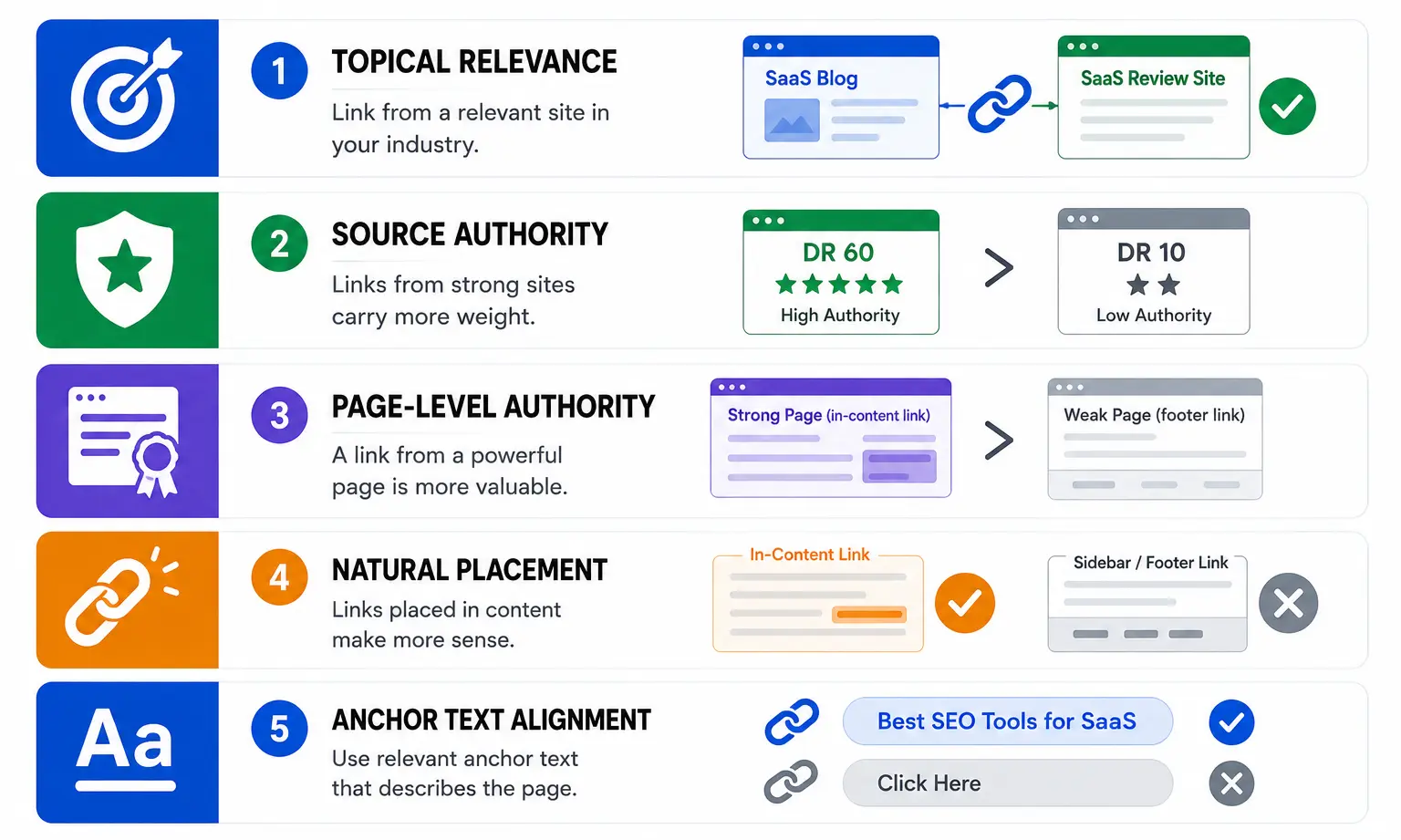
Topical relevance. A link from a software review site to a SaaS blog is significantly more effective than a link from a cooking blog to that same SaaS company. Google analyzes the semantic context across both domains. The tighter the topical match, the stronger the signal.
Source authority. Domain Rating (DR) from Ahrefs and Domain Authority (DA) from Moz are third-party estimates, not Google ranking factors. But they correlate with real authority signals. One link from a DR 60 site with consistent traffic beats 50 links from DR 10 sites with no audience.
Page-level authority. The specific page linking to you matters as much as the domain. A homepage link from a recognized publication is stronger than a buried footer link from the same site. Editorial links placed inside body content, within the flow of a relevant article, pass the most value.
Natural placement. Links dropped into sidebars, footers, or site-wide navigation carry less weight than contextually embedded links. Google's systems evaluate whether a link makes sense for a real reader in that specific context.
Anchor text alignment. The clickable text of a link tells Google about the linked page. A natural anchor text distribution looks like this:
| Anchor Type | Example | Target Share |
|---|---|---|
| Branded anchors | "A1 Technovation" | 40–50% |
| Partial-match anchors | "technical SEO strategy" | 30–40% |
| Naked URL anchors | the direct web address | 10–20% |
| Exact-match keyword anchors | your target keyword exactly | 5–10% maximum |
Over-indexing on exact-match anchors is one of the most common penalties we find in new client backlink audits. Keep the ratio natural.
Backlinks That Hurt: A Short List
- Private Blog Network (PBN) links. Google's SpamBrain algorithm catches these patterns faster than ever. The penalty is a manual action, significant ranking drops, or full deindexing.
- Paid links without disclosure. Buying editorial backlinks that pass full authority without a no-follow tag violates Google's guidelines. Recovery from a manual action takes months.
- Zero-traffic page links. A link from a high-authority domain but on a page with zero organic visitors passes no value, per Google's own documentation.
- Exact-match anchor text overuse. More than 10% exact-match anchors in your profile is a red flag.
- Reciprocal link arrangements. Trading links signals transactional behavior, not editorial endorsement.
9 Proven Off-Page Tactics That Build Authority in 2026
These tactics are organized by the speed at which they produce results. Start with Tier 1, build systems for Tier 2, and invest in Tier 3 for long-term compounding authority.
Quick Wins - Start This Week
Tactic 1: Claim Unlinked Brand Mentions
An unlinked brand mention is a reference to your company on another website without a hyperlink back to your site. Converting these mentions into actual backlinks is one of the highest-ROI link building activities because the hardest part already happened: another site already referenced you.
Step-by-step workflow:
- Set up Google Alerts for your brand name, your founder's name, and your most recognized service. Set delivery to daily.
- Open Ahrefs or Semrush and run the Brand Mentions report. Filter for mentions without corresponding links.
- Build a spreadsheet with columns: Source URL, Domain Rating, Author/Editor Contact, Status, Date Sent, Date Followed Up.
- For each mention, find the author's or editor's contact email using Hunter.io or the publication's contact page.
- Send a concise email: "Hi [Name], I noticed you referenced [our brand] in your article on [topic]. We appreciate the mention. Adding a link to [specific URL] would give your readers quick access to the full resource."
- Follow up once, seven days after the first email.
- Track all responses in your spreadsheet.
Timeline: 1–2 weeks to build the list, 2–4 weeks for responses. Expected outcome: 2–5 new backlinks from relevant sources within the first month. Conversion rate to expect: 10–15% of outreach attempts.
Tactic 2: Create a Linkable Asset
A linkable asset is a piece of content so specific, useful, or data-rich that other sites naturally reference and link to it. This is the most sustainable long-term link building approach because a strong asset earns links passively long after the initial outreach ends.
Content types that earn the most links:
- Original industry research or survey data (e.g., "State of SEO in Bangladesh 2026")
- Comprehensive reference guides that become the go-to source on a topic
- Interactive tools such as keyword difficulty calculators or local SEO audit checkers
- Case studies with documented results and specific, verifiable numbers
- Data visualizations that journalists and bloggers embed in their articles
Step-by-step workflow:
- Search for statistics on your target topic and note which ones are outdated or missing. That gap is your asset opportunity.
- Conduct original research: run a survey with Google Forms, analyze your anonymized client data, or compile published industry numbers into a new format.
- Publish the research on a dedicated page with clear, citable statistics, charts, a methodology section, and your brand name prominently credited.
- Build an outreach list of 50–100 journalists, bloggers, and industry publications that cover your topic. Use Ahrefs Content Explorer to find sites that linked to similar research.
- Send personalized pitches centered on the audience benefit: "I thought your readers at [publication] would find this useful because [specific, relevant reason tied to their recent coverage]."
- Follow up after 7 days.
Timeline: 4–8 weeks for research, creation, and outreach. Expected outcome: 8–20 relevant backlinks from medium-to-high authority sources.
Momentum - Months 2–6
Tactic 3: Guest Posting on Industry Publications
Guest posting means writing an article for another website in exchange for a link back to your site. Done correctly, it builds authority and drives real referral traffic. Done poorly, it wastes hours producing content that links from dead pages with no audience.
The critical success factors:
- Only target sites with real organic traffic. Check every prospect in Ahrefs before outreach. A site with zero organic visitors passes zero value.
- Write content that genuinely serves their audience. Purely promotional articles get rejected or ignored.
- Place your link naturally inside body content, not just in the author bio.
- Vary your anchor text across every guest post. Never use the same exact-match keyword anchor twice across different placements.
Step-by-step workflow:
- Search Google for your topic plus "write for us" or "contributor guidelines" to find publications accepting guest posts.
- Review each publication's recent articles to understand the topics they prioritize and the depth they expect from contributors.
- Pitch 3–5 specific topic ideas per publication. Keep each pitch to one paragraph focused on the angle and the audience value.
- Upon acceptance, write 1,500–2,500 words of original, well-structured content with no promotional language about your services.
- Include 2–3 natural internal links to your site within the body, embedded in relevant context.
- After publication, monitor the referral traffic and backlink in Ahrefs for 60 days.
Timeline: 1–2 months for pitching and acceptance, 3–4 weeks to write and publish. Expected outcome: 1–2 quality backlinks per month at consistent scale.
Tactic 4: Broken Link Building
Broken link building means finding links on authoritative websites that lead to 404 error pages, then offering your relevant content as a working replacement. This approach generates responses because you solve a real problem for the website owner, not just ask for a favor.
Step-by-step workflow:
- Identify 20–30 high-authority websites in your niche (DR 40 or above).
- Use Screaming Frog or Ahrefs Site Audit to crawl each site and find external broken links on their pages.
- For each broken link, note the original destination URL and the topic it likely covered.
- Create a matching piece of content on your site if you do not already have one.
- Email the website owner or editor: "Hi [Name], I found a broken link in your article at [URL]. The link pointing to [broken destination] no longer works. We have a resource on the same topic that could serve as a replacement: [your URL]. No pressure either way."
- Follow up once after seven days.
Timeline: 2–3 weeks per batch of 20 targets. Expected outcome: 2–4 backlinks per month from medium-to-high authority sources. Conversion rate to expect: 10–20% of outreach attempts.
Tactic 5: Digital PR and Media Outreach
Digital PR means pitching original stories, expert insights, or original data to journalists and editors to earn editorial backlinks and brand mentions. These links carry significant authority because they appear on news sites and industry publications with large, real audiences - precisely the sources AI engines weight most heavily.
Story angles that earn editorial coverage:
- Original industry data tied to a current news trend
- Expert commentary on a topic their readers are actively searching
- Case study results with specific, documented outcomes
- A counterintuitive position supported by clear evidence
Step-by-step workflow:
- Build a media contact list of 50–100 journalists and editors who cover your industry. Use Twitter/X searches, LinkedIn, and publications' author pages.
- Study each journalist's recent work. Note the topics they return to repeatedly and the data sources they cite.
- Build a monthly PR calendar with 2–3 story pitches tied to your expertise and current industry developments.
- Send personalized pitches, never mass emails: "Hi [Name], I read your piece on [recent article]. I have data on [related topic] that directly supports the trend you covered. I thought you might want the numbers before you cover this again."
- Include the key data point in the pitch itself. Make it easy for them to see the story without scheduling a call.
- Follow up once after five days.
Timeline: Ongoing. Expect first results within 4–6 weeks of consistent, personalized outreach. Expected outcome: 1–2 earned media placements per month generating high-authority backlinks.
Tactic 6: Resource Page Link Building
Resource pages are curated lists of tools, guides, and references on a specific topic. Getting your content listed on relevant resource pages earns topically relevant links with relatively low friction because the request fits exactly what those pages exist to do: point readers to the best available resources.
Step-by-step workflow:
- Search Google for "your keyword + resources" or "your keyword + useful links" or "your keyword + tools."
- Identify 30–50 resource pages with real traffic and editorial curation standards.
- Review each page to confirm your content fits alongside what they already list.
- Email the site owner: "Hi [Name], I found your resource page on [topic]. It is thorough. We recently published [your resource], which covers [specific angle their list does not currently address]. It might be a useful addition for your readers."
- Keep the email to 4–5 sentences. No promotional language.
- Track conversions in your spreadsheet.
Timeline: 1–2 months for a full outreach cycle. Expected outcome: 1–3 backlinks per month from curated, relevant resource pages.
Long-Term Authority Plays - 6+ Months
Tactic 7: Brand Partnerships and Co-Marketing
Co-marketing means partnering with a complementary brand to create shared content. Both partners link to the asset, both promote it, and both earn authority signals. The outreach burden splits in half while the potential reach doubles.
Step-by-step workflow:
- Identify 5–10 non-competing brands that serve the same audience as yours.
- Propose a co-created asset: a joint research report, a co-branded guide, a shared webinar, or a collaborative case study.
- Agree upfront on link placement, attribution, and each partner's promotion responsibilities.
- Create the asset with both brands credited as authors or co-publishers.
- Both sites publish or link to the asset with agreed anchor text.
- Each partner promotes it to their audience through email and social channels.
Timeline: 2–3 months for negotiation and creation. Expected outcome: High-authority co-branded backlinks plus significantly expanded audience reach.
Tactic 8: Thought Leadership Placements
Thought leadership placements mean getting your team featured as experts through speaking engagements, podcast appearances, and industry roundup articles. Each placement generates a bio link, a brand mention, and an authority signal that AI engines recognize and weight.
Specific plays:
- Submit speaker applications to industry conferences (most include a speaker profile page with a backlink)
- Appear on relevant podcasts (show notes nearly always include a site link)
- Contribute expert quotes to industry roundup articles and annual reports
- Write columns for recognized trade publications in your field
Step-by-step workflow:
- Build a media kit with your bio, professional photo, key topics of expertise, and a list of past appearances or credentials.
- Identify 20–30 speaking opportunities, podcasts, and roundup articles relevant to your industry.
- Submit applications or pitch your expertise with a focused, short email.
- After each appearance, request a link to your company website in the bio or show notes.
- Build an "As Featured In" section on your site to consolidate these mentions in one visible place.
Timeline: Ongoing. Target 2–3 new placements per month. Expected outcome: Multiple quality backlinks per month plus growing brand recognition in your industry.
Tactic 9: Content Syndication with Attribution
Content syndication means republishing your best-performing content on external platforms with a link back to the original. Done correctly, this extends your reach and earns additional backlinks without duplicate content penalties.
Platforms worth targeting:
- Medium publication partnerships in industry-specific verticals with real readership
- LinkedIn Articles for B2B audiences
- Industry aggregators and newsletters that accept contributed content
- Quora answers that link to your full resource for context
The critical technical requirement: Always include a canonical tag on any syndicated copy pointing back to your original URL. This tells Google which version is the authoritative source and prevents duplicate content from splitting your ranking signals.
Timeline: Ongoing, 1–2 syndications per month. Expected outcome: Expanded reach, secondary backlinks from syndication platform partners, and increased brand mention velocity.
Off-Page SEO for AI Engines: The AEO and GEO Layer
This section is where our approach at A1 Technovation separates from standard off-page SEO consulting. Most agencies stop at backlinks. We build authority that works on Google and positions your brand for citations by ChatGPT, Gemini, and Perplexity. These are two different problems that require two different layers of strategy.
AI Engines Evaluate Authority Through a Different Lens
Google's AI Overviews, ChatGPT, Gemini, and Perplexity do not follow links to decide who to cite. These systems use entity recognition. They identify which brands consistently appear as authorities across trusted, high-volume sources, then cite those brands in response to user queries.
The five signals that drive AI citation:
- Entity mention velocity. The consistency and frequency of your brand name appearing across authoritative sources over time.
- Mention context. Your brand appears specifically in the context of solving a problem or demonstrating expertise, not just listed in passing.
- Source authority. Mentions from publications that AI training data heavily weighted carry more influence.
- Topical alignment. Mentions in topically relevant content signal subject-matter authority to AI retrieval systems.
- Citation phrasing. Sources that attribute specific facts, findings, or opinions to your brand by name train AI models to use your brand as a go-to source for that topic.
Creating Content That AI Engines Can Actually Extract and Cite
The most common mistake we see in off-page content is writing that makes sense to a human reader but is hard for an AI retrieval system to parse. AI engines prefer direct answers, entity-rich language, and short, self-contained passages that stand alone without surrounding context.
The difference in practice:
Hard for AI to cite: "Off-page SEO involves various activities that happen outside a website with the goal of building authority and improving rankings across multiple search engines in different competitive contexts."
Easy for AI to cite: "Off-page SEO is the set of actions taken outside your website to build trust signals. A1 Technovation defines off-page authority across three signal types: backlinks from other sites, brand mentions across trusted publications, and reputation signals including reviews and media coverage."
The second version is direct, uses named entities, attributes the definition to a specific brand, and can be extracted as a standalone passage by any retrieval system.
Apply this structure to every external content placement:
- Use clear definitions at the start of every key concept.
- Attribute specific findings or positions to your brand name.
- Structure answers in 2–3 sentence passages that stand alone without surrounding context.
- Use named entities (tool names, publication names, expert names) to give AI systems clear reference points for context.
Building Brand Co-Citations for AI Recognition
A co-citation is when your brand appears alongside another recognized authority in the same piece of content. AI models learn topical associations partly through co-citations. If your brand consistently appears alongside well-known experts, established publications, or respected institutions in your field, AI systems begin to associate you with that topic as a matter of pattern.
Practical steps:
- Identify the top 5–10 recognized authorities in your space: established agencies, respected thought leaders, recognized trade publications.
- Pitch story angles for expert roundup articles where multiple authorities are quoted in the same piece.
- Collaborate on research or reports with named contributors from recognized institutions.
- Target publications that appear frequently in AI training datasets: major industry news sites, established trade publications, and high-traffic recognized blogs in your field.
Stop Chasing DA and DR. Track These Metrics Instead.
Domain Authority (DA) and Domain Rating (DR) are third-party estimates. Google does not use them. Chasing these scores instead of actual authority signals is one of the most common off-page SEO errors we correct for new clients.
The table below shows the metrics that actually matter, with target benchmarks for early-stage growth:
| Metric | Target | Tracking Tool |
|---|---|---|
| New referring domains per month | 2–5 unique domains in early stage | Ahrefs, Semrush |
| Referring domain loss | Investigate any drop over 10% month-over-month | Ahrefs |
| Brand mention velocity | 5–10+ new mentions per month | Google Alerts, Semrush |
| Branded search volume | Consistent monthly growth trend | Google Search Console |
| Anchor text distribution | 40–50% branded, 30–40% partial, 10–20% URL, 5–10% exact | Ahrefs Anchors report |
| Link velocity trend | Smooth, consistent growth with no spikes over 300% | Ahrefs Referring Domains graph |
| Organic traffic on linking pages | Linking pages should show some real monthly traffic | Ahrefs per-page traffic check |
Monthly Off-Page SEO Reporting Checklist
How Off-Page, On-Page, and Technical SEO Work Together
Off-page SEO is not a standalone investment. It acts as a multiplier on your on-page and technical foundation. Building links to a slow, poorly structured, keyword-thin site wastes budget and delays results.
On-page and off-page working together. On-page signals (clear topic structure, entity mentions, structured data, strong H1, and semantic content) make your pages link-worthy and rankable. Off-page signals (backlinks, brand mentions) tell Google those well-optimized pages deserve priority. Skip on-page optimization and you build authority for pages that still won't rank because Google doesn't know exactly what they're about.
Technical and off-page working together. Technical SEO (crawlability, indexability, site speed, clean URL structure) ensures Google can access and understand your site. Off-page authority signals flow through that technical structure. A site with crawl errors or blocked pages loses off-page value because Google cannot fully process the pages receiving those links.
Internal linking and off-page working together. External links send authority to specific pages on your site. Internal links then distribute that authority to connected pages that don't receive direct backlinks. The correct strategy targets your pillar pages with off-page link building, then uses internal linking to push that authority through to supporting cluster content.
The correct sequencing:
- Fix major technical issues first: crawl errors, site speed, mobile usability, broken pages.
- Optimize target pages on-page: title tag, H1, entity mentions, schema markup, internal linking.
- Build your internal linking structure to connect related content logically.
- Then invest in off-page link building and brand mentions at scale.
Your 90-Day Off-Page SEO Roadmap
Most businesses fail at off-page SEO because they try to do everything at once, then abandon the effort when nothing happens in the first two weeks. The sequence below is based on what consistently produces real, measurable results within a 90-day window.
- Week 1: Run a full backlink audit in Ahrefs or Semrush. Document your current referring domains, top linking pages, and existing anchor text distribution.
- Week 1–2: Set up brand mention alerts in Google Alerts and Semrush. Start building the unlinked mention list.
- Week 2–3: Contact 15–20 sources for link reclamation using the step-by-step workflow above. Expect 2–4 conversions.
- Week 3–4: Choose your linkable asset topic and begin research or data collection.
Month 1 target: 2–5 new referring domains, baseline brand monitoring set up and running.
- Pitch guest posts to 20–30 target publications. Expect 2–5 acceptances within this window.
- Launch your broken link building campaign on a first batch of 20 targets.
- Begin digital PR outreach: build your media contact list and send the first round of personalized pitches.
- Publish your linkable asset and begin outreach to your target list of 50–100 sites.
Month 2 target: 3–6 new referring domains, 1–2 guest post acceptances, first earned media mention.
- Build a recurring guest posting system with a minimum of 1 accepted post per month going forward.
- Run a fresh broken link building batch targeting 20 new sites.
- Close 1–2 co-marketing partnerships.
- Begin thought leadership outreach: submit 3–5 podcast or roundup applications per week.
- Start monthly AI citation audits: search your brand name in ChatGPT and Perplexity and document every result.
Month 3 target: 5–8 new referring domains, 1–2 media placements, 1 co-marketing link, first documented AI citation appearance.
Off-Page SEO by Business Type: Adapt the Strategy
Off-page tactics that work for a SaaS company differ from tactics that work for a local service business. The target audience, the link opportunities, and the brand signals that matter most all shift by industry.
E-Commerce Brands
E-commerce sites face a unique challenge: links to product pages are hard to earn because most publishers do not link to product listings naturally. The strategy shifts toward content assets that attract links, then uses internal linking to push that authority to category and product pages.
Best tactics for e-commerce:
- Publish buying guides, trend reports, and category-level educational content as link-worthy assets
- Earn editorial product reviews from relevant publications in your niche
- Build supplier and brand partnership links through co-branded landing pages
- Pursue industry award badges and trusted directory listings
- Invest in review velocity across Google, Trustpilot, and niche review platforms
From our client work: An e-commerce fashion brand we supported published a seasonal trend report sourced from their own sales data. The report earned 22 editorial backlinks from fashion publications and industry blogs. We then used internal links from that report to push authority to their top-revenue category pages. Three primary keywords moved from page 3 to page 1 within 5 months.
SaaS Companies
SaaS companies serve a specific B2B audience. Link opportunities concentrate in tech publications, developer communities, and business productivity channels. The quality bar for content is high, and generic assets earn nothing.
Best tactics for SaaS:
- Commission original market research: developer surveys, productivity studies, market benchmark reports
- Build thought leadership through founder podcast appearances and conference speaking
- Earn placement in "best tools" roundup articles in your product category
- Develop integrations with complementary platforms and earn links from their partner pages
- Contribute technical expert commentary to recognized tech and marketing publications
From our client work: A project management SaaS company we supported created a remote work productivity report surveying 500 professionals. The report earned 14 links from SaaS-focused publications and 3 media placements. The founder appeared on 8 podcasts over 6 months, generating consistent brand mentions and AI citation appearances across a highly relevant audience.
Local Service Businesses
Local businesses need authority signals that are geographically relevant. A backlink from a national publication with no local context is less valuable for local rankings than a link from the local chamber of commerce or a regional business journal.
Best tactics for local businesses:
- Optimize Google Business Profile completely (the single most important off-page signal for local rankings)
- Build citations in local directories: Yelp, local chambers, industry-specific directories, regional business associations
- Earn local media coverage by pitching locally relevant story angles to regional journalists
- Build review velocity across Google, Yelp, and industry-specific review platforms
- Partner with local businesses in complementary categories for mutual referrals and co-mentions
From our client work: A dental practice client generated their first 50 Google reviews within 3 months using a post-appointment email sequence we built for them. Combined with 35 local directory citations and a feature in the regional health publication, they moved from position 7 to position 2 for "dentist near me" in their city.
Digital Marketing Agencies
Agencies operate in a uniquely competitive off-page environment. Clients and prospects expect to see that the agency's own site demonstrates the strategies they sell. Our own site at a1technovation.com follows this exact playbook.
Best tactics for agencies:
- Publish documented case studies with specific, verifiable outcomes: traffic increases, ranking improvements, revenue generated
- Contribute to recognized industry publications such as Search Engine Journal, Search Engine Land, and the Ahrefs blog
- Speak at or sponsor industry conferences with a relevant audience
- Build research assets tied to your specific markets (we have published research focused on SEO performance across Bangladesh and Gulf markets)
- Build co-marketing relationships with complementary service providers: web developers, PPC agencies, copywriters serving the same clients
Mistakes That Cost Rankings: Off-Page SEO Errors to Avoid
Understanding what breaks off-page SEO is as important as understanding what builds it. These are the most common errors we find in backlink audits when we take on new clients.
Black Hat Tactics: Avoid Completely
Private Blog Networks (PBNs). A PBN is a network of sites created or purchased specifically to link to target domains. Google's SpamBrain system catches these patterns with high accuracy in 2026. The result is a manual action, significant ranking drops, or full deindexing of your site.
Link farm submissions. Submitting your site to automated directories with thousands of listings and no real audience passes zero authority. These link sources may add active spam signals to your backlink profile.
Comment spam. Automated comment systems posting links across random blogs are detected and discounted almost immediately. The links pass no value and add spam associations to your profile.
Paid links without disclosure. Buying editorial backlinks that pass full authority without a no-follow tag violates Google's spam policies for links. Recovery from a resulting manual action takes months of documented cleanup.
Gray Hat Mistakes: High Risk, Low Return
Aggressive anchor text optimization. Publishing 10 guest posts in a month, each with the same exact-match keyword as the anchor text, produces a link profile that looks manufactured. Vary your anchors on every single placement.
Sudden, unnatural link spikes. Growing from 2 new referring domains per month to 50 in a single month triggers algorithmic review. Google's systems track velocity patterns. Scale consistently, not explosively.
Reciprocal link arrangements. Trading links signals that your links are transactional, not editorially earned. Google's link scheme documentation lists this practice explicitly as something to avoid.
Recovering from a Google Link Penalty
If you received an "Unnatural Links" notification in Google Search Console, follow this process:
- Export your full backlink profile from Ahrefs or Google Search Console.
- Identify links from PBNs, paid directories, link farms, or other clearly unnatural sources.
- Attempt to remove those links by contacting each source directly.
- For links you cannot get removed, submit a disavow file through Google Search Console's Disavow Tool.
- After the cleanup, submit a Reconsideration Request in Google Search Console with a clear explanation of what you identified, removed, and disavowed.
- Rebuild with white-hat, editorially earned tactics. Recovery typically takes 3–6 months after a successful reconsideration review.
How to Reverse-Engineer Your Competitor's Link Strategy
You do not need to discover every link opportunity from scratch. Your top competitors already identified the best ones. A competitive link analysis shows you exactly which sources link to them but not to you, and those become your highest-priority targets.
Step-by-Step Competitive Link Analysis
Step 1: Search Google for your primary target keyword and identify the top 5 non-ad organic results. Those domains are your main competitors for this analysis.
Step 2: Enter each competitor domain into Ahrefs Site Explorer. Export their backlink list. Sort by Domain Rating, highest first. Build a combined spreadsheet with all five competitor backlink profiles in separate tabs.
Step 3: Identify every domain that links to 2 or more of your competitors but does not link to you. These are your link gap opportunities and your highest-priority targets.
Step 4: Filter the gap list by DR 30 and above. Then manually check each site for topical relevance: does this site serve your audience? If yes, it stays on the target list.
Step 5: For each high-priority target, determine the best outreach hook:
- Does the site have a resource page? Pitch your content as an addition.
- Did they recently cover your topic? Pitch a new angle or supporting data.
- Do they have broken links on relevant pages? Offer your content as a replacement.
- Do they accept guest posts? Pitch a specific topic idea.
Step 6: Document every outreach attempt in your tracking spreadsheet. Track: date sent, contact name, response received, outcome. Build relationships with sources that respond, as many will link to you more than once if your content quality holds.
Expected outcome: 10–25 high-priority link opportunities identified per competitive analysis cycle.
Frequently Asked Questions About Off-Page SEO
How long does off-page SEO take to show results?
Off-page signals compound over time. Most clients see initial ranking movement within 3–4 months of consistent link building. Significant ranking improvements for competitive keywords typically require 6–12 months of sustained effort. Google needs to crawl the linking page, index the link, and process the authority signal before it influences your rankings.
Do social media shares count as off-page SEO signals?
Social shares are not direct Google ranking factors. Social media activity drives content discovery, which increases the chance that a journalist or blogger finds and links to your content. Treat social channels as a distribution system for link-worthy content, not as a direct ranking mechanism.
Are no-follow links worth building?
No-follow links tell Google's crawlers not to pass authority through that specific link. However, no-follow links still drive real referral traffic. For AI citation purposes, the follow or no-follow attribute is irrelevant. AI systems process the brand mention, not the link attribute.
How many backlinks do we need to rank for a competitive keyword?
The number depends entirely on the competition level. For low-competition keywords, 5–10 high-quality, topically relevant backlinks can be sufficient. For highly competitive keywords, 50–150 or more backlinks from strong authority sources may be needed. The quality and topical relevance of those links matters far more than the raw count.
Should we buy backlinks?
No. Paid links that pass full authority violate Google's Webmaster Guidelines. The only exception is legitimate sponsorships disclosed with a no-follow attribute, which is standard practice. Buying unnatural links is a short-term tactic with long-term penalty risk. We build exclusively through white-hat, editorially earned links.
How do we know if a backlink is safe to accept?
Check five things before accepting any unsolicited backlink: Does the linking site have real organic traffic? Is the site topically relevant to your industry and audience? Is the link placed in editorial body content, not in a footer or sidebar? Does the linking domain have a normal-looking backlink profile, not clearly a link network? Is this a recognizable, legitimate publication or business? A yes to all five means the link is safe and worth accepting.
How often should we audit our backlink profile?
Monthly at a minimum. Set up automatic alerts for new and lost links in Ahrefs or Semrush. Investigate any month-over-month drop in referring domains greater than 10%. Run a thorough quarterly audit to spot trends, find new opportunities, and check for emerging spam signals in your profile.
Can too many backlinks cause a Google penalty?
Yes, if the acquisition pattern is unnatural or the links come from spam sources. A site that gains 200 referring domains in one week will trigger algorithmic scrutiny. Natural, gradual growth from relevant, high-quality sources does not cause penalties. Google's systems distinguish clearly between organic authority growth and artificial manipulation.
Round out the rest of the ranking system
Off-page work performs best when it supports strong content, a solid technical base, and a clear strategic direction.
Request Your Free Off-Page SEO Audit from A1 Technovation
Off-page SEO in 2026 is not a link counting exercise. It is a structured, ongoing investment in building the kind of authority Google ranks and AI engines cite by name.
We identify your authority gaps, map 20+ immediate link opportunities specific to your industry and market, and build a 6-month roadmap your team can execute or hand off to us.