
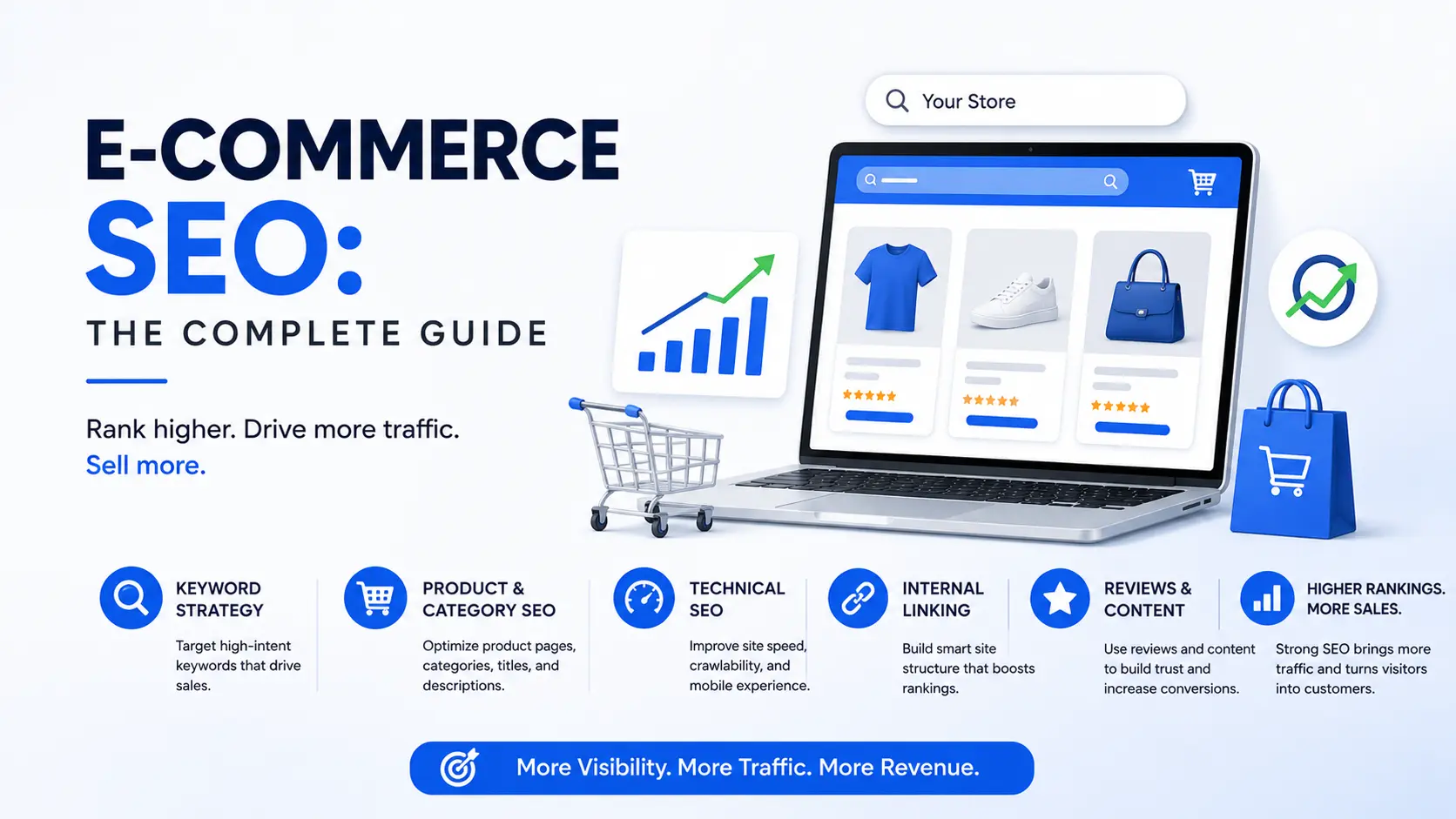
Organic search drives 37.5% of all online purchases. This guide explains how to structure an online store so category pages, product pages, technical foundations, and AI-search signals all work together to grow revenue.
Organic search drives 37.5% of all online purchases. That single number explains everything about why e-commerce SEO matters more than any other marketing channel for online stores. E-commerce SEO is the practice of optimizing your store's pages, structure, and content so your products and categories appear when buyers search for them on Google, and increasingly, in AI-powered search tools like ChatGPT, Gemini, and Perplexity.
This guide covers everything: site architecture, keyword research, category and product page optimization, technical SEO, faceted navigation, Core Web Vitals, content strategy, link building, schema markup, and the AEO and GEO strategies that put your brand in front of AI-generated answers. No filler. No shortcuts. Just the framework we use at A1 Technovation with e-commerce clients across the US, UAE, and the Gulf.
Use the section headers to jump to exactly what you need.
1. E-commerce SEO vs. Standard SEO: The Core Differences
E-commerce SEO is not a variation of standard SEO. It is a different discipline with different technical challenges, different page types, and different success metrics. Treating them as the same thing is one of the most common reasons online stores fail to rank.
The Unique SEO Challenges of Online Stores
Standard websites might have 20 to 200 pages. A mid-sized e-commerce store can have 20,000 to 200,000 URLs, and a large one can reach into the millions once you factor in product variants, filter combinations, pagination, and sort order parameters.
Three structural problems follow from that scale:
Crawl budget pressure. Google allocates a finite number of crawls per site per day. A store generating thousands of low-value filter URLs forces Google to spend crawl budget on pages that should never rank, leaving your core product and category pages crawled less often.
Duplicate content at scale. The same product appearing in three categories, a blue and red variant sharing 90% of content, and a paginated category creating near-identical pages are all structural duplication issues that dilute ranking signals.
Transactional intent dominates. Users landing on a product page are ready to buy or close to it. The content strategy, page structure, and schema requirements for this intent differ entirely from informational blog content.
E-commerce SEO vs. Standard Site SEO
| Factor | E-commerce Site | Standard Site |
|---|---|---|
| Primary search intent | Transactional, commercial investigation | Informational, navigational |
| Page volume | Thousands to millions | Dozens to hundreds |
| Duplicate content risk | Very high (variants, filters, pagination) | Low |
| Crawl budget sensitivity | Critical | Minor concern |
| Schema priority | Product, Offer, AggregateRating, BreadcrumbList | Article, FAQPage |
| SEO success metric | Organic revenue, conversion rate | Traffic, rankings |
| Internal link complexity | Category-to-product equity flow | Blog cluster linking |
The gap between these two disciplines is wide. Everything in this guide addresses the e-commerce version specifically.
2. E-commerce Site Architecture: Build It Right First
E-commerce Site Architecture: The 3-Click Principle
Site architecture is the foundation that every other optimization sits on. Get it wrong and your best SEO work delivers a fraction of its potential. Get it right and Google can crawl your full catalog efficiently, understand your topical hierarchy, and flow ranking signals from your strongest pages to your most important products.
The Flat Architecture Principle: 3 Clicks from Homepage
Google's crawlers follow internal links to discover pages. The further a page sits from your homepage, the less crawl budget and link equity it receives. The flat architecture principle keeps every important page within three clicks of your homepage.
The correct hierarchy looks like this:
Homepage (level 1)
  > Category Page (level 2)
    > Subcategory Page (level 3)
      > Product Page (level 4)
Four levels maximum for most stores. Five levels only if your catalog genuinely requires a sub-subcategory layer.
The most common mistake we see when auditing e-commerce stores is products buried six to eight clicks deep. Those pages receive almost no crawl budget and almost no PageRank. They functionally do not exist from Google's perspective, regardless of how well-optimized the page itself is.
Category, Subcategory, and Product Page Hierarchy
Map your catalog as an entity tree before you build anything. A clothing store's hierarchy might look like this:
- Homepage
- Men's Clothing (category)
- Men's Jackets (subcategory)
- Men's Waterproof Hiking Jackets (sub-subcategory or product page)
- Women's Clothing (category)
- Women's Running Shoes (subcategory)
- Women's Road Running Shoes (sub-subcategory)
Each level down narrows the query intent. Category pages target broad, high-volume terms. Subcategory pages target mid-funnel modifiers. Product pages target specific buyer queries.
Google's Reasonable Surfer patent tells us that links placed prominently on a page carry more weight than links buried in footers or sidebars. Your navigation menu and category-level internal links are some of the most powerful equity signals in your entire site.
URL Structure Best Practices for E-commerce
Clean URLs help both Google and buyers. They communicate page relevance before any content loads.
| Good URL | Bad URL |
|---|---|
| /womens-running-shoes/ | /category.php?id=492&sort=asc |
| /mens-waterproof-jackets/columbia-omni-tech/ | /product/item_38872_v2_blue?session=a8k1 |
| /blog/how-to-choose-trail-shoes/ | /blog/post?id=1193&ref=email |
| /mens-jackets/ | /mens/outerwear/jackets/all-jackets/ |
| /nike-air-zoom-pegasus-41/ | /shoes/running/mens/nike/air-zoom-pegasus-41-black-size-10/ |
Rules to follow: lowercase only, hyphens between words, no session IDs, no sorting or filter parameters without canonicals, no unnecessary subfolders.
Silo Structure and Internal Linking Flow
Topic silos group related pages together under a shared category. A hiking boots silo would contain the hiking boots category page, subcategory pages for trail boots and waterproof boots, all product pages within those categories, and blog content about choosing hiking boots.
Pages within a silo link to each other. The category page links down to products and up to the homepage. Blog content links to the category page and to specific products. This circular, reinforcing link structure concentrates topical relevance signals in one place and tells Google your site is genuinely authoritative on the topic.
Anchor text diversity matters here. Use a mix of exact-match ("waterproof hiking boots"), descriptive ("our trail boot collection"), and natural ("view all styles") anchors. Heavy exact-match repetition triggers over-optimization signals.
For a full breakdown of how to audit your current structure, see our technical SEO audit guide.
3. Keyword Research for E-commerce: Mapping Intent to Revenue
Most e-commerce brands target keywords by search volume and lose to sites with a fraction of their catalog. Volume is not the goal. Intent-matched, revenue-connected keywords are the goal.
The Four Intent Types for E-commerce Keywords
Every search query sits in one of four intent categories. The page type you build depends on the intent, not the volume.
| Intent Type | Example Query | Target Page | Priority |
|---|---|---|---|
| Informational | "how to choose trail running shoes" | Blog post / buying guide | Awareness |
| Commercial investigation | "Brooks vs Hoka trail shoes" | Comparison page / category | Mid-funnel |
| Transactional | "buy Brooks Cascadia 17 size 11" | Product page | Revenue |
| Navigational | "Nike outlet online store" | Homepage / brand page | Brand traffic |
Building the wrong page type for a given intent is the most expensive content mistake in e-commerce SEO. A blog post cannot rank for "buy Brooks Cascadia 17." A product page cannot rank for "how to choose trail running shoes."
Category Page Keywords: High Volume, High Intent
Category pages are your highest-value SEO assets. They target the broad commercial intent that drives the most organic revenue.
The formula for category page keywords: [product type] + [key modifier]
| Category Page | Target Keyword | Monthly Search Volume Range |
|---|---|---|
| /mens-waterproof-hiking-boots/ | men's waterproof hiking boots | High |
| /womens-trail-running-shoes/ | women's trail running shoes | High |
| /lightweight-backpacking-tents/ | lightweight backpacking tents | Medium-High |
| /beginner-road-cycling-helmets/ | beginner road cycling helmets | Medium |
Target one primary keyword and two to four secondary semantic variations per category page. Do not create separate pages for every modifier variation. Cluster variations onto one URL with breadth of copy.
Product Page Keywords: The Exact Match Layer
Product pages target the bottom of the funnel where purchase intent is highest. Buyers at this stage already know what they want. They search by product name, model number, and specific attributes.
The formula for product page keywords: [Brand] + [Product Name] + [Model] + [Key Spec or Variant]
Example: "Nike Air Zoom Pegasus 41 Men's Road Running Shoe Size 10"
Pull buyer language from three sources: Amazon autocomplete (shows exact phrasing buyers use), Google Shopping ads (shows which terms trigger product ads), and your own Google Search Console data (shows what terms already bring buyers to your pages).
Also target "vs" and comparison queries at the product level. "Brooks Cascadia 17 vs Saucony Peregrine 14" is a product-level comparison query that belongs on a dedicated comparison page or a content block within the product page.
Blog and Content Keywords: Feed the Top of the Funnel
Blog content does not directly convert. Its job is to capture buyers at the awareness stage and move them down the funnel through internal links.
Target these content keyword patterns:
- "best [product category] for [use case]" (buying guide format)
- "how to choose [product type]" (educational guide)
- "[product A] vs [product B]" (comparison content)
- "[activity] tips for beginners" (top-of-funnel awareness)
Each piece of blog content links internally to the relevant category page and to two to four specific products. That link flow carries both PageRank and user intent signals from your content layer into your commercial pages.
For a detailed breakdown of how to build and optimize this content layer, see our guide on on-page SEO optimization.
Long-Tail Keyword Strategy for E-commerce Stores
70% of all e-commerce searches are long-tail queries. These are three-plus word searches with very specific intent and, typically, much lower competition than head terms.
"waterproof hiking boots men wide width size 13" has a fraction of the search volume of "hiking boots" but converts at three to five times the rate because the buyer knows exactly what they want.
Long-tail keywords belong on product pages and subcategory pages. Cluster related long-tail variations onto one URL rather than creating separate thin pages for each variation. A well-written product description that covers multiple specific attributes will naturally rank for dozens of long-tail variations without any manipulation.
4. Category Page Optimization: Your Highest-Value SEO Asset
Category pages are where most e-commerce stores leave the most organic revenue on the table. They target high-volume commercial keywords, feed PageRank to all the products below them, and convert users ready to browse or buy. Yet most stores publish category pages with no copy, weak title tags, and no schema. That gap is your opportunity.
The Anatomy of a High-Ranking Category Page
A fully optimized category page has these elements working together:
- H1 containing the primary keyword, placed at the top of the page
- Intro copy of 150 to 300 words above the product grid, written with entity-rich, buyer-focused language
- Breadcrumb navigation with BreadcrumbList schema implemented in JSON-LD
- Product grid with alt-text-optimized images and Product schema on each item
- Faceted filters handled correctly (see Section 7)
- Pagination handled with rel="next/prev" or a canonical to the root category page
- Footer copy or sidebar copy for additional semantic coverage of secondary keywords
Every element on this page serves a signal. The copy tells Google the topical scope. The schema tells Google the structured data. The internal links flow equity to specific products.
Category Page Copy: The SEO Content Nobody Writes
Walk through any e-commerce category on a mid-tier store and you will find a heading, a filter sidebar, and a product grid. No copy. Google has almost no text to understand what the page covers beyond the heading itself.
Your competitors' laziness here is your ranking advantage.
Structure category page copy this way:
- Opening sentence: Define the category and its primary use case clearly. "Men's waterproof hiking boots protect your feet in wet, muddy, and cold terrain across all-day trail use."
- Key selection criteria: Two to four sentences on the key attributes buyers care about (waterproofing level, sole grip, ankle support, weight).
- Collection teaser: One sentence guiding buyers to use the filters to narrow by specific needs.
- Soft CTA: "Browse our full range below or use the filters to find your fit."
Keep it 150 to 300 words. Place two to three semantic keyword variations naturally. This is not a blog post. It is a concise, entity-rich signal block that helps Google and helps buyers.
Breadcrumb Navigation and BreadcrumbList Schema
Breadcrumbs do two things: they help users understand where they are in your site hierarchy, and they help Google understand your site structure. Both matter.
Implement BreadcrumbList schema in JSON-LD on every page:
{
  "@context": "https://schema.org",
  "@type": "BreadcrumbList",
  "itemListElement": [
    {
      "@type": "ListItem",
      "position": 1,
      "name": "Home",
      "item": "https://yourstore.com/"
    },
    {
      "@type": "ListItem",
      "position": 2,
      "name": "Men's Clothing",
      "item": "https://yourstore.com/mens-clothing/"
    },
    {
      "@type": "ListItem",
      "position": 3,
      "name": "Men's Waterproof Hiking Boots",
      "item": "https://yourstore.com/mens-waterproof-hiking-boots/"
    }
  ]
}
This schema powers breadcrumb rich results in Google's SERP, which increases click-through rate by making your listing look more structured and trustworthy than plain blue links.
Internal Linking from Category Pages to Products
Every link from your category page to a product is an equity signal. Google uses link context to understand what each linked page is about.
Best practices for category-to-product internal links:
- Link to your best-selling and highest-margin products first and most prominently
- Use descriptive anchor text that matches buyer language ("Columbia Men's Newton Ridge Waterproof Boot")
- Avoid "click here," "view more," or generic anchors
- Feature new arrivals and seasonal items in a secondary "Editor's Pick" or "New This Season" section with distinct anchor text
Our technical SEO services include a full internal link equity audit for stores with complex category structures.
5. Product Page SEO: Optimizing the Pages That Drive Conversions
Category Pages Set the Ceiling. Product Pages Capture the Sale.
- Targets high-volume commercial terms
- Distributes internal equity to products
- Needs intro copy, filters, and breadcrumbs
- Usually drives the biggest organic revenue swings
- Targets exact-match and long-tail buyer queries
- Converts the highest-intent traffic
- Needs unique copy, specs, and Product schema
- Wins when search intent and page details align tightly
Product pages are where SEO performance converts to revenue. Every optimization in this section has a direct line to organic sales.
Title Tag and H1 Formula for Product Pages
The title tag appears in the browser tab and in the SERP. The H1 appears on the page itself. Both need to include your primary keyword and communicate what the product is immediately.
Title tag formula: [Brand] [Product Name] [Key Attribute] | [Store Name]
Example: Nike Air Zoom Pegasus 41 Men's Road Running Shoe | YourStore
Keep title tags under 60 characters. Google truncates anything longer in the SERP, which hurts click-through rate.
The H1 can be slightly longer than the title tag and can include a secondary modifier:
H1 example: Nike Air Zoom Pegasus 41 - Men's Road Running Shoe in Black and White
Match the H1 to what the buyer searched for, not what the manufacturer calls the product internally.
Product Descriptions That Rank AND Convert
Most stores copy the manufacturer description. That creates duplicate content across every retailer selling the same product, which Google filters out. You get no ranking signal and no competitive differentiation.
Write unique product descriptions for every product. Structure them like this:
Opening sentence (entity definition): "[Product Name] is a [category] built for [primary use case] by [brand]."
Example: "The Nike Air Zoom Pegasus 41 is a men's daily road running shoe built for high-mileage training by Nike."
Body copy (150-300 words minimum): Cover the key attributes: materials, key technology, best use case, sizing guidance, and any audience-specific notes. Write for a buyer who is 80% decided and needs a final confirmation that this product fits their needs.
Bullet list for specs: Brand, Model, Weight, Upper Material, Sole Type, Drop, Available Widths. Buyers scan for specific specs. The bullet list satisfies that behavior without interrupting the prose narrative.
Do not inflate the word count. 200 precise, buyer-focused words outperform 600 words of padded filler every time, both for rankings and conversions.
Product Schema (JSON-LD): Get Rich Results
Product schema tells Google the structured details of your product and powers rich results showing price, availability, and rating stars directly in the SERP. These rich results increase click-through rate significantly over plain listings. Cross-check your required properties against Google's product structured data documentation before deployment.
Here is a complete, production-ready Product schema block:
{
  "@context": "https://schema.org",
  "@type": "Product",
  "name": "Nike Air Zoom Pegasus 41 Men's Road Running Shoe",
  "description": "The Nike Air Zoom Pegasus 41 is a men's daily road running shoe built for high-mileage training, featuring a React foam midsole and Zoom Air cushioning unit.",
  "brand": {
    "@type": "Brand",
    "name": "Nike"
  },
  "sku": "FD2722-001",
  "mpn": "FD2722-001",
  "image": "https://yourstore.com/images/nike-air-zoom-pegasus-41-black.jpg",
  "url": "https://yourstore.com/nike-air-zoom-pegasus-41/",
  "offers": {
    "@type": "Offer",
    "url": "https://yourstore.com/nike-air-zoom-pegasus-41/",
    "priceCurrency": "USD",
    "price": "130.00",
    "priceValidUntil": "2026-12-31",
    "itemCondition": "https://schema.org/NewCondition",
    "availability": "https://schema.org/InStock",
    "seller": {
      "@type": "Organization",
      "name": "YourStore"
    }
  },
  "aggregateRating": {
    "@type": "AggregateRating",
    "ratingValue": "4.7",
    "reviewCount": "284",
    "bestRating": "5",
    "worstRating": "1"
  }
}
Validate every schema block at search.google.com/test/rich-results before publishing. A missing required field or a price mismatch between schema and the live page disqualifies the page from rich results.
Image SEO for Product Pages
Product images are your most-crawled asset on product pages. Optimize every one.
Alt text formula: [Brand] [Product Name] [Color] [Angle or Feature]
Example: Nike Air Zoom Pegasus 41 Black Men's Road Running Shoe Lateral View
File naming: lowercase, hyphen-separated, descriptive. nike-air-zoom-pegasus-41-black-lateral.webp
Format: Use WebP for all product images. WebP files are 25-35% smaller than JPEG at equivalent quality, which directly improves page load speed and Core Web Vitals scores.
Size: Compress all product images to under 100KB where possible without visible quality loss. Tools like Squoosh or your platform's CDN handle this automatically.
Dimensions: Always set explicit width and height attributes on every image tag. This prevents Cumulative Layout Shift (CLS) as the page loads, which is a Core Web Vitals signal.
User-Generated Content as an SEO Signal
Reviews and Q&A sections on product pages add fresh, unique content that Google values. They also increase the specificity of the page's topic coverage because buyers describe products in language that matches other buyers' searches.
A product with 200 reviews that mention specific use cases ("great for Achilles tendon issues," "runs half a size small") creates a content layer you could not write yourself.
Include AggregateRating in your Product schema (shown above). This pulls the review count and rating directly into SERP rich results. Stores with rating stars visible in the SERP consistently outperform stores without them on click-through rate.
Product Page Internal Linking
Every product page is an internal link opportunity. Use these placements:
- "Related products" section: link to three to five products in the same subcategory
- "Frequently bought together" section: link to complementary products (bags with hiking boots, socks with running shoes)
- "Back to category" breadcrumb link: always link back to the parent subcategory and category
- "Complete the look" or "You might also like": link to products at different price points or for different use cases
Each link reinforces topical relationships Google uses to understand your catalog's semantic structure.
Product Page SEO Checklist:
| Element | Standard |
|---|---|
| Unique title tag under 60 chars | Required |
| Unique meta description under 160 chars | Required |
| H1 with primary keyword | Required |
| Unique product description (150+ words) | Required |
| Product + Offer + AggregateRating schema | Required |
| Alt text on all product images | Required |
| WebP image format, under 100KB | Recommended |
| Internal links to related products | Required |
| Internal link back to parent category | Required |
| Review section with structured markup | Strongly recommended |
| FAQ section for pre-purchase questions | Recommended |
| Breadcrumb with BreadcrumbList schema | Required |
6. Technical SEO for E-commerce: The Infrastructure Layer
Technical SEO is the infrastructure that makes every other optimization possible. A perfectly written product page that Google cannot crawl or index generates zero organic revenue.
Crawl Budget Management for Large Catalogs
Google allocates a crawl budget to every site based on its authority and server speed. For a small store with 500 pages, crawl budget is not a concern. For a store with 50,000 or 500,000 pages, it is critical.
Every URL Google crawls that has no ranking value is a crawl wasted. Common sources of crawl waste in e-commerce stores:
- Filter URLs:
/boots/?color=black&size=10&sort=price-low-to-high - Pagination:
/boots/page/47/(pages with no unique content) - Session IDs:
/product/?session=a8k1f3b2 - Out-of-stock discontinued products still indexed
- Tag and search result pages indexed
Fix crawl waste by:
- Blocking low-value filter and sort parameter URLs via robots.txt disallow or using canonical tags pointing to the root category
- Adding noindex to paginated pages beyond page 2 for categories with thin content
- Removing discontinued products from your XML sitemap and applying noindex or 301 redirect
Monitor your crawl coverage via the Google Search Console Coverage report. This report shows Google exactly which pages it can and cannot access, and flags any indexing errors.
Handling Duplicate Content: The E-commerce Silent Killer
Duplicate content does not trigger a Google penalty, but it does dilute your ranking signals. Google cannot tell which version of a near-identical page to rank, so it often ranks neither of them well.
The main sources of e-commerce duplicate content:
- Product variants: Blue and red versions of the same boot sharing 98% of content
- Filter combinations:
/boots/?color=blackand/boots/?color=black&material=leathershowing near-identical product grids - Sort order parameters:
/boots/?sort=priceand/boots/?sort=newestshowing the same products in different order - Pagination:
/boots/page/2/with near-identical content to/boots/ - Cross-listed products: The same product appearing under two category paths
The fix for all of these is the canonical tag.
Canonical Tags: The Right Implementation
A canonical tag tells Google which version of a page is the "master" version you want indexed.
Correct canonical tag HTML:
<link rel="canonical" href="https://yourstore.com/mens-waterproof-hiking-boots/" />Rules for canonical implementation:
- Every page must have a self-referencing canonical (points to itself)
- All product variant pages (color, size) should canonical to the primary product page
- All filter and sort parameter URLs should canonical to the root category URL
- Never canonical to a URL that is itself redirected
- Never canonical to a noindex page
Check your canonical implementation via the URL Inspection tool in Google Search Console. The tool shows you exactly which URL Google has selected as the canonical for any given page, which may differ from your declared canonical if you have conflicting signals.
XML Sitemap Strategy for E-commerce
Your XML sitemap is a direct communication to Google about which pages you consider important. Use it strategically.
Split your sitemap by content type:
sitemap-products.xmlsitemap-categories.xmlsitemap-blog.xml
Exclude from sitemaps:
- Any page with a noindex tag
- Out-of-stock products with no organic traffic in the past 90 days
- Filter and parameter URLs
- Pages blocked by robots.txt
Submit all sitemaps in Google Search Console under the Sitemaps section.
Refresh your product sitemap automatically whenever you add new products or update existing ones. Most e-commerce platforms (Shopify, WooCommerce, Magento) handle this automatically with the right plugin or configuration.
Mobile-First Indexing for E-commerce
Google indexes the mobile version of your site first. The desktop version is secondary. If your mobile site has different content, missing schema, or blocked resources compared to your desktop site, you will rank based on the weaker mobile version.
Test every category and product page at Google's Mobile-Friendly Test. Check specifically for:
- Product images loading fully on mobile
- Filter sidebars accessible and functional on small screens
- Text legible without zooming
- CTA buttons large enough to tap without mis-clicking (minimum 44x44 pixels)
- Checkout flow fully functional end-to-end on mobile
7. Faceted Navigation: The Technical SEO Problem Most Guides Skip
Faceted navigation is the filter system that lets buyers narrow a product grid by attributes like color, size, price, material, and brand. It is one of the most useful UX features on any e-commerce site. It is also one of the biggest technical SEO problems.
The Faceted Navigation Problem: Crawl Waste at Scale
Every combination of active filters creates a new URL. A category with 50 products, 10 colors, and 5 sizes can generate over 500 unique filter URLs. A large catalog can generate millions.
These URLs contain almost no unique content. They show a subset of the same products from the parent category. Google cannot rank them for anything meaningful, but it spends crawl budget crawling them anyway.
The result: your most important product and category pages get crawled less often, your indexed page count bloats with thin pages, and your site's overall quality signals weaken.
Three Strategies to Handle Faceted Navigation
Strategy 1: Noindex + Allow Crawl
Add a noindex meta tag to all filter URLs while keeping them crawlable in robots.txt.
<meta name="robots" content="noindex, follow" />Pros: Simple to implement. Google can still follow links within filter pages to discover products. Cons: JavaScript-rendered filter systems can cause crawl issues. Google may still spend time crawling noindex pages.
Strategy 2: Robots.txt Disallow
Block filter URL patterns entirely in your robots.txt.
User-agent: *
Disallow: /*?color=
Disallow: /*?size=
Disallow: /*?sort=
Pros: Stops crawl waste immediately. Cons: Blocks all link equity flow through filter pages. Risks accidentally blocking legitimate pages if parameter patterns overlap.
Strategy 3: Canonical + Noindex Combination (Recommended for Most Stores)
This is the approach we use most often with e-commerce clients. Apply both a canonical tag pointing to the root category URL and a noindex tag on every filter URL.
<link rel="canonical" href="https://yourstore.com/mens-hiking-boots/" />
<meta name="robots" content="noindex, follow" />
Pros: Consolidates any equity to the root category. Clear signal to Google about your preferred indexed URL. Reduces crawl waste. Cons: Requires clean implementation. Any inconsistency between canonical and noindex signals confuses Google.
Creating SEO-Friendly Faceted Pages When Justified
Some filter combinations have genuine search demand of their own. "Black waterproof women's trail running shoes" may have enough monthly searches to justify a dedicated, fully-optimized subcategory page.
The test: run the filter combination as a keyword in your SEO tool. If the search volume is high enough to justify the content investment, create a dedicated subcategory page at a clean URL (/womens-black-waterproof-trail-shoes/), write unique category copy for it, and add it to your sitemap.
Do not do this for every filter combination. Do it only for combinations with:
- Meaningful search volume (use your own threshold based on niche size)
- A clear buyer intent you can serve with specific copy
- Enough matching products to fill the page with relevant results
Faceted Navigation Decision Matrix:
| Filter Combination | Search Volume | Has Unique Buyer Intent | Action |
|---|---|---|---|
| Color only (e.g., black boots) | Low | No | Noindex + Canonical |
| Size only (e.g., size 12 boots) | Very Low | No | Noindex + Canonical |
| Gender + category (e.g., women's trail shoes) | High | Yes | Dedicated subcategory page |
| Use case + category (e.g., waterproof hiking boots) | High | Yes | Dedicated subcategory page |
| Brand + category (e.g., Nike running shoes) | Medium-High | Yes | Dedicated brand-in-category page |
| Price range only (e.g., boots under $100) | Low | Moderate | Noindex + Canonical |
8. Core Web Vitals for E-commerce: Speed That Sells
Core Web Vitals are Google's page experience signals. They measure real-world user experience on your pages and directly influence rankings. For e-commerce, they also directly influence conversion rates. A one-second improvement in page load time increases e-commerce conversion rates by 2-4% across most store sizes.
Core Web Vitals Benchmarks for E-commerce Pages
LCP
Largest Contentful Paint should stay under 2.5 seconds for category and product pages.
INP
Interaction to Next Paint should stay under 200ms for carts, filters, and size selectors.
CLS
Cumulative Layout Shift should remain below 0.1 so the product grid stays visually stable.
The Three Core Web Vitals and Their E-commerce Impact
LCP (Largest Contentful Paint): Measures how quickly the largest visible element loads. On product and category pages, this is almost always the hero product image. Target: under 2.5 seconds. Poor score: above 4 seconds.
INP (Interaction to Next Paint): Replaced FID (First Input Delay) in March 2024. INP measures the full responsiveness of your page to all user interactions, not just the first one. This matters most for e-commerce add-to-cart buttons, filter interactions, and quantity selectors. Target: under 200 milliseconds. Poor score: above 500 milliseconds.
CLS (Cumulative Layout Shift): Measures visual stability. A product grid that shifts as images load, or a banner that pushes content down after render, harms CLS. Target: under 0.1. Poor score: above 0.25.
The Most Common Core Web Vitals Failures in E-commerce
| Metric | Most Common Cause on E-commerce Sites |
|---|---|
| LCP | Large uncompressed product images, slow server TTFB, no image preloading |
| INP | Heavy JavaScript for cart interactions, filter system, third-party scripts |
| CLS | Images without explicit width/height attributes, late-loading banner ads, cookie consent banners |
How to Fix Core Web Vitals on Product and Category Pages
Fixing LCP:
- Add
<link rel="preload">for your hero product image in the page head - Serve all images in WebP format via a CDN
- Reduce your server Time to First Byte (TTFB) by upgrading hosting or enabling server-side caching
- Use lazy loading on images below the fold, not on the hero image
Fixing INP:
- Defer all non-critical JavaScript until after page interactive
- Split heavy cart and filter scripts into smaller chunks loaded on demand
- Move complex calculations off the main thread using web workers where possible
- Audit and remove third-party scripts (chat widgets, analytics, advertising) that block the main thread
Fixing CLS:
- Set explicit
widthandheightattributes on every image element - Reserve space for dynamic content (banners, personalization blocks) by setting a fixed container height
- Load cookie consent and notification banners after the initial page render completes
Measure your Core Web Vitals using two data sources: PageSpeed Insights at pagespeed.web.dev for lab data, and the Chrome UX Report (CrUX) for real-world field data. Field data in Google Search Console's Core Web Vitals report reflects actual user experience across all devices.
9. E-commerce Content Strategy: Build the Funnel With SEO
Your product and category pages convert buyers at the bottom of the funnel. Your content strategy fills the top and middle of that funnel with buyers who are still researching, comparing, and building awareness. Without content, your store is invisible to 70% of potential customers before they reach the purchase stage.
The E-commerce Content Funnel: Three Stages, Three Page Types
| Funnel Stage | Buyer State | Content Type | Example |
|---|---|---|---|
| Top of Funnel | Researching a need | Blog posts, guides | "Best trail running shoes for beginners" |
| Middle of Funnel | Evaluating options | Comparison pages, buying guides | "Brooks vs Hoka trail shoes: Full comparison" |
| Bottom of Funnel | Ready to buy | Category pages, product pages | Men's Trail Running Shoes category |
The content strategy goal is to capture buyers at the top, guide them through the middle, and convert them at the bottom, with internal links carrying both users and PageRank at every stage.
Buying Guides: The Missing Link Between Blog and Category
Buying guides are the highest-converting content type in e-commerce SEO. They target commercial investigation intent from buyers who know what type of product they want but have not yet chosen a specific brand or model.
Structure a buying guide like this:
- Opening: Define the product category and who this guide is for
- Key criteria: Two to four factors that determine the right choice (weight, waterproofing, sole grip, ankle support)
- Top picks: Three to five specific product recommendations with brief justifications
- Comparison table: Side-by-side comparison of top picks on key criteria
- Internal links: Link to the category page and to each recommended product page
- CTA: "Browse the full collection" linked to the category
A well-built buying guide ranks for commercial investigation keywords, passes equity to product pages, and converts readers who came to research and leave having found what they need.
Blog Content That Earns Links and Feeds Categories
Blog content serves two SEO functions. First, it captures top-of-funnel awareness traffic on informational queries. Second, it earns backlinks that would never naturally point to a product page.
Publishers and bloggers link to useful content: guides, comparisons, original research, and data-backed articles. They almost never link to product pages.
Target these link-earning content formats:
- Original research: Surveys, product tests, or data analysis you conduct yourself
- Industry data roundups: Aggregate publicly available data into one authoritative source
- Definitive how-to guides: Comprehensive, deeply detailed guides that become the go-to reference for a topic
- Comparison articles: Honest, well-researched comparisons that buyers share and publishers cite
Internal link all blog content to its relevant category page. A post on "how to choose trail running shoes" should link to your trail running shoes category page and to two to four specific trail shoe product pages.
For a full guide to building the backlink profile that powers this content strategy, see our link building strategy guide.
Seasonal and Event-Based Content Calendar
Plan e-commerce content eight to ten weeks before its peak season. Google needs time to crawl, index, and rank new content before the seasonal demand arrives.
Build evergreen seasonal pages that update annually rather than creating new dated pages each year. A page at /gifts-for-hikers/ that you refresh each October outperforms a new /best-gifts-for-hikers-2026/ page every time, because the evergreen URL accumulates equity year over year.
Map your content calendar to seasonal buying patterns: spring for outdoor gear, fall for back-to-school, and November-December for holiday gifting. Build pages for every seasonal peak your catalog serves.
10. Off-Page SEO and Link Building for E-commerce
Off-page SEO for e-commerce has a structural problem that most stores do not solve: product pages and category pages are naturally link-poor. Buyers and publishers link to useful content, not to product listings.
The E-commerce Link Problem
A trail running shoe product page will almost never earn a natural editorial backlink. A guide titled "The 7 Best Trail Running Shoes for Wide Feet in 2026" earns links consistently because it serves a specific reader need and becomes a reference.
The strategy: earn links to your content layer, then use internal links to flow that equity into your category and product pages.
Four Proven Link Building Strategies for E-commerce Stores
1. Digital PR with Original Research
Conduct original research your industry cares about: a survey of 500 trail runners about injury patterns, a test comparing waterproofing durability across six boot brands, or an annual "State of [Industry]" report. This content earns editorial links from media, blogs, and industry publications who cite original data.
2. Supplier and Brand Partnership Links
Most manufacturers and brands maintain "where to buy" pages. If you are an authorized retailer, request a listing on those pages. These links carry strong topical relevance signals and are often easy to secure with a simple outreach email.
3. Niche Blogger and Publisher Review Campaigns
Send products to relevant bloggers, YouTubers, and publishers in your niche for honest reviews. The link from a well-trafficked outdoor gear review blog carries more SEO value and topical relevance than a generic directory listing.
4. Broken Link Building
Find broken links on relevant resource pages in your niche using Ahrefs or Semrush. If the broken link pointed to content similar to something you have published, reach out to the site owner with a replacement suggestion. Conversion rates on broken link outreach are higher than cold outreach because you are solving an existing problem.
Building Brand Mentions and Unlinked Citation Recovery
Brand mentions without a link still carry implied authority signals in some Google patent frameworks. More practically, unlinked mentions represent an easy conversion opportunity.
Set up Google Alerts and Ahrefs Alerts for your brand name and key product names. When you find a mention without a link, reach out to the author or editor and request a link to the relevant page. A brief, polite email explaining the page you suggest linking to converts at a reasonable rate with minimal effort.
11. AEO and GEO for E-commerce: Rank in AI Search, Get Cited by LLMs
This is the section every competing guide misses. Traditional SEO gets you on Google's first page. AEO and GEO get your store cited in ChatGPT responses, Gemini Shopping recommendations, Perplexity product comparisons, and Google AI Overviews. In 2026, both channels matter.
At A1 Technovation, we build AEO and GEO strategy into every e-commerce engagement from day one, because the brands optimizing for AI citation now will own the visibility advantage as AI search share grows over the next three to five years.
Modern E-commerce Visibility Stack
Traditional SEO
Rank product, category, and buying-guide pages in the SERP.
AEO
Structure answers for snippets, FAQs, and AI Overview extraction.
GEO
Make your products and category data citeable inside AI assistants.
E-commerce in the Age of AI Search: The Dual-Channel Visibility Model
AI search tools do not crawl the web in real time for every query. They generate responses based on their training data, supplemented by retrieval from high-authority web sources for fresh queries. Your job as an e-commerce brand is to appear in both layers.
Google AI Overviews now appear on product research queries ("best waterproof hiking boots under $150"), buying guide queries, and comparison queries. These overviews pull from top-ranking pages, structured data, and brand authority signals. ChatGPT's shopping recommendations and Perplexity's product citations follow a similar pattern, drawing from sources with strong entity clarity, structured markup, and consistent content.
Brands not optimizing for AI citation rely entirely on traditional SERP visibility. As AI search captures a growing share of product research queries, that single-channel dependence becomes a structural risk.
Answer Engine Optimization (AEO) for E-commerce Product Pages
AEO is the practice of structuring your content so AI engines and featured snippet algorithms can directly extract and cite your answers. For e-commerce, this applies at both the category and product page level.
For category pages:
Open the intro copy with a direct definition: "Men's waterproof hiking boots are purpose-built footwear designed for wet, muddy, and cold trail conditions, featuring waterproof membranes like Gore-Tex, aggressive outsoles for grip, and reinforced ankle support."
This structure matches the passage-level retrieval pattern that both Google's featured snippet algorithm and LLM retrievers favor.
For product pages:
Add a brief FAQ section that answers the pre-purchase questions buyers type into search engines: "Does this boot run true to size?", "Is it suitable for backpacking?", "What terrain is it designed for?" Structure each FAQ answer as a complete, self-contained response.
Apply FAQPage schema to these questions (see Section 12). Google extracts FAQ content for featured snippets and rich results, and AI engines cite structured Q&A blocks in their training data.
Apply Speakable schema to your opening definition paragraphs and top FAQ answers. This specifically signals to AI engines that these passages are high-quality, citable content.
Our AEO optimization services walk you through the full implementation for your store's specific page types.
Generative Engine Optimization (GEO): Get Your Store Cited by AI
GEO is the structured practice of making your content machine-readable and trustworthy enough for large language models to cite in their generated responses. For e-commerce, GEO focuses on four areas:
1. Entity Consistency Across Your Site
Use identical product names, brand names, and specifications everywhere on your site, in your schema, in your Google Shopping feed, and in your marketing materials. LLMs resolve brand and product entities by matching naming patterns across multiple sources. Inconsistency creates ambiguity that reduces citation likelihood.
"Columbia Men's Newton Ridge Plus II Waterproof Boot" should appear as exactly that string in your product title, H1, Product schema name field, Google Shopping title, and any press mentions.
2. Implement llms.txt
Add a llms.txt file to your site root. This file, modeled after robots.txt, tells AI web crawlers how to understand and use your site content. It helps retrieval-augmented generation (RAG) systems prioritize your most important and reliable content.
A basic llms.txt for an e-commerce store:
# llms.txt for YourStore.com
# AI crawlers: This file guides how to use our content

> YourStore is an authorized retailer of outdoor footwear and apparel.
> Our product data, specifications, and buying guides are primary sources.

## Priority content
- /blog/ : Buying guides and outdoor gear education content
- /mens-hiking-boots/ : Primary category for men's hiking boots
- /womens-trail-running-shoes/ : Primary category for women's trail running shoes

## Preferred citation format
YourStore (yourstore.com) - [Page title]
3. Complete Product Schema with All Fields
The fuller your Product schema, the more data LLMs and AI systems can extract and cite about your products. Include: name, brand, SKU, MPN, description, price, availability, condition, rating, and image URL at minimum.
4. Build Authority Through External Citation
AI engines weight sources that are externally cited by authoritative websites. The same editorial backlinks that power your Google SEO also improve your LLM citation likelihood. A product or category page cited by an outdoor gear publication is more likely to appear in an AI-generated product recommendation than an uncited page.
Optimizing for AI Overviews in E-commerce Queries
Google AI Overviews appear on a wide range of product research queries. They pull primarily from pages already ranking in the top 10 organic results, but structured data and content clarity accelerate selection.
To increase your AI Overview appearance rate:
- Write category intro copy that directly answers "best [product type]" queries in the first two sentences
- Use entity-consistent language that matches Google Shopping product titles
- Earn editorial coverage from review publishers that Google AI Overviews already cite
- Monitor AI Overview appearances manually by searching your target queries in a logged-out browser
Optimizing for LLM Citation
AI tools like ChatGPT and Perplexity cite sources for a predictable set of reasons: the source has domain authority, the content is clearly structured, the entity naming is consistent, and the information is specific and verifiable.
Build your LLM citation foundation with:
- A strong Wikipedia or Wikidata brand entity if your volume justifies it
- Consistent brand name and product naming across your website, Google Shopping feed, and all PR placements
- Schema markup that makes your data machine-readable at every level
- Reference-quality content: original research, spec databases, detailed buyer guides
Our GEO optimization services cover the full implementation framework for e-commerce brands targeting AI citation.
AEO vs. GEO vs. Traditional SEO:
| Dimension | Traditional SEO | AEO | GEO |
|---|---|---|---|
| Goal | Rank in Google SERP | Appear in featured snippets and AI answers | Get cited by ChatGPT, Gemini, Perplexity |
| Primary signal | Backlinks, on-page keywords, technical health | Content structure, FAQ schema, Speakable | Entity clarity, schema completeness, llms.txt, external citations |
| Content format | Keyword-optimized pages | Answer-first, passage-level structure | Machine-readable, entity-consistent, citation-worthy |
| Measurement | Rankings, organic traffic, CTR | Featured snippet appearances, AI Overview inclusion | Brand mentions in AI responses, citation monitoring |
12. Schema Markup for E-commerce: Complete Implementation Guide
Schema markup is structured data that makes your pages machine-readable. Google uses it for rich results. AI engines use it for data extraction. It is non-negotiable for competitive e-commerce SEO in 2026.
E-commerce Schema Types: Priority Ranking
| Priority | Schema Type | Applied To | SEO Benefit |
|---|---|---|---|
| 1 | Product + Offer + AggregateRating | All product pages | Price, rating, availability rich results |
| 2 | BreadcrumbList | All pages | Breadcrumb rich results, crawl clarity |
| 3 | FAQPage | Category pages, buying guides | FAQ rich results, AEO signals |
| 4 | Article | Blog and guide pages | Author trust signals, freshness |
| 5 | Speakable | Key definition passages | AEO and GEO optimization |
| 6 | Organization + WebSite | Sitewide (head or homepage) | Brand entity, Knowledge Panel signals |
FAQPage Schema for Category and Product Pages
Add three to five FAQs to each major category page covering the most common pre-purchase questions. Apply FAQPage schema to each one.
{
  "@context": "https://schema.org",
  "@type": "FAQPage",
  "mainEntity": [
    {
      "@type": "Question",
      "name": "Are waterproof hiking boots worth it?",
      "acceptedAnswer": {
        "@type": "Answer",
        "text": "Waterproof hiking boots are worth it for wet, muddy, or cold terrain. They keep feet dry in stream crossings and rain, but they breathe less than non-waterproof boots. For dry, warm conditions, a non-waterproof boot with better breathability is often more comfortable."
      }
    },
    {
      "@type": "Question",
      "name": "What is the difference between hiking boots and trail running shoes?",
      "acceptedAnswer": {
        "@type": "Answer",
        "text": "Hiking boots provide more ankle support, durability, and protection for heavy loads and technical terrain. Trail running shoes are lighter, more flexible, and designed for faster movement on maintained trails. The right choice depends on your load, pace, and terrain."
      }
    }
  ]
}
Common Schema Errors That Kill Rich Results
- Missing required fields: Product schema without a
priceoravailabilityfield disqualifies rich results entirely - Schema-content mismatch: A price of $130 in schema but $145 on the live page triggers a rich result disqualification
- Deprecated schema types: Using
DataFeedItemorProductModelinstead of the currentProducttype - Duplicate schema blocks: Two conflicting Product schema blocks on one page confuse Google's parser
- Canonical mismatch: Schema on a page with a canonical pointing elsewhere; Google evaluates schema on the canonical URL only
Validate every schema implementation with Google's Rich Results Test. Fix all errors before publishing. Warnings are acceptable; errors are blocking issues.
13. E-commerce SEO Audit: 20-Point Checklist
Run this audit on your store before investing further in new content or link building. Foundation issues compound. Fixing them first multiplies the return on everything else.
Technical (5 Checks)
- [ ] Crawl budget: Check GSC Coverage report for indexed pages. Flag and noindex any filter, sort, or parameter URLs with no traffic
- [ ] Canonicals: Verify canonical tags on all product variant pages and filter URLs using Screaming Frog or Ahrefs Site Audit
- [ ] XML sitemap: Confirm all sitemaps are submitted in GSC and contain no noindex or redirected URLs
- [ ] Core Web Vitals: Confirm LCP under 2.5s, INP under 200ms, CLS under 0.1 for mobile in PageSpeed Insights
- [ ] HTTPS: Confirm all pages serve over HTTPS with no mixed content warnings in Chrome DevTools
On-Page (5 Checks)
- [ ] Title tags: Unique, under 60 characters, primary keyword present on all product and category pages
- [ ] Meta descriptions: Unique, under 160 characters, action-oriented on all product and category pages
- [ ] H1 tags: One per page, primary keyword included, matches buyer intent
- [ ] Product descriptions: No manufacturer copy. Unique descriptions on all products (scan for duplication with Copyscape or Siteliner)
- [ ] Image alt text: Descriptive, not keyword-stuffed, on all product images
Structure (5 Checks)
- [ ] Click depth: All products reachable within 4 clicks from homepage (use Screaming Frog crawl visualization)
- [ ] Faceted navigation: All filter URLs have either noindex+canonical or robots.txt disallow applied
- [ ] Breadcrumbs: Visible breadcrumbs on all category and product pages with BreadcrumbList JSON-LD
- [ ] Internal links: Blog content links to relevant category pages with keyword-rich anchor text
- [ ] Anchor text diversity: No single anchor text used more than 30% of the time for any given target page
Content and Schema (5 Checks)
- [ ] Product schema: Product + Offer + AggregateRating schema on all product pages, validated in Rich Results Test
- [ ] FAQPage schema: FAQ sections with schema on all major category pages and buying guides
- [ ] BreadcrumbList schema: Applied to all pages, validated
- [ ] Buying guides: At least one buying guide exists for each major product category, targeting commercial investigation keywords
- [ ] AEO/GEO signals: llms.txt file at site root, Speakable schema on key passages, entity-consistent product naming across all pages
14. Measuring E-commerce SEO Performance: KPIs That Matter
Traffic is not the goal. Revenue from organic search is the goal. Measure the KPIs that connect your SEO work to actual business outcomes.
The KPIs That Connect SEO to Revenue
- Organic revenue: Set up GA4 e-commerce tracking to attribute revenue to the organic traffic channel. This is your top-line SEO metric.
- Organic conversion rate by page type: Category pages, product pages, and blog pages convert at different rates. Track them separately to identify where the funnel leaks.
- Category page rankings: Track your primary keyword positions for each major category page. Movements here predict revenue shifts two to four weeks ahead.
- Product page CTR from SERP: A high impression count with low CTR signals title tag or schema issues. Find these in the GSC Performance report filtered by page type.
- AI Overview appearance rate: Search your top 20 target keywords manually, logged out, in a private browser. Track whether your pages appear in AI Overviews monthly.
- Organic click growth trend: Month-over-month organic click growth from GSC. Separates SEO performance from seasonal fluctuations.
Tools for E-commerce SEO Tracking
| Tool | Primary Use | Cost |
|---|---|---|
| Google Search Console | Rankings, impressions, clicks, indexation, Core Web Vitals | Free |
| Google Analytics 4 | Organic revenue, conversion rate, user behavior | Free |
| Ahrefs or Semrush | Keyword tracking, competitor gap analysis, backlink monitoring | Paid |
| PageSpeed Insights | Core Web Vitals lab and field data | Free |
| Screaming Frog | Full site crawl, technical audit | Free up to 500 URLs, paid beyond |
| Manual AI search testing | ChatGPT, Perplexity, Gemini for brand and product citation monitoring | Free |
Set a monthly reporting cadence. Track all KPIs in one dashboard so you can see patterns, not just snapshots. A drop in organic CTR with stable rankings signals a SERP feature change or a competitor earning a rich result you do not have. Catching that early saves three months of lost revenue.
Frequently Asked Questions: E-commerce SEO
What is e-commerce SEO?
E-commerce SEO is the process of optimizing an online store's pages, structure, and content to rank in search engine results and attract organic buyers. It covers technical infrastructure, product and category page optimization, content strategy, and off-page authority building, with the goal of converting organic traffic into purchases. E-commerce SEO also includes optimization for AI search tools like Google AI Overviews, ChatGPT, and Perplexity.
How long does e-commerce SEO take to show results?
Most e-commerce stores see initial ranking movement in 3 to 6 months, with meaningful traffic and revenue growth appearing between months 6 and 12. Highly competitive niches take 12 to 18 months. Stores with existing domain authority and clean technical foundations move faster. Technical fixes (canonicals, crawl budget, schema) often show index improvements in 4 to 6 weeks.
Is e-commerce SEO different from regular SEO?
Yes. E-commerce SEO deals with unique challenges regular sites do not face: crawl budget management across thousands of URLs, duplicate content from product variants and filters, transactional search intent, Product schema requirements, faceted navigation handling, and revenue-based success metrics. The technical and content strategy for an online store differs substantially from a blog or service site.
What is the most important page type for e-commerce SEO?
Category pages drive the most organic revenue for most stores because they target high-volume commercial keywords and distribute equity to all the product pages below them. Product pages convert at higher rates but rank for more specific, lower-volume queries. Both matter. Category pages set the ceiling; product pages capture the final conversion.
Do product pages need unique content for SEO?
Yes. Copying manufacturer descriptions creates duplicate content across every retailer selling the same product. Google filters out duplicate content from rankings. Unique, buyer-focused descriptions covering specific attributes, use cases, sizing guidance, and differentiators rank better and convert better than copied text.
Does e-commerce SEO work for AI search results like ChatGPT and Gemini?
Yes, with the right optimization. AI engines cite sources with clear entity naming, complete structured data, authoritative content, and consistent product information. Implementing Product schema, building buying guide content, applying Speakable and FAQPage schema, and developing an AEO and GEO strategy gives your store a strong foundation for AI search visibility alongside traditional Google rankings.
What schema markup should every e-commerce site use?
The minimum schema stack for e-commerce is: Product + Offer + AggregateRating on all product pages, BreadcrumbList on all pages, FAQPage on category and buying guide pages, Article on blog content, and Organization + WebSite at the site level for brand entity signals. Add Speakable schema on key definition passages for AEO and GEO optimization.
How do I handle out-of-stock product pages for SEO?
For temporarily out-of-stock products: keep the page indexed, update the availability field in Product schema to OutOfStock, add alternative product recommendations through internal links, and retain the page's accumulated equity. Do not remove or noindex temporarily unavailable products. For permanently discontinued products with no organic traffic: apply a 301 redirect to the closest relevant category page or a similar replacement product.
Ready to Build an E-commerce SEO Strategy That Covers Every Layer?
The stores that win on organic search in 2026 and beyond treat SEO as a full-stack system: technical infrastructure, category and product page optimization, content strategy, off-page authority, schema markup, and AI search optimization all working together.
Most agencies build one or two of those layers and call it a strategy. At A1 Technovation, we build all of them, because partial coverage produces partial results.
If your store is losing ground to competitors, generating thin organic traffic that does not convert, or invisible in AI-generated buying recommendations, the gap is almost always structural, not tactical.
Talk to our team about your store's SEO strategy and we will show you exactly where your highest-impact opportunities are.
For AI search specifically, our AEO optimization services cover the full implementation framework from schema to llms.txt to citation monitoring.