Over 60% of Google searches now end without a single click to any website. Google AI Overviews answer the question at the top of the page. ChatGPT processes 2.5 billion prompts every day, and 65% of those qualify as search intent. Perplexity AI delivers cited, synthesized answers in seconds. Voice assistants on 8.4 billion devices speak responses directly to users.
In this environment, AEO, Answer Engine Optimization, is the discipline that determines whether your content gets cited as the answer or gets ignored entirely.
This guide covers the precise definition of AEO, how answer engines work, how AEO differs from SEO and GEO, and the six-step implementation framework we use at A1 Technovation to help businesses earn citations across Google AI Overviews, ChatGPT, Gemini, and Perplexity.
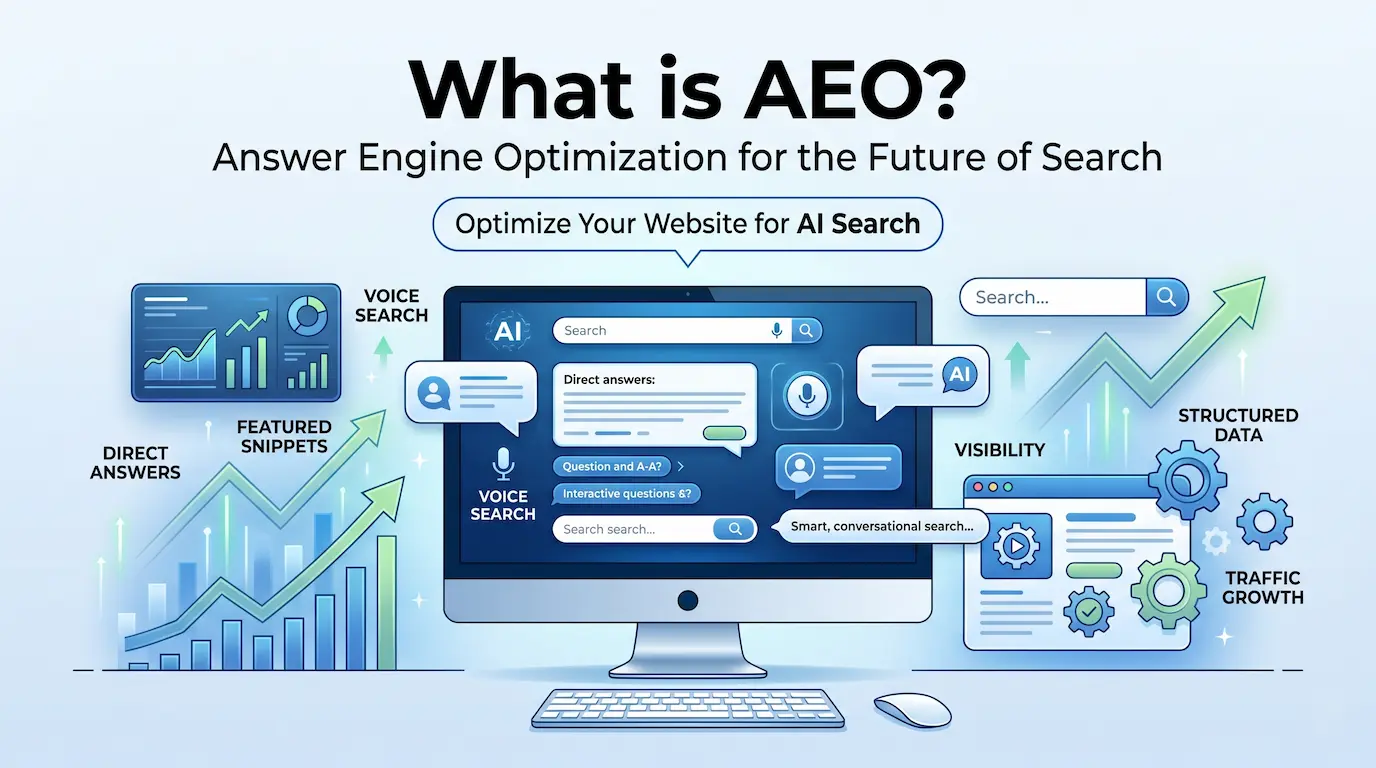
AEO (Answer Engine Optimization) is the practice of structuring and formatting content so that AI-powered tools, including Google AI Overviews, ChatGPT, Perplexity AI, Gemini, Microsoft Copilot, and voice assistants, can extract it as a direct, cited answer to a user's question. The goal is to become the source an answer engine cites, not just a result it ranks among ten others.
AEO Meaning - The Precise Definition
AEO stands for Answer Engine Optimization. It is the practice of engineering your content to be selected as the cited answer by AI-powered platforms, not just ranked among a list of links.
An answer engine is any platform that synthesizes a direct answer to a user's question rather than returning a list of links to browse. In 2026, that category includes:
- Google AI Overviews - the AI-generated summary appearing at the top of Google search results.
- ChatGPT with web browsing - conversational search experiences with clickable source citations.
- Perplexity AI - a citation-transparent answer engine that lists numbered sources for every answer.
- Google Gemini - Google's standalone AI answer product, separate from AI Overviews.
- Microsoft Copilot - integrated into Windows, Edge, and Microsoft 365.
- Voice assistants - Siri, Alexa, and Google Assistant delivering spoken responses directly to users.
The shift these platforms represent is fundamental. Traditional search asks users to choose from a list of results. Answer engines remove that choice. They select one answer, from one or a handful of sources, and deliver it directly. The source they cite collects all the visibility. Every source they do not cite gets nothing from that interaction.
At A1 Technovation, we define AEO this way: it is the work you do so that when an AI engine answers a question in your field, your content is the source it uses.
The Search Behavior Shift That Makes AEO Non-Negotiable
This is not a theoretical future shift. The numbers from 2025 and 2026 confirm it is already happening at scale.
AI Search Adoption Growth (2023 - 2026)
The behavioral shift driving Answer Engine Optimization
The scale of AI search adoption:
- Gartner predicts traditional search engine volume will decline as AI answer engines absorb informational queries at scale.
- Google AI Mode surpassed billions of monthly active users across 200+ countries.
- 31.3% of the US population will use generative AI search in 2026.
- Ahrefs found AI Overviews reduced click-through rates for top-ranking organic content.
- Visitors from AI search convert at 4.4 times the rate of traditional organic search visitors.
AI search sends fewer visitors, but the ones it sends often arrive with stronger intent. The user already received an answer from the AI, and they are visiting because the AI trusted the source enough to cite it.
The business case for AEO in plain terms: being cited in an AI answer is not just an SEO metric. It is a brand trust signal that influences purchase decisions across every channel the buyer touches next.
For queries that never receive a click at all, a citation still puts your brand name, positioning, and expertise in front of the reader. That brand exposure compounds in a channel many competitors have not started building yet.
AEO vs. SEO - The Key Differences and Why You Need Both
AEO and SEO are not competing strategies. They are sequential layers, where SEO builds the foundation that AEO depends on.
SEO: Rank a web page high in a list of search results. The goal is a click.
AEO: Get your content extracted as the direct answer. The goal is to be cited as the source.
SEO builds the authority that makes AEO possible. AEO structures the content that earns the citation.
| Factor | SEO | AEO |
|---|---|---|
| Target platform | Google and Bing organic SERPs | Google AI Overviews, ChatGPT, Perplexity, Gemini, voice |
| Primary success metric | Keyword rankings, organic traffic | AI citations, snippet appearances, answer extraction rate |
| Content goal | Rank for a keyword | Be selected as the direct answer to a question |
| Content structure focus | Keyword relevance, backlinks, topical authority | Inverted pyramid, direct-answer blocks, schema markup |
Read our foundational guide: What Is SEO? A Complete Beginner's Guide for 2026
AEO vs. GEO - A Clear Distinction Most Guides Get Wrong
AEO and GEO overlap, but they target different surfaces.
- AEO: Optimizing content to be extracted as a direct answer in featured snippets, Google AI Overviews, People Also Ask boxes, and voice search results.
- GEO: Optimizing to earn citations and brand mentions in synthesized, conversational responses generated by large language models such as ChatGPT, Gemini, Perplexity, and Microsoft Copilot.
The 2026 Search Visibility Hierarchy
SEO gets you indexed and ranked. AEO gets you extracted as the answer. GEO gets you recommended by AI engines that synthesize responses from multiple sources. In 2026, a complete visibility strategy requires all three.
Learn about our AEO services and GEO services.
How Answer Engines Work - The Technical Mechanics Behind AEO
Understanding how answer engines select and cite content is the prerequisite for optimizing effectively. Four technical layers drive most citation decisions.
The 4 Pillars of AI Engine Citation
Natural Language Processing and Semantic Intent
Answer engines use Natural Language Processing to interpret the intent behind a query, not just the surface keywords. Content that directly answers the intent of a question performs better in AEO than content that keyword-matches without addressing the actual question.
Passage Ranking and Extraction
AI engines evaluate content at the passage level, asking whether a specific block can be extracted as a reliable, citable answer. A page can rank number one and still never appear in an AI Overview citation if no passage delivers a clean answer.
Entity Recognition and Trust Signals
AI engines scan content for named entities: people, companies, products, organizations, locations, tools, and regulatory bodies. Schema markup makes those relationships machine-readable.
Multi-Source Authority Consensus
AI engines synthesize from your website and external sources such as industry publications, review platforms, professional directories, forums, and trusted databases. External brand mentions strengthen citation eligibility.
The 6-Step AEO Implementation Framework
This is the process we apply at A1 Technovation when auditing and rebuilding content for answer engine citation eligibility.
AEO Implementation Framework
Step 1 - Audit Your Content for Answer-Readiness
Pull your top traffic pages from Google Search Console. Check whether the opening 50 words of every H2 section directly answer the implied question.
Step 2 - Restructure Content Using the Inverted Pyramid
The inverted pyramid puts the answer first, context second, and supporting evidence third. AI engines extract the clearest answer fastest.
Inverted Pyramid Content Structure for AEO
Before: "Kitchen renovations have become one of the most popular home improvement projects. With rising home values, homeowners are investing more than ever. For those considering this project, understanding the timeline is one of the most common concerns. The typical kitchen renovation takes between 6 and 12 weeks."
After: "A mid-size kitchen renovation typically takes 6 to 12 weeks from demolition to completion. The timeline varies based on scope of work, material lead times, and permit processing."
Step 3 - Add Direct-Answer Blocks to Every Major Section
Every H2 section should open with a 40 to 60 word direct answer block. These are the passages most likely to be extracted for AI Overviews and voice answers.
Step 4 - Build a Question-First Content Structure
Use question-based headings throughout your content. The question format matches how users phrase queries to AI engines.
Step 5 - Implement Schema Markup
For AEO, the most important schema types are FAQPage, Article with named author, HowTo, Speakable, and Service schema.
Step 6 - Build Off-Page Authority
Earn editorial features, build profiles on trusted directory platforms, and distribute original data. Multi-source consensus is the most durable AEO signal.

AEO Best Practices - Quick Reference Checklist
| AEO Best Practice | Purpose |
|---|---|
| Open every H2 section with a 40-60 word direct answer | Enables passage extraction by AI engines |
| Use question-based H2 and H3 headings | Matches conversational query format |
| Add FAQPage schema | Qualifies content for snippet and PAA extraction |
| Apply Article schema with named author | Builds EEAT entity signals |
| Include specific statistics with source attribution | Signals factual grounding and cite-worthiness |
| Build external brand mentions | Establishes multi-source consensus |
Answer Engines You Need to Optimize For in 2026
Google AI Overviews
Google AI Overviews is the AI-generated summary that appears at the top of Google SERPs. It responds well to clean heading structure, FAQPage schema, inverted pyramid content, and high EEAT signals.
ChatGPT with Web Browsing
ChatGPT surfaces clickable citations alongside answers when browsing is enabled. It favors content that is clear, factually dense, and published on domains with established authority.
Perplexity AI
Perplexity AI is citation-transparent. Every response includes numbered, clickable source citations, making it one of the easiest answer engines to audit for visibility.
Google Gemini and Microsoft Copilot
Gemini and Copilot both rely on factual density, brand trust signals, and entity clarity when generating recommendations and explanations.
AEO for Different Business Types
- Professional services: Optimize recommendation and local trust queries.
- SaaS companies: Optimize feature comparison, use-case, and integration queries.
- E-commerce brands: Optimize product recommendation and specification queries.
- Local businesses: Optimize location-based queries with Business Profile, reviews, local schema, and service-area content.
How to Measure AEO Performance

- Featured snippet appearance rate: Monitor snippet movement in Search Console and SEO tools.
- AI Overview impression patterns: Track queries where impressions rise but clicks flatten.
- AI engine referral traffic: In GA4, monitor referral sources such as Perplexity, ChatGPT, and Gemini.
- Brand query growth: AI visibility often lifts direct brand searches.
- Manual citation audits: Test repeat prompts in ChatGPT, Gemini, Perplexity, and Copilot.
Common AEO Mistakes and Fixes
| Mistake | Risk | Fix |
|---|---|---|
| Burying the answer | AI engines find no extractable answer | Put the direct answer in sentence one |
| No FAQ section | Misses PAA and FAQPage opportunities | Add 6-8 question-answer pairs |
| Generic writing | Low entity recognition | Name tools, companies, sources, and facts |
| No schema markup | Low structured extraction eligibility | Implement FAQPage, Article, HowTo, and Service schema |
| No off-page authority | Weak multi-source consensus | Build brand mentions on trusted platforms |
Frequently Asked Questions About AEO
Is AEO the same as SEO?
No. SEO focuses on ranking pages in traditional search engine results for organic clicks. AEO focuses on structuring content to be extracted as a direct answer by AI-powered platforms.
Is AEO the same as GEO?
They overlap significantly but target different surfaces. AEO focuses on answer extraction. GEO focuses on brand citations in LLM responses.
Does AEO work for small businesses?
Yes. AI engines cite sources based on clarity, credibility, and directness, not brand size or ad spend.
How long does it take to see AEO results?
Featured snippet and structured-data gains can appear within 30 to 60 days. Broader AI citation visibility usually takes 3 to 6 months because it depends on content quality and external authority signals.
Does AEO hurt my organic traffic?
No. AEO may change how traffic arrives, but AI-referred visitors often arrive with stronger trust because the answer engine already cited your source.
Do I need to rebuild my website for AEO?
No. AEO is primarily a content restructuring and schema implementation effort.
Are there tools to track AEO performance?
Yes. Use Search Console, GA4, manual AI prompt audits, and dedicated AI visibility tools to track snippets, referrals, mentions, and citations.
Can AEO replace paid advertising?
No. AEO builds compounding citation presence over months. Paid advertising captures immediate commercial intent. The highest-ROI approach combines both.
Explore the connected search layers
These articles help place answer-engine optimization beside SEO fundamentals, generative visibility, and search behavior.
Start Building Your AEO Strategy Today
We have built AEO and GEO citation strategies for businesses that need visibility inside Google AI Overviews, ChatGPT, Gemini, and Perplexity.
Request a Free AEO Audit →