Car buyers spend an average of 14.5 hours researching online before stepping onto a lot. Google is where most of that research starts, and a growing share now begins on ChatGPT, Perplexity, and Gemini.
The problem is simple. Most dealerships pour budget into paid ads and third-party listings like AutoTrader and Cars.com. The organic channel, the one that compounds every month and costs near-zero per lead once established, sits largely untapped. Organic leads from SEO convert at 2 to 3 times the rate of third-party marketplace leads, at a fraction of the cost-per-sale.
This guide covers the complete strategy for how to do SEO for a car dealership. Every section is built around one goal: get your dealership ranking on Google, generating consistent leads, and getting cited by AI engines so buyers find you before they ever think to contact a competitor.
We cover local SEO, Google Business Profile optimization, inventory page strategy, schema markup, content architecture, link building, AEO and LLM citation setup, video SEO, technical foundations, and how to measure every piece of it against real revenue.
No theory. No recycled advice. This is the playbook we use for dealerships that want to own their market.
How Car Buyers Search for Dealerships Today
The automotive buyer journey is longer and more fragmented than almost any other local purchase. A buyer researching a new Honda CR-V might touch 12 to 15 different online sources across 6 to 8 weeks before contacting a dealership.
Google research from Automotive News shows that 87% of automotive purchase journeys start with a search engine. That number includes every stage: model research, price comparison, dealership selection, financing research, and trade-in valuation. If your dealership is invisible at any stage, a competitor captures that buyer.
The Four Search Intent Types Driving Dealership Traffic
Search intent is the single most important variable in automotive SEO. Every buyer searches differently depending on where they are in the decision process.
Informational intent covers early-stage research: "2026 CR-V fuel economy," "best SUV for a family of four," "how does car financing work." These buyers are not ready to visit a dealership yet. They need educational content that builds trust and moves them toward the next stage.
Commercial investigation intent covers comparison and shortlisting: "CR-V vs RAV4," "certified pre-owned vs used," "is $500 a month too much for a car payment." These buyers know roughly what they want. They are narrowing options. Comparison pages and buying guides capture this traffic.
Local and navigational intent covers dealership selection: "Honda dealer near me," "Toyota dealership Dallas TX," "best car dealership in Fort Worth." These buyers have decided on a make and are choosing a dealership. Google Business Profile optimization and location pages win this traffic.
Transactional intent covers ready-to-buy searches: "2026 Honda CR-V EX-L for sale Dallas," "used Toyota Tacoma under $30,000 near me." These buyers have a credit card and a trade-in. Your inventory pages either appear here or you lose the sale to whoever does.
| Intent Type | Example Query | Page to Target |
|---|---|---|
| Informational | "How does car financing work?" | Blog post or FAQ |
| Commercial investigation | "CR-V vs RAV4 2026" | Comparison page |
| Local / navigational | "Honda dealer near me" | GBP + Location page |
| Transactional | "2026 Honda CR-V for sale Dallas" | SRP or VDP |
Map every piece of content on your site to one of these four intent types. A mismatch between intent and content is why pages fail to rank even with strong on-page optimization.
The AI Search Shift Every Dealership Needs to Understand
A growing segment of buyers now starts automotive research directly on ChatGPT, Perplexity, or Gemini. Instead of searching Google, they ask: "What is the most reliable midsize SUV under $40,000?" or "Is now a good time to buy or lease a car?"
According to eMarketer, 31.3% of US consumers will use generative AI for product research in 2026. For automotive, this percentage skews higher among buyers aged 25 to 44, the primary car-buying demographic.
This shift demands a different type of content. AI engines do not rank pages. They extract answers. Dealerships that structure content for AI citation appear inside those answers, building brand awareness and trust before the buyer ever loads Google.
We cover the full AEO and LLM citation strategy in Section 10. But the foundation starts here: every page you publish should be written to answer a specific question directly and completely.
The Entity Map: The Full Semantic Universe of Car Dealership SEO
Most dealerships optimize for a handful of keywords and call it SEO. The dealerships that consistently dominate local search think differently. They build entity authority, a comprehensive signal network that tells Google exactly what their business is, what it offers, and who it serves.
An entity, in Google's context, is a named thing with distinct properties and relationships. Your dealership is an entity. Honda CR-V is an entity. Dallas, Texas is an entity. Your service technicians, your CPO certification, your financing options: all entities. Google's Knowledge Graph maps the relationships between them.
AI engines use entity relationships to build answers. The richer your entity map, the more likely your dealership gets cited.
The Core Entity Web for a Car Dealership
Primary entity: Car dealership (AutoDealer in schema vocabulary)
Branch entities connected to your dealership:
- New vehicle sales department
- Used vehicle sales department
- Certified Pre-Owned (CPO) program
- Fixed operations: service department, parts department, collision center
- Finance and insurance (F&I) department
- Trade-in appraisal service
Inventory entities: Each vehicle you stock creates sub-entities: brand, make, model, year, trim level, body style, condition, VIN, color, mileage, price.
Geographic entities: Your city, surrounding neighborhoods, ZIP codes, metro area. Each one is a relationship signal. "Our Honda dealership serves Dallas, Plano, Frisco, and Garland" communicates geographic entity coverage.
Buyer intent entities: Financing, leasing, buy here pay here, warranty, trade-in value, CPO inspection. These are the concepts buyers connect to their purchase decision. Your content needs to own them.
Trust entities: Google star rating, review count, BBB accreditation, OEM certification badge, CARFAX partnership, awards and recognitions. Each one is a verifiable signal that AI engines and Google use to assess authority.
Building Entity Authority on Your Website
The practical application of entity-based SEO is straightforward. Create dedicated pages for each entity branch. An oil change entity gets its own service page. The Honda CR-V entity gets its own model landing page. The Dallas service entity gets a location-specific page.
Use consistent naming conventions across your website, Google Business Profile, schema markup, and local citations. If your business is "Park Cities Honda" in schema and "Park Cities Honda Dealership" on Yelp and "ParkCitiesHonda" on Facebook, Google sees three different entities instead of one strong one.
Reference named entities throughout your content. "Our Honda-certified technicians in Dallas service all CR-V and Pilot models" is far more powerful to entity-aware algorithms than "our team provides great service."
This entity foundation underpins every SEO and AEO result this guide covers. Build it first.
Keyword Research for Car Dealerships: The Full Framework
Keyword research for a dealership is not one exercise. It is five separate keyword universes, each with its own intent, its own page type, and its own conversion path. Most dealerships only work with one or two of these universes. The ones that cover all five own their markets.
Keyword Category 1: Inventory Keywords (Highest Purchase Intent)
These keywords signal a buyer ready to act. The formula is simple: [Year] + [Make] + [Model] + [Trim] + [City or Near Me].
Real examples: "2026 Honda CR-V EX-L for sale Dallas," "used Toyota Tacoma TRD Pro near me," "certified pre-owned Lexus RX 350 Fort Worth TX."
Body style keywords work separately from model keywords. "Used trucks for sale near me," "SUVs under $25,000 Dallas," and "used sedans under $15,000" capture buyers who know their category but are open to multiple models. These pages consistently convert because the search intent is pure purchase.
The semantic field for inventory pages requires specific co-occurring terms. Google uses these to verify relevance. Every inventory page should naturally include: price, mileage, condition, VIN, financing available, test drive, trim level, color options, and available inventory count.
Keyword Category 2: Fixed Ops and Service Keywords (Highest Margin)
Service keywords represent the most underutilized SEO opportunity in automotive. Service customers spend more per visit than sales customers over their ownership lifetime, and service searches have lower competition than inventory searches.
Target these keyword patterns:
- General service: "oil change near me," "brake repair [city]," "tire rotation [city]"
- Brand-specific: "Honda oil change Dallas," "Toyota brake service Plano TX"
- Urgency-based: "brake repair open Saturday near me," "same-day tire repair Dallas"
- Recall and warranty: "[brand] recall service," "is coolant flush covered under warranty"
- Pricing intent: "how much does an oil change cost at a Honda dealership"
Every one of these requires its own dedicated page. One generic "Service" page does not rank for all of them. Build a page per service type, per city if you have multiple locations.
The semantic field for service pages must include: certified technician, OEM parts, appointment, estimate, turnaround time, warranty on parts, service specials, and brand references.
Keyword Category 3: Financing and Buying Process Keywords
Financing searches convert exceptionally well because the buyer is actively working through the purchase decision. These keywords are often ignored by franchise dealers who assume a strong inventory presence covers everything.
Target:
- "Auto loan rates 2026 Dallas"
- "Car loan bad credit Fort Worth"
- "Buy here pay here near me no credit check"
- "Lease vs buy a car 2026"
- "First-time car buyer program Texas"
- "How to trade in a car with negative equity"
- "Pre-qualify for a car loan without hurting credit"
The semantic field for financing pages includes: APR, credit score, down payment, monthly payment, pre-approval, loan term, co-signer, and dealer financing vs. bank financing.
Keyword Category 4: Research and Comparison Keywords
These keywords live at the commercial investigation stage. The buyer has a shortlist and is making a final decision. Comparison content that ranks here pulls buyers directly into your inventory funnel.
Target patterns:
- "[Model A] vs [Model B] [Year]", "2026 CR-V vs RAV4," "F-150 vs Silverado 2026"
- "Best [category] [year]", "best midsize SUV 2026," "most reliable trucks 2026"
- "Is [product] worth it", "is certified pre-owned worth it," "is extended warranty worth buying"
- "New vs used [model]", "new vs used Honda Accord 2026"
These pages require balanced, honest comparison. Buyers reading comparison content are sophisticated. Biased content that reads like a sales pitch loses them. Answer the real question, even if the answer occasionally points toward a competitor's model.
Keyword Category 5: AI and Conversational Keywords (AEO Targets)
These keywords mirror how buyers phrase questions to ChatGPT or Perplexity. They often have modest search volume in traditional keyword tools, but their value is enormous for AI citation.
Examples:
- "What is the best Honda dealer in Dallas?"
- "How does certified pre-owned certification work?"
- "Is it worth buying a car now or should I wait?"
- "What documents do I need to buy a car at a dealership?"
- "How long does it take to get financing approved at a dealership?"
Structure FAQ sections to answer these directly. Keep answers under 300 words. Open with the answer, then support with detail. This format is what AI engines extract.
Keyword Mapping Table: Intent to Page Architecture
| Keyword Type | Target Page | URL Pattern | Schema | CTA |
|---|---|---|---|---|
| [Year] [Make] [Model] [City] | SRP / VDP | /inventory/[year]-[make]-[model]-[city] | Vehicle + Offer | Schedule test drive |
| [Service] near me / [city] | Service page | /service/[service-name]-[city] | Service + LocalBusiness | Book appointment |
| [Make] dealer [city] | Location page | /locations/[city]-[make]-dealer | LocalBusiness + Review | Get directions |
| [Model A] vs [Model B] | Comparison page | /compare/[model-a]-vs-[model-b] | Article + FAQ | View inventory |
| How to [buying process] | Blog post | /blog/[topic-slug] | HowTo + FAQ | Contact us |
| Bad credit car loan [city] | Finance page | /financing/bad-credit-[city] | Service | Apply now |
Google Business Profile: Your Dealership's Most Powerful Free Ranking Tool
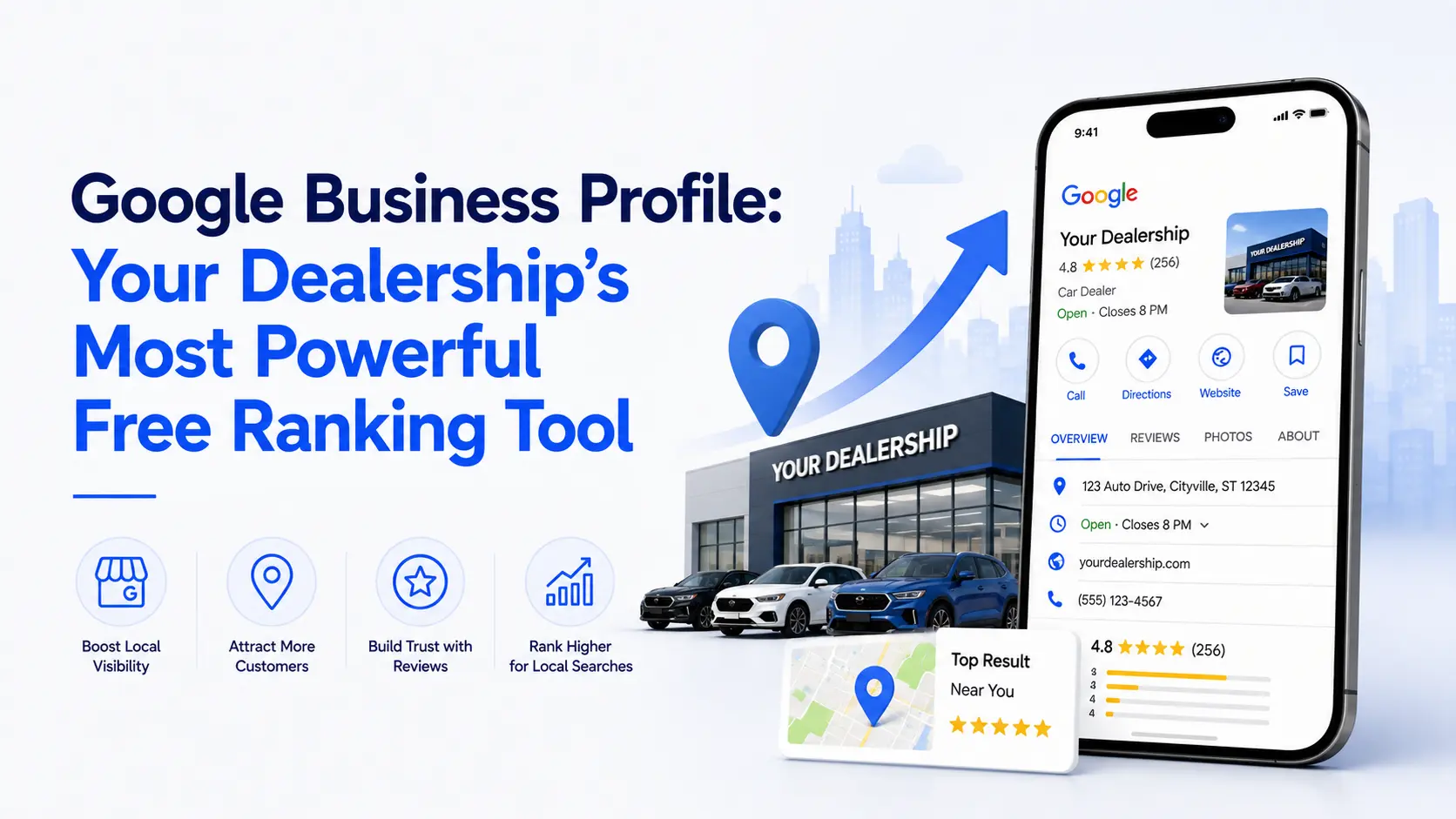
Google Business Profile (GBP) is not a secondary marketing channel. For local dealerships, it is often the single highest-traffic source that costs nothing per click. The local 3-pack, the three business listings that appear at the top of local search results, captures 44% of all clicks for queries with local intent.
Most dealerships claim a GBP and stop there. Active, well-structured profiles with consistent posting, optimized categories, and managed reviews outrank passive ones in every local market we have analyzed.
Setting Up Your GBP for Maximum Visibility
Start with category selection. The primary category controls how Google classifies your business and which searches surface your listing.
- Primary category: Car Dealer (not "Automobile Dealer", Google differentiates these in ranking)
- Secondary categories for a full-service franchise dealership: Used Car Dealer, Car Finance and Loan Company, Auto Parts Store
- If your location includes service: add Auto Repair Shop as a secondary category
Your business description gets 750 characters. Use the first sentence to include your primary keyword and city. Use the remaining space to cover your top 2 to 3 services and the geographic area you serve. No generic language. No vague claims.
Attributes matter more than most dealerships realize. Enable every applicable attribute: test drives available, financing available, wheelchair accessible, LGBTQ+ friendly, appointment not required for service. These attributes appear in local search results and influence click decisions.
The GBP Content Calendar That Improves Rankings
Active posting signals to Google that your business is current and engaged. Inactive profiles lose ground to active ones in the local pack, regardless of review count.
Post at minimum four times per month:
- Week 1: New inventory spotlight (specific model, photo, price, CTA)
- Week 2: Service special or coupon (oil change price, service package)
- Week 3: Educational content (car care tip, financing FAQ, seasonal maintenance)
- Week 4: Community or dealership update (event, award, staff spotlight)
The Q&A section is a hidden ranking tool. Seed it with 10 to 15 common buyer questions and answer them yourself before customers do. Include keywords naturally: "Our Dallas Honda dealership offers test drives seven days a week, no appointment needed." These Q&A entries appear in Knowledge Panel results and feed AI engine responses.
Photo cadence: upload a minimum of 20 new photos per month. Mix inventory walk-arounds, interior shots, service bay photos, staff headshots, and customer delivery moments. Profiles with consistent fresh photos receive significantly higher direction request rates.
Review Management as a Google Ranking Engine
Reviews affect local 3-pack ranking through four specific signals: volume, velocity, recency, and sentiment. Most dealerships focus only on volume. The dealerships that dominate local packs manage all four.
Velocity beats volume. Five new reviews per month for 12 consecutive months outperforms 60 reviews in a single quarter. Google weights recent reviews more heavily than old ones, regardless of total count.
Target: 10 to 20 new reviews per month for your sales GBP. Build a separate review stream for your service GBP.
The QR code method works consistently across our client dealerships. At delivery, the salesperson hands the customer a physical card with a QR code linking directly to the Google review page. The conversation is simple: "If you had a great experience today, a 60-second review helps our team a lot."
Follow up with a 24-hour SMS: "Hi [Name], thank you for choosing [Dealership Name] for your new [Model]. We'd love to hear about your experience, here's a direct link: [URL]"
A 30-day check-in email closes the loop: "How's the [Model] treating you? We'd love to hear what you think, [link]."
Keyword signals in reviews matter. When customers naturally write "Honda service," "oil change," or "Dallas Honda dealer" in reviews, those terms amplify your local relevance signals. Train your team to encourage specific, detailed reviews, not scripted ones.
Responding to Reviews the Right Way
Respond to every review within 24 hours. For positive reviews, include the service type and city naturally: "Thank you for trusting us with your Honda service in Dallas. We look forward to seeing you for your next appointment."
For negative reviews: acknowledge, apologize briefly, and move the conversation offline. Never argue, never include keywords, and never use a templated response that ignores the specific complaint. Google sees review response patterns as a trust signal.
Build a Separate GBP for Your Service Department
Sales and service serve completely different buyer intents and attract different search queries. Run them as separate GBP listings.
Service department GBP setup:
- Primary category: Auto Repair Shop
- Secondary categories: Oil Change Service, Tire Shop (if applicable), Auto Parts Store
- Link to the /service/ section of your website, not the homepage
- Separate phone number or extension if possible
- Set accurate service hours independently from sales hours
This separation lets you compete for "oil change near me" and "brake repair near me" as a distinct local entity, independent of your sales GBP ranking.
Website Architecture: Building the Foundation That Ranks
A car dealership website handles a challenge most businesses never face: an inventory that changes daily, thousands of individual product pages, and the need to rank for both local service searches and specific model-and-city combinations.
Most dealer website platforms (CDK Global, DealerSocket, Reynolds and Reynolds) provide templates, not SEO strategy. The template gives you a functional site. The strategy below gives you rankings.
The Five-Tier Dealership Website Architecture
| Tier | Page Type | Example | SEO Purpose |
|---|---|---|---|
| 1 | Homepage | yourdealership.com/ | Brand + location signal |
| 2 | Inventory hubs | /inventory/new-cars/ | Category authority |
| 3 | Make / model pages | /inventory/new-honda-crv-dallas/ | Model-level targeting |
| 4 | Vehicle Detail Pages (VDPs) | /inventory/2026-honda-crv-ex-l-dallas-123/ | Transactional |
| 5 | Service / Finance / Location | /service/oil-change-dallas/ | Supporting entity pages |
Every tier links down to the next and links back up to the tier above. This internal linking structure distributes authority from your homepage to your highest-intent pages.
SEO-Friendly URL Structure for Dealerships
URLs are entity signals. Structured correctly, they tell Google exactly what the page covers before a bot reads a single word of content.
Rules: lowercase letters, hyphens (never underscores), keyword in the URL, no unnecessary parameters, under 60 characters where possible.
- SRP: /inventory/used-honda-crv-dallas-tx/
- VDP: /inventory/2026-honda-crv-ex-l-dallas-vin-suffix/
- Service page: /service/oil-change-dallas-tx/
- Location page: /locations/dallas-honda-dealership/
- Blog post: /blog/how-to-trade-in-a-car-with-negative-equity/
- Finance page: /financing/bad-credit-auto-loans-dallas/
Internal Linking Map for Maximum Crawl Efficiency
The goal of internal linking is two-fold: help Google crawl every important page efficiently, and pass link authority from high-authority pages toward high-conversion pages.
Your homepage is your most authoritative page. It should link to:
- New inventory hub
- Used inventory hub
- CPO inventory hub
- Service hub
- Finance page
- Location page
Each inventory hub links to make/model SRPs. Each SRP links to individual VDPs. Each blog post links to at least 3 relevant SRPs or service pages. Each service page cross-links to the inventory pages for the same brand ("Browse our Honda inventory" on an oil change page).
Minimum internal links per content type:
- Blog posts: 3 to 4 internal links
- VDPs: link back to parent SRP + one comparison or model guide
- Service pages: 2 internal links minimum, one to the service hub, one to a relevant inventory or blog page
Orphaned pages, pages with no internal links pointing to them, are effectively invisible to Google. Audit for orphans every quarter.
Core Web Vitals: The Technical Baseline for Rankings
Google uses Core Web Vitals as a ranking signal. More importantly, slow and unstable pages drive buyers away before they can convert. A one-second delay in page load time reduces conversions by 7%.
The three metrics that matter:
LCP (Largest Contentful Paint): The time for the main content to load. Target: under 2.5 seconds. Fix: Compress hero images to WebP format. Implement server-side caching. Set loading="eager" on above-fold images. Use a CDN for image delivery.
INP (Interaction to Next Paint): The time between a user action and the browser's response. Target: under 200 milliseconds. Fix: Defer non-critical JavaScript. Remove heavy chat widgets that block the main thread. Lazy-load chat functions after page interaction.
CLS (Cumulative Layout Shift): The visual stability of the page as it loads. Target: under 0.1. Fix: Set explicit width and height on all images. Never inject ads or banners above the fold after load. Reserve space for dynamic content.
Run a Core Web Vitals audit in Google Search Console every month. Test your homepage, top SRPs, and top VDPs separately, each page type has different bottlenecks.
Inventory Page SEO: Optimizing VDPs and SRPs
Inventory pages are the highest-intent, highest-conversion pages on any dealership website. They are also the most technically complex pages to optimize correctly.
The challenge: inventory changes daily. Cars sell. New stock arrives. Prices change. A VDP that ranked yesterday disappears tomorrow when the car sells. An SRP that worked last month needs fresh content as the model year changes.
This section covers the complete blueprint for inventory page SEO that holds up regardless of inventory churn.
Optimizing Search Result Pages (SRPs)
An SRP is a category page showing multiple vehicles, all used Honda CR-Vs, all trucks under $30,000, all CPO vehicles. These pages target the commercial investigation and local intent stages.
Every SRP needs:
A unique H1: "Used Honda CR-V for Sale in Dallas, TX, Browse Current Inventory"
A 200 to 300-word unique intro block above the inventory grid. This block should explain why buyers choose this model, what your dealership offers that others don't, and what the local market looks like. This text is what Google reads. The vehicle listings below are dynamically generated and often ignored by crawlers.
Canonical tags on every filtered or sorted URL variation. If a buyer filters by color and the URL becomes /inventory/used-honda-crv-dallas/?color=blue, the canonical tag points back to /inventory/used-honda-crv-dallas/. This prevents duplicate content across hundreds of filter combinations.
Breadcrumbs on every SRP: Home > Inventory > Used Cars > Honda CR-V
Internal links to the top 3 to 5 individual VDPs below the intro block, then let the inventory grid handle the rest.
Optimizing Vehicle Detail Pages (VDPs)
Each VDP is a targeted landing page for one specific vehicle. Done correctly, it ranks for the exact query a ready-to-buy customer searches.
URL structure: /inventory/[year]-[make]-[model]-[trim]-[city]-[partial-VIN]/
Example: /inventory/2026-honda-crv-ex-l-dallas-tx-5j6rw2h85pa000123/
Title tag formula: [Year] [Make] [Model] [Trim] for Sale in [City] | [Dealership Name]
Example: "2026 Honda CR-V EX-L for Sale in Dallas TX | Park Cities Honda"
Meta description formula: [Price] | [Mileage] miles | [One unique feature] | [Dealership Name] serves [City]. Schedule your test drive today.
The unique dealer note is non-negotiable. OEM boilerplate descriptions appear on hundreds of dealer websites across the country. Google classifies these as duplicate content and suppresses pages that use them. Write a 100 to 150-word dealer-specific note for every high-value VDP:
"This 2026 Honda CR-V EX-L arrived at our Dallas lot with one previous owner and a clean CARFAX report. The Aegean Blue Metallic exterior is one of three CR-Vs we currently stock in this color. Standard features include a panoramic sunroof, heated front seats, and a 10.2-inch infotainment screen. Our Park Cities Honda certified technicians completed a full 150-point inspection before listing. Financing starts at 5.9% APR for qualified buyers, and we accept trade-ins on all makes and models."
That note ranks. Boilerplate does not.
Managing Inventory Churn: The 301 Redirect Protocol
The most common technical SEO mistake on dealership websites is the 404 error on sold vehicles. A VDP that earned backlinks or ranking authority should never return a 404.
The protocol is simple:
- Vehicle sells → 301 redirect to parent SRP immediately (e.g., /inventory/used-honda-crv-dallas-tx/)
- If the VDP had external backlinks → 301 to the most similar current model in stock
- Remove sold VDPs from XML sitemap within 24 hours
- Keep filtered SRP variants out of sitemap entirely (canonical handles them)
Automated tools like DealerSocket and CDK often delete sold VDP pages rather than redirecting them. Override this default in your platform settings or ask your provider to implement redirect automation on sale events.
VIN-Level Entity Optimization
The Vehicle Identification Number is a unique entity signal. Each VIN connects your listing to verifiable external data, safety ratings, recall status, ownership history, CARFAX reports.
Include on every VDP: the full VIN, accident history status, number of previous owners, service history availability, and CARFAX or AutoCheck badge where applicable. These signals confirm to both users and search engines that your listing is legitimate, specific, and trustworthy.
Image SEO for Vehicle Photos
Inventory photos are an underutilized SEO asset. Most dealerships upload images with file names like "IMG_4832.jpg" and blank alt text. Both are missed ranking opportunities.
File naming formula: [year]-[make]-[model]-[color]-[angle]-[city].jpg
Example: 2026-honda-crv-aegean-blue-exterior-front-dallas.jpg
Alt text formula: [Year] [Make] [Model] in [Color], [Angle] view, for sale at [Dealership Name] [City State]
Example: "2026 Honda CR-V in Aegean Blue Metallic, front exterior view, for sale at Park Cities Honda Dallas TX"
Technical requirements:
- Format: WebP (30 to 50% smaller than JPEG with equal quality)
- Maximum file size: under 150KB per image
- Minimum photos per VDP: 8 (exterior front, rear, side, interior front, interior rear, cargo, engine, odometer)
- All below-fold images: lazy load attribute enabled
Schema Markup: The Structured Data Blueprint for Car Dealerships
Schema markup is the technical layer that connects your content to Google's Knowledge Graph and AI engine training data. Most dealerships have no schema, or one incomplete LocalBusiness implementation.
A complete schema setup for a dealership covers six distinct markup types. Each one serves a different purpose across different page types.
LocalBusiness Schema (Every Location Page and Homepage)
Use the AutoDealer type, which is a sub-type of LocalBusiness. This schema confirms your business entity to Google.
{ "@context": "https://schema.org", "@type": "AutoDealer", "name": "Park Cities Honda", "address": { "@type": "PostalAddress", "streetAddress": "5000 Lemmon Ave", "addressLocality": "Dallas", "addressRegion": "TX", "postalCode": "75209", "addressCountry": "US" }, "telephone": "+1-214-555-0100", "openingHoursSpecification": [ { "@type": "OpeningHoursSpecification", "dayOfWeek": ["Monday","Tuesday","Wednesday","Thursday","Friday"], "opens": "09:00", "closes": "20:00" }, { "@type": "OpeningHoursSpecification", "dayOfWeek": "Saturday", "opens": "09:00", "closes": "18:00" } ], "geo": { "@type": "GeoCoordinates", "latitude": 32.8301, "longitude": -96.8219 }, "priceRange": "$$", "aggregateRating": { "@type": "AggregateRating", "ratingValue": "4.8", "reviewCount": "342" }, "url": "https://parkcitishonda.com/" }Vehicle Schema (Every VDP)
This schema makes your individual vehicle listings eligible for rich results in Google Search and provides the structured data AI engines use to answer inventory-related queries.
Required fields: make, model, model date, body type, vehicle condition, VIN, mileage from odometer, offers (price, currency, availability), color, and image.
{ "@context": "https://schema.org", "@type": "Vehicle", "name": "2026 Honda CR-V EX-L", "vehicleModelDate": "2026", "brand": { "@type": "Brand", "name": "Honda" }, "model": "CR-V", "bodyType": "SUV", "vehicleCondition": "https://schema.org/NewCondition", "vehicleIdentificationNumber": "5J6RW2H85PA000123", "mileageFromOdometer": { "@type": "QuantitativeValue", "value": "12", "unitCode": "SMI" }, "color": "Aegean Blue Metallic", "offers": { "@type": "Offer", "price": "37995", "priceCurrency": "USD", "availability": "https://schema.org/InStock" }, "image": "https://parkcitishonda.com/images/2026-honda-crv-ex-l-front.jpg" }FAQPage Schema (All FAQ Sections)
FAQPage schema is the most direct path to both featured snippets and AI engine citation. Google extracts FAQ markup and surfaces it in search results as expandable Q&A blocks. AI engines use FAQ content as training and response data.
Apply to every FAQ block on your site. Format: Question paired with a direct, complete answer under 300 words. Answers should open with the answer itself, not with "Great question" or "It depends."
Service Schema (Every Fixed Ops Page)
Each service page needs Service schema connecting the offering to your dealership entity and geographic area.
{ "@context": "https://schema.org", "@type": "Service", "name": "Honda Synthetic Oil Change Dallas TX", "provider": { "@type": "AutoDealer", "name": "Park Cities Honda", "address": { "addressLocality": "Dallas", "addressRegion": "TX" } }, "areaServed": { "@type": "City", "name": "Dallas" }, "offers": { "@type": "Offer", "price": "79.95", "priceCurrency": "USD" } }HowTo Schema (Process Content)
Apply HowTo schema to any content that walks through a step-by-step process: how to trade in a car, how to apply for auto financing, how to prepare your car for a road trip. This schema signals to Google that the page is instructional and authoritative, a strong AEO signal.
BreadcrumbList Schema (All Pages)
Required on every page. It communicates your site hierarchy to Google and generates breadcrumb paths in search result snippets, increasing CTR by making your result look more organized.
VideoObject Schema (VDP and Blog Pages with Video)
If a page includes an embedded video, add VideoObject schema: name, description, thumbnailUrl, uploadDate, duration, and contentUrl. This makes your video eligible for video rich results.
All schema should be implemented as JSON-LD in the <head> section. Never use Microdata or RDFa for new implementations. JSON-LD is Google's preferred format and the most maintainable.
Content Strategy: The Full-Funnel Content Map
A dealership's content strategy should operate like a sales funnel built from search queries. Each content type targets a specific buyer stage, answers a specific question, and moves the buyer toward the next step.
Most dealerships publish generic blog posts about "car care tips" and call it content marketing. That approach generates traffic from people who will never buy from them. The strategy below generates traffic from buyers who are already in the purchase process.
Awareness Stage Content: Capturing Buyers Before They Choose a Model
Awareness content targets buyers who know they need a car but have not committed to a model or dealership. These searches drive large traffic volumes with lower immediate conversion rates, but they build brand familiarity with buyers who will return when they are ready.
Content types that work at this stage:
- Annual model guides: "2026 Honda CR-V, Everything You Need to Know Before You Buy"
- Category guides: "Best SUVs for Families in Dallas, 2026 Buyer's Guide"
- Cost guides: "How Much Does a Honda CR-V Cost in 2026? (Full Price Breakdown)"
- Timing guides: "Best Month to Buy a Car in 2026, Data-Backed Timing Strategy"
- Reliability guides: "Most Reliable Midsize Trucks in 2026, Owner Data and Expert Analysis"
The CTA for awareness content is soft: "Browse our current Honda CR-V inventory" or "Download our free car buying checklist."
Consideration Stage Content: Winning Buyers on the Shortlist
Consideration content targets buyers comparing options. These are high-intent searches from buyers who have narrowed their options and are researching differences, trade-offs, and value.
Content types that work at this stage:
- Comparison pages: "2026 Honda CR-V vs Toyota RAV4, Full Comparison"
- CPO guides: "Is Certified Pre-Owned Worth It? The Honest Answer"
- Trade-in guides: "How to Get the Most for Your Trade-In at a Dealership"
- Financing guides: "Lease vs. Buy, Which Makes More Sense in 2026?"
- Credit guides: "How to Get Approved for a Car Loan with a 580 Credit Score"
The CTA at this stage is medium-strength: "See our current CPO inventory," "Use our trade-in calculator," "Apply for financing in 60 seconds."
Decision Stage Content: Converting Ready-to-Buy Traffic
Decision stage content targets buyers who know what they want and are choosing where to buy. This content wins the sale.
Content types that work at this stage:
- Location pages: "Honda Dealer in Dallas, TX, Park Cities Honda"
- Inventory landing pages: "Used Honda CR-V for Sale in Dallas, Browse In-Stock Models"
- Financing pages: "Bad Credit Car Loans Dallas, TX, Get Approved Today"
- Comparison pages: "Park Cities Honda vs Other Dallas Honda Dealers"
The CTA is direct: "Schedule a test drive," "Call us now," "Apply for financing," "Get directions."
Fixed Ops Content: Building a Second SEO Ecosystem
Service content is the most underutilized opportunity in dealership SEO. Service customers represent recurring revenue across the ownership lifetime of a vehicle. They search with high intent and low competition compared to inventory searches.
Build one dedicated page per service type. Each page follows the same structure:
- H1: [Service Name] in [City, State], [Dealership Name]
- What the service includes (2 to 3 paragraphs with entity terms)
- Pricing range or starting price
- Service frequency guidance (how often, what mileage)
- Trust signals (certified technicians, OEM parts, warranty on work)
- Booking CTA: online scheduling link + phone number
- Service schema applied
Required service pages for a full-service franchise dealership:
- Synthetic oil change
- Conventional oil change
- Brake pad replacement
- Brake inspection
- Tire rotation
- Tire replacement
- Battery replacement and testing
- Transmission service
- A/C service and recharge
- Multi-point vehicle inspection
- Recall service (high-trust signal, buyers actively search this)
The Content Ladder: From Research to Revenue
The content ladder model sequences your content so that every piece pulls buyers toward a purchase.
| Rung | Content Type | Example | Links To |
|---|---|---|---|
| 1 | Informational | "2026 CR-V full review" | Comparison page |
| 2 | Comparison | "CR-V vs RAV4, which is right for you?" | Inventory SRP |
| 3 | Local guide | "Best Honda dealer in Dallas" | Location page + SRP |
| 4 | Transactional | "Used CR-V for sale in Dallas" | Individual VDPs |
Every piece of content links down to the next rung. A buyer who finds your informational blog post follows a link to the comparison page, then to the SRP, then schedules a test drive from a VDP. The content ladder guides them through that path automatically.
Seasonal SEO Calendar for Dealerships
Automotive search traffic follows predictable seasonal patterns. Match your content to these patterns and you capture traffic that competitors ignore.
- January to March (Tax Season): Buyers use tax refunds for down payments. Publish: "How to Use Your Tax Refund as a Down Payment," "Best Cars to Buy with a Tax Refund Under $5,000." Update GBP with tax season financing specials.
- April to June (Spring Buying Season): New graduates and spring buyers enter the market. Publish: "Best First Cars for New Drivers 2026," "Graduation Car Deals, What to Expect at a Dealership."
- July to September (Model Year Changeover): New model years release. Publish: "2027 Honda CR-V vs 2026 CR-V, Should You Wait?" "End of Model Year Deals, How Much Can You Save?"
- October to December (Year-End Push): Dealers clear inventory before year-end. Publish: "Best Car Deals in December 2026," "Year-End Car Buying Guide, Best Time to Buy a New Car."
Fixed publishing cadence: 4 GBP posts per month, 2 to 3 blog posts per month, and monthly updates to service specials pages.
Local SEO: Citations, NAP Consistency, and Local Authority
Local SEO for a car dealership extends well beyond Google Business Profile. The network of citations, directories, and local signals that point to your business collectively builds the "prominence" factor in Google's local ranking formula.
Google's local 3-pack ranks on three signals: relevance (does your business match the search?), distance (how close is the user?), and prominence (how well-known and trusted is the business?). You control relevance through content and categories. Distance is fixed by your location. Prominence is built through the strategies in this section.
The Three-Tier Citation Strategy
| Tier | Platforms | Priority |
|---|---|---|
| Tier 1 (Foundation) | Google Business Profile, Yelp, Facebook, Apple Maps, Bing Places | Start here, resolve before anything else |
| Tier 2 (Automotive-Specific) | Cars.com, AutoTrader, CarGurus, Edmunds, DealerRater, Autolist | Complete within first 30 days |
| Tier 3 (Local Authority) | BBB, Chamber of Commerce, local newspaper, automotive associations | Build in Month 2 |
All Tier 1 listings must be claimed and verified. Unclaimed listings can be edited by other users, creating NAP inconsistencies that suppress local rankings.
NAP Consistency: The Foundation of Local Trust
NAP stands for Name, Address, Phone. Every mention of your dealership across the web should match exactly.
This means exactly: "Park Cities Honda," not "Park Cities Honda Dealership" or "ParkCities Honda." "5000 Lemmon Ave," not "5000 Lemmon Avenue." "(214) 555-0100," not "214.555.0100."
Run a full NAP audit before building new citations. Use BrightLocal, Whitespark, or Moz Local to identify every listing and every inconsistency. Resolve all Tier 1 and Tier 2 inconsistencies before submitting new citations. Adding new citations over broken old ones accelerates the problem.
If your dealership changes its address, phone number, or name: update every listing within 7 days. Stale NAP data is one of the most common reasons dealerships lose local pack position after moving.
Local Link Building for Car Dealerships
Backlinks remain a top three Google ranking factor. For dealerships, the most effective links come from local and automotive-relevant sources, not generic directory spam.
Community sponsorships are the highest-ROI link building tactic for local dealerships. Sponsoring a local sports team, school event, charity drive, or community festival typically earns a link from the organization's website plus coverage in local news. One community event can generate 3 to 5 editorial backlinks from local domains.
Chamber of commerce membership earns a consistent DA 40+ backlink from your local chamber's member directory. This is one of the most reliable and sustainable local link sources available.
OEM co-op marketing programs offer dealerships backlinks from the manufacturer's dealer locator pages. Honda, Toyota, Ford, and most major OEMs maintain dealer directories on their primary domains. Make sure your listing is current, complete, and linked to your website.
Press release strategy: Dealership events, vehicle donation to a local family, sponsorship of a charity, new showroom opening, staff achievement, are legitimate news for local media. Pitch these stories to your local newspaper and news websites. A well-placed editorial story earns a powerful local link with zero cost beyond your time.
Automotive blogger outreach: Automotive journalists and YouTube reviewers occasionally publish test drive reviews or model guides. A relationship with 2 to 3 local or regional automotive writers can generate editorial links from relevant domains.
AEO and GEO: Getting Your Dealership Cited by AI Engines
AI-generated search answers are no longer an emerging trend. ChatGPT, Perplexity, and Google's AI Overviews now directly answer questions that previously sent buyers to a list of blue links.
"What is the best-rated Honda dealer in Dallas?" used to generate a list of results. Now it generates a direct answer, often naming two or three specific dealerships. If your dealership is not structured to appear in those answers, a competitor takes the citation.
This section covers the complete strategy for AEO (Answer Engine Optimization) and GEO (Generative Engine Optimization) in the automotive context.
How AI Engines Answer Automotive Queries
AI engines operate differently from traditional search algorithms. Instead of ranking pages by authority and relevance, they synthesize information from multiple sources to generate a direct answer.
The sources they draw from:
- Indexed web content (pages Google has crawled)
- Structured data (schema markup confirming entity relationships)
- Training data (content that was indexed before the model's training cutoff)
- Real-time search results (Perplexity and Google's AI use live search)
For automotive queries specifically, AI engines weight:
- Review data from Google and automotive-specific platforms
- Content that answers the user's exact question in the first sentence
- Specific, verifiable data (EPA fuel economy ratings, MSRP, safety scores)
- Named entity associations (dealership name + city + brand + models)
The 7 Content Signals That Get Your Dealership Cited by AI
Signal 1: Direct question-answer format. Open every major section with the answer, not the question. If a heading is "How Long Does Dealership SEO Take?" the first sentence must answer it: "Dealership SEO typically shows measurable results within 60 to 90 days for local pack improvements, and 3 to 6 months for significant organic traffic growth."
Signal 2: Specific, verifiable data. Include exact prices, ratings, EPA fuel economy numbers, safety scores, and real timelines. AI engines treat specific data as authoritative. Vague statements ("we offer competitive pricing") get ignored.
Signal 3: Named entity density. Use specific proper nouns throughout your content. "Our Honda-certified technicians in Dallas" is citable. "Our team" is not.
Signal 4: Content freshness. Update pricing, model year information, hours, and key data regularly. AI engines that use live search weight recent, updated content. Add a "Last updated" date to key pages.
Signal 5: Source authority. Earn backlinks from local media, automotive publications, and OEM directories. AI engines use link graphs to assess which sources are credible enough to cite.
Signal 6: Conversational language matched to natural queries. Write content that sounds like a direct answer to a spoken question. The buyer asks ChatGPT: "Is it better to buy or lease a car in 2026?" Your content should open its answer with: "Buying makes more sense in 2026 if you drive more than 15,000 miles per year or plan to keep the vehicle longer than 4 years."
Signal 7: Structured FAQs with schema. FAQPage schema turns your Q&A content into structured data that AI engines can reliably extract. Every FAQ answer should be under 300 words and open with the direct answer.
The 30-Question AEO FAQ Framework for Dealerships
These are the questions AI engines receive most frequently about car dealerships. Publishing clear, direct answers to all 30, with FAQPage schema applied, positions your dealership as a citable source across multiple buyer intent categories.
Purchase and Buying Process:
- How long does it take to buy a car at a dealership?
- What documents do I need to buy a car?
- Can I negotiate the price of a new car at a dealership?
- What is the best day of the week to buy a car?
- What is dealer markup on new cars in 2026?
Financing and Credit:
- Can I get a car loan with bad credit?
- What credit score do I need to buy a car?
- Is it better to finance through the dealer or my bank?
- What is buy here pay here financing?
- How much should my monthly car payment be based on my income?
Certified Pre-Owned:
- What is the difference between a CPO vehicle and a regular used car?
- How does Honda certified pre-owned certification work?
- Is certified pre-owned worth the higher price?
- What does a CPO warranty cover?
- How many miles can a certified pre-owned car have?
Service and Maintenance:
- How often should I get an oil change?
- Are dealership oil changes worth the price compared to quick lube shops?
- What is a multi-point vehicle inspection?
- Does my manufacturer warranty require dealership service?
- How do I find if my car has an open recall?
Dealership Trust and Selection:
- What should I look for when choosing a car dealership?
- What does it mean if a dealership is OEM-certified?
- What is the difference between a franchise dealership and an independent dealer?
- How do I read and evaluate dealership Google reviews?
- Can I return a car to a dealership if I change my mind?
Trade-In:
- How do dealerships calculate trade-in value?
- Should I sell my car privately or trade it in at a dealership?
- Can I trade in a car that I still owe money on?
- What is negative equity in a car trade-in?
- How do I prepare my car to get the best trade-in value?
Measuring AI Citation Performance
AI citation is measurable even without dedicated tools. Run this process monthly:
- Open ChatGPT, Perplexity, and Google AI Overview in separate windows
- Run 20 automotive queries relevant to your dealership and market
- Log: query, AI engine, whether your dealership was cited, position in the answer
- Track this spreadsheet month-over-month
Within Google Analytics 4, set up a custom channel group to capture AI referral traffic. Add the following sources: chat.openai.com, perplexity.ai, gemini.google.com, bing.com/chat. This lets you measure direct AI-originated traffic separate from organic search.
AI citation compounds with content authority. The more complete and entity-rich your content becomes, the more consistently AI engines draw from it.
Reputation Management as an SEO System
Reviews are not a marketing add-on. For car dealerships, they are a primary local ranking input, a conversion signal, and an AEO citation factor, all three simultaneously.
Most dealerships treat review generation as a periodic initiative. A strong quarter prompts a push. Results slow. Interest fades. This cycle produces exactly the review pattern Google down-weights: spikes followed by silence.
The dealerships that hold top local pack positions run review generation as a continuous system, not a campaign.
Review Velocity vs. Review Volume
Google's local algorithm weighs review recency significantly. A dealership with 450 reviews, all older than 14 months, consistently loses position to a competitor with 120 reviews accumulated steadily over the past year.
Target 10 to 20 new reviews per month for your sales GBP. Target 5 to 10 per month for your service GBP. These are consistent, sustainable targets, not event-driven spikes.
The difference between sustainable velocity and review inflation is the difference between ranking stability and GBP suspension. Google's classifier identifies fake review patterns: sudden volume increases from new accounts, identical language across reviews, reviews from users with no other review history. Accounts flagged for fake reviews face suspension, a penalty that can take months to resolve.
Build volume the right way, and velocity becomes your competitive moat.
The 3-Step Review Generation System
Step 1: At-delivery QR code card. Print a physical card with a QR code that links directly to your Google review page, not your homepage or a landing page, but the Google review compose window. The salesperson hands this to the customer at delivery: "If you had a great experience today, a quick Google review helps our team more than you know. It takes about 60 seconds."
Step 2: 24-hour SMS follow-up. "Hi [Name], thank you for choosing [Dealership Name] for your new [Model]. We hope you love it. If you have 60 seconds, a Google review means everything to our team: [direct link]." SMS open rates exceed 90%. This follow-up alone doubles review volume for most dealerships.
Step 3: 30-day check-in. An email at 30 days closes the loop with buyers who missed the first two touchpoints. "How's the [Model] treating you? We'd love to hear about your experience, [link]." Some buyers are more comfortable reviewing after they have lived with the car for a month.
For service customers, the timeline compresses. Send the follow-up SMS within 2 hours of the completed appointment, while the experience is fresh.
Reviews as a Keyword Signal
Customer reviews contain natural language that functions as user-generated keyword content for your GBP. When a reviewer writes "took my CR-V in for an oil change and the service team in Dallas was fantastic," Google processes "CR-V," "oil change," and "Dallas" as relevance signals for your listing.
Train your team not to script reviews, but to encourage specificity: "Feel free to mention what service you had done or which model you purchased, detailed reviews help other buyers make decisions."
In your response to every review, naturally include service type and location: "Thank you for bringing your Accord in for transmission service at our Dallas location, your trust means everything to our team."
Negative Review Protocol
Respond to negative reviews within 24 hours. Every time, without exception.
Your response has three goals: acknowledge the specific concern, demonstrate that you take it seriously, and move the conversation offline. "We are sorry to hear about your experience with our service department. Please contact our service manager directly at [phone] or [email], we would like to make this right."
Never argue publicly. Never include keywords in negative review responses. A measured, professional response to a 1-star review often converts the reader and the hundreds of people who see your response better than no negative reviews at all.
Video SEO for Car Dealerships
Video is the only content format that your competitors consistently ignore and that buyers consistently consume before making a car purchase. A well-structured video SEO program gives your dealership visibility in Google Video search, YouTube search, and rich snippet video results, three additional traffic channels that most dealerships never access.
YouTube as a Lead Generation Channel
YouTube is the second-largest search engine in the world. Automotive is one of its highest-engagement content categories. Buyers watch walkaround videos, model comparisons, and dealership reviews before they ever call.
Vehicle walkaround videos are the highest-converting content format for dealerships. Structure every walkaround for search:
Title formula: "[Year] [Make] [Model] [Trim] Full Walkaround, [Dealership Name] [City] [State]"
Example: "2026 Honda CR-V EX-L Full Walkaround, Park Cities Honda Dallas TX"
YouTube description (300+ words): Cover the key features, trim specifications, price, dealership address, phone number, website URL, and links to the vehicle's VDP. Include natural keyword phrases: "This 2026 Honda CR-V EX-L is currently in stock at our Dallas location..."
Tags: [Year] + [Make] + [Model] + [Trim] + [City] + "for sale" + "walkaround" + "review"
Publish a walkaround for every high-value inventory item: all CPO vehicles, all vehicles above your average selling price, and any model with strong local search volume.
Fixed Ops Video Content
Service content on YouTube generates consistent traffic from buyers who do not know your dealership yet but discover you through a search for maintenance advice.
Effective service video topics:
- "What to Expect at Your First Honda Oil Change Appointment, Park Cities Honda"
- "How Our Technicians Inspect a Used Car Before It Goes on the Lot"
- "How to Check Your Tire Pressure, Free Tutorial from Our Dallas Service Team"
- "Does My Honda Warranty Cover This? Service Advisor Explains"
These videos build trust with buyers before they ever need your dealership. The buyer who finds your tire pressure video becomes more likely to choose your service department when the time comes.
VideoObject Schema on Your Website
Every page on your website that includes an embedded video needs VideoObject schema. This schema makes your video eligible for video rich snippet results, a visual thumbnail that appears directly in Google search results.
Required VideoObject fields: name, description, thumbnailUrl, uploadDate, duration, contentUrl (the direct video URL), and embedUrl (the YouTube embed URL).
Place VideoObject schema on every VDP with a walkaround video embedded. This combination of rich content and structured data gives your VDPs a significant advantage over competitors who show only static images.
Short-Form Video for Brand Trust Signals
YouTube Shorts and Instagram Reels serve a different purpose than long-form walkarounds. They build brand familiarity through frequency, appearing in buyer feeds repeatedly before a purchase decision is made.
Effective short-form topics:
- "How we detail and recondition a used car before it hits our lot" (30 seconds)
- "Meet our service advisor, [Name], 12 years with Honda" (15 seconds)
- "First look: the 2027 Honda CR-V just arrived at our Dallas dealership" (45 seconds)
Social media engagement increases brand search volume. Buyers who see your Reels regularly are more likely to search directly for your dealership name, and branded search volume is a significant local ranking factor for your GBP.
Technical SEO Audit Framework for Car Dealerships
Technical SEO for a dealership is substantially more complex than for most local businesses. Daily inventory changes, thousands of VDPs, filtered search result pages, and dynamically generated content create technical challenges that most generic SEO advice does not address.
This section covers the complete technical audit framework specific to dealership websites.
Crawlability and Indexation Controls
Robots.txt rules for dealership sites should block filtered SRP URL variants:
User-agent: * Disallow: /inventory?sort= Disallow: /inventory?color= Disallow: /inventory?price_max= Disallow: /inventory?mileage_max=This prevents Google from wasting crawl budget on thousands of filtered URL combinations that produce near-identical content.
XML sitemap management: Your sitemap should update daily as inventory changes. Every new VDP should appear in the sitemap within 24 hours of publishing. Every sold VDP should be removed from the sitemap within 24 hours of the sale.
Verify your sitemap submission in Google Search Console under Index > Sitemaps. Check the "Last read" date and the number of submitted URLs vs. discovered URLs. Large discrepancies indicate either sitemap delivery failures or indexation issues.
Canonical tags must be implemented on every filtered and sorted SRP variant. The canonical URL points to the base SRP: <link rel="canonical" href="https://yourdealership.com/inventory/used-honda-crv-dallas/" />
Noindex tags should appear on: thank-you pages after form submissions, internal search result pages (/search?q=), test drive confirmation pages, and account login pages. These pages consume crawl budget without contributing to rankings.
Site Architecture Health Checks
Crawl depth audit: Every VDP should be reachable within 3 clicks from your homepage. If a buyer has to click Home → Inventory → New Cars → Honda → CR-V → Specific Trim → then a VDP, that is 6 clicks, too deep. Restructure your navigation or add shortcut links in the footer.
Orphan page identification: An orphan page has no internal links pointing to it. Google rarely indexes orphan pages well. Run a crawl using Screaming Frog or Sitebulb and filter for pages with zero inlinks. Every orphaned page needs at least one internal link.
301 redirect map: Maintain a living spreadsheet of all redirected VDPs. Include columns for: original URL, destination URL, redirect reason (sold, relisted, URL structure change), and date redirected. This map is essential when a VDP had external backlinks, you need to know where to direct the redirect to preserve link equity.
Crawl error monitoring: Check Google Search Console's Indexing > Pages report weekly. Address 404 errors immediately, especially for URLs that still receive external traffic.
Duplicate Content Issues Specific to Dealerships
OEM description duplication is the most common and most damaging duplicate content issue in automotive SEO. Manufacturer-supplied vehicle descriptions appear on hundreds of dealer websites simultaneously. Google classifies these as thin duplicate content and suppresses the pages that use them.
The fix: mandatory unique dealer notes on every VDP. Even 100 words of original content is enough to differentiate a page from OEM boilerplate.
Inventory syndication creates a related problem. When your inventory feeds to Cars.com, AutoTrader, and CarGurus, your VDP descriptions appear on those platforms alongside your own VDPs. Ensure your canonical tags on VDPs point to your domain, not to the syndicated listings.
Trim-level SRP duplication: If you have separate SRPs for "Honda CR-V LX," "Honda CR-V EX," and "Honda CR-V EX-L" with near-identical content, Google may see them as duplicates. Differentiate each with unique intro copy covering the trim's specific features, price range, and buyer profile.
Mobile Usability for Dealership Websites
65% of automotive searches happen on mobile. The buyer searching "Honda dealer near me" while sitting in another dealership's parking lot is a real scenario. Your mobile experience must be conversion-ready.
Above-the-fold on mobile must include:
- Click-to-call button (prominent, with your primary phone number)
- Directions link (opens Google Maps)
- Search inventory CTA
Tap targets: minimum 48x48 pixels for all buttons and links. Small tap targets frustrate mobile users and increase bounce rate.
No intrusive pop-ups or interstitials on mobile. Google's mobile penalty for intrusive interstitials suppresses pages where pop-ups block primary content on entry.
Run Google Search Console's Mobile Usability report monthly and address every flagged error within 48 hours.
Competitor Analysis: How to Outrank Other Dealers in Your Market
Most dealerships run SEO without knowing what their competitors are actually doing. They optimize their own pages in isolation while competitors claim positions that were available for the taking.
A structured competitor analysis identifies the exact pages, keywords, and backlinks that drive your competitors' rankings, and shows you the gaps your content needs to fill.
Identifying Your True Local SEO Competitors
Run your top 10 target keywords in Google. Note which dealerships consistently appear in positions 1 through 3. These are your actual SEO competitors, not necessarily your market competitors.
You may also find that Cars.com, AutoTrader, or Edmunds occupy top positions for high-volume keywords. These are aggregator competitors. The strategy to compete with aggregators differs from the strategy to outrank other local dealers:
For local dealer vs. local dealer: focus on GBP optimization, review velocity, local link building, and unique content depth.
For local dealer vs. aggregator: target long-tail keywords the aggregators under-optimize, focus on local specificity ("used CR-V in Dallas near North Park"), and leverage your unique local knowledge and trust signals.
Analyzing Competitor GBP Profiles
Study your top 3 local competitors' GBP listings:
- Total review count and average rating
- Review velocity (how many new reviews in the last 30 days, check dates)
- Categories they have selected (view on mobile or use a GBP auditing tool)
- Photo count and upload frequency
- Post frequency and content types
- Q&A population
Use BrightLocal's GBP Audit tool or Whitespark's Local Citation Finder for competitive intelligence. What you find often reveals quick wins: a competitor with 200 reviews and no photos is vulnerable to a dealership that adds 20 fresh photos per month.
Analyzing Competitor Website Structure
Open Ahrefs or Semrush Site Explorer and enter a competitor's domain. You need three pieces of data:
1. Top pages by organic traffic: Which of their pages receive the most search visitors? These are the content types working in your market.
2. Top ranking keywords: Which keywords do they rank for that you do not? Export this list and sort by search volume multiplied by commercial intent. This becomes your content calendar.
3. Backlink profile: Which local domains link to them? Local newspaper links, chamber memberships, OEM directories; each one is a link source you can pursue independently.
The Keyword Gap Analysis Workflow
Semrush's Keyword Gap tool compares your domain against up to 4 competitors simultaneously. It shows keywords they rank for that you do not, sorted by traffic potential.
Export all gap keywords. Sort by search volume. Filter for keywords with clear commercial or local intent. Cluster them by topic (model-specific, service-specific, financing-specific, location-specific). Build content to fill each cluster.
Repeat this analysis quarterly. Competitor content strategies evolve. Gaps that did not exist 3 months ago appear as you expand your content library and new gaps open as competitors publish.
Measuring SEO Performance: KPIs That Connect to Revenue
SEO for a car dealership is an investment. Dealership owners who approve and maintain that investment need to see its output connected to actual revenue, not just rankings.
This section covers the measurement framework that turns SEO data into a business case.
The Monthly SEO Reporting Framework
| KPI | Tool | What It Proves |
|---|---|---|
| Non-branded organic sessions | Google Search Console | Buyers finding you without knowing your name |
| Organic leads (form fills + calls) | GA4 + call tracking | Organic traffic converting to sales activity |
| GBP calls + direction requests | GBP Insights | Local discovery driving physical visits |
| Local 3-pack positions (top 5 keywords) | BrightLocal | GBP visibility across your market |
| Core Web Vitals pass rate | Google Search Console | Site health protecting ranking stability |
| Review velocity | Manual count | Local ranking input being actively maintained |
Track all metrics month-over-month and against the same month in the prior year (accounting for seasonal variation).
Non-branded organic sessions are the most important indicator of SEO progress. Branded searches, people who already know your dealership, do not reflect SEO performance. The growth in buyers who find you through searches like "Honda dealer Dallas" or "used CR-V near me" is the real measure.
Connecting Organic Traffic to Sold Units
The conversation that matters most to a dealership owner is: "How many cars did SEO sell this month?"
UTM tagging creates that connection. Set up UTM parameters on your primary organic landing pages:
- utm_source: google
- utm_medium: organic
- utm_campaign: inventory-seo (or service-seo, or content-seo, depending on the section)
When a buyer fills out a contact form or calls through an organic landing page, the UTM parameters carry into your CRM. Tag each lead with its source. At month-end, pull a sold unit report by lead source.
Compare your cost-per-sale by channel:
- Organic SEO leads: near-zero cost per lead once content is published (monthly SEO investment divided by total organic leads)
- AutoTrader/Cars.com: typically $60 to $80 per lead, 15% lead-to-sale rate, $400+ per sold unit
- Paid search: $20 to $40 per lead, higher competition, cost rises monthly
When a dealer principal sees organic lead cost at $40 per sale against AutoTrader at $420 per sale, the SEO budget conversation changes entirely.
AI Citation Reporting
Build a monthly AI citation log. Run 20 to 30 automotive queries across ChatGPT, Perplexity, and Google AI Overviews. Record:
- Query text
- AI engine used
- Whether your dealership was cited (yes/no)
- Position in the response (first mention, second mention, etc.)
- Competitor citations in the same response
Track this monthly. As your content authority grows and your schema coverage improves, citation frequency increases. This metric is the leading indicator for the next 12 months of organic performance.
The 90-Day Dealership SEO Action Plan
The difference between a dealership SEO strategy and a dealership SEO result is execution sequence. The order of these actions matters. Fixing technical errors before content is irrelevant if the content is duplicate. Building links before schema is in place wastes link equity.
Follow this 90-day sequence in order.
Month 1: Foundation (Days 1 to 30)
Week 1, GBP and Citations:
- Audit GBP for both sales and service departments
- Fix primary and secondary categories
- Update business description with primary keyword and city
- Verify NAP consistency across all Tier 1 and Tier 2 citations
- Set up the 3-step review generation system (QR cards, SMS sequence, 30-day email)
Week 2, Technical SEO:
- Run a full site crawl with Screaming Frog or Sitebulb
- Fix all 404 errors with appropriate 301 redirects
- Implement canonical tags on all filtered SRP variants
- Update robots.txt to block filter parameter variants
- Connect Google Search Console and submit XML sitemap
- Run Core Web Vitals audit and prioritize the top 3 fixes
Week 3, Inventory Page Optimization:
- Audit top 20 VDPs for OEM boilerplate descriptions
- Write unique dealer notes for all 20 (100 to 150 words each)
- Fix title tags and meta descriptions following the formulas in Section 6
- Fix image file names and alt text on top 20 VDPs
- Verify Vehicle schema on at least the top 10 VDPs
Week 4, Schema and FAQs:
- Implement LocalBusiness (AutoDealer) schema on homepage and location pages
- Implement FAQPage schema on existing FAQ content
- Build a 20-question FAQ page with full schema
- Implement BreadcrumbList schema site-wide
Month 2: Content Build (Days 31 to 60)
Week 5 to 6, Fixed Ops Content:
- Launch 4 individual service pages with full structure, schema, and unique copy
- Topics: oil change, brake service, tire rotation, battery replacement
- Launch 4 more in Week 6: transmission, A/C, recall service, multi-point inspection
Week 7, Comparison and Research Content:
- Publish 2 comparison blog posts targeting your top 2 competitive model pairs
- Publish 1 buying guide targeting your highest-volume informational keyword
Week 8, Location and Inventory Landing Pages:
- Build or optimize location pages for your top 3 target cities or neighborhoods
- Build or optimize SRP content blocks for your top 3 highest-traffic model pages
Month 3: Authority and AEO (Days 61 to 90)
Week 9, Local Link Building:
- Submit chamber of commerce membership application (or confirm existing link is live)
- Identify and contact 3 local community organizations for sponsorship opportunities
- Submit a press release for one recent dealership community event to 3 local news outlets
Week 10, AEO Build-Out:
- Expand FAQ to 30 questions across all five buyer intent categories
- Apply FAQPage schema to all FAQ sections site-wide
- Run the first AI citation audit: 20 queries across ChatGPT, Perplexity, and Google AI Overview
Week 11, Video Launch:
- Film and publish 3 vehicle walkaround videos with optimized YouTube titles, descriptions, and tags
- Embed top walkaround on corresponding VDP with VideoObject schema
- Set up YouTube channel with complete business profile, linked to website
Week 12, Review and Optimize:
- Pull Month 3 performance report: organic sessions, GBP metrics, lead volume, Core Web Vitals
- Compare against Month 1 baseline
- Build Month 4 content calendar based on keyword gap analysis
- Identify the next 5 content pieces to publish based on competitor gaps
Expected results by timeline:
| Timeframe | Expected Result |
|---|---|
| 30 days | GBP visibility improves, crawl errors resolved, schema live |
| 60 days | Service pages ranking locally, review velocity established |
| 90 days | 20 to 40% non-branded organic traffic growth |
| 6 months | Consistent monthly organic leads, local 3-pack stability |
| 12 months | Full content ecosystem compounding, content library driving leads autonomously |
Common Dealership SEO Mistakes and How to Fix Them
Every mistake in this section is a pattern we observe repeatedly across dealerships, regardless of market size, brand, or budget level.
Mistake 1: 404-ing Sold Vehicles
Every sold VDP that returns a 404 wastes the ranking authority and link equity that page had accumulated. Fix: set up automated 301 redirects to the parent SRP on every sale event. Confirm with your website platform provider that this is configured at the system level.
Mistake 2: Using OEM Boilerplate Descriptions
Factory-supplied vehicle descriptions are identical across every dealer website in the country. Google sees them as thin duplicate content and suppresses the pages. Fix: write a unique 100-word dealer note for every VDP. Focus on local relevance, specific inventory context, and the buyer's perspective.
Mistake 3: Treating the Website Platform as Your SEO Strategy
CDK, DealerSocket, and similar platforms build functional websites. They do not build content depth, local authority, or AEO signals. Fix: treat the platform as the frame, not the strategy. Content, schema, internal linking, and GBP management require your active involvement regardless of which platform you use.
Mistake 4: Keyword Cannibalization Across Inventory Pages
When multiple SRPs target the same keyword with near-identical content, they compete with each other rather than with competitors. Fix: differentiate each SRP with a unique H1, unique intro copy, and different featured vehicles. A "Used Honda Accord" SRP and a "Used Honda Accord Under $20,000" SRP need meaningfully different content.
Mistake 5: Setting GBP and Never Touching It Again
Inactive GBP profiles lose local pack position to active ones over 3 to 6 months, regardless of review count or original optimization. Fix: implement the GBP content calendar above. Four posts per month, 20 photos per month, active review responses, all non-negotiable.
Mistake 6: Skipping Fixed Ops SEO
Service customers generate more revenue per relationship over the ownership lifetime of a vehicle than sales customers. Yet most dealerships have one generic "Service" page ranking for nothing. Fix: build one dedicated page per service type, per city, with local schema applied.
Mistake 7: Buying Review Packages
Google's review quality classifier identifies fake review patterns: sudden volume spikes from new accounts, identical sentence structures, reviews from accounts with no other review history. GBP suspensions from fake reviews take months to resolve and destroy local pack visibility during that period. Fix: run the 3-step review generation system above and build volume organically.
Mistake 8: No Internal Linking Between Content and Inventory
Blog posts that educate buyers and then send them nowhere convert at near-zero rates. Fix: every blog post needs at least 3 internal links pointing to relevant SRPs, service pages, or financing pages. The content's job is to move buyers one step closer to a conversion, not to exist as a standalone article.
FAQs: Car Dealership SEO
FAQPage schema is applied to all questions below.
How long does car dealership SEO take to show results?
Dealership SEO shows initial results within 30 to 60 days for technical and GBP improvements, crawl errors resolved, GBP visibility improving, service pages beginning to rank locally. Significant organic traffic growth typically builds over 3 to 6 months as content authority accumulates. Sustained, compounding results, where the content library drives consistent monthly leads without additional spend, generally appear at the 9 to 12-month mark.
How much does SEO cost for a car dealership?
Dealership SEO investment ranges from $1,500 to $6,000 per month for a single-location franchise, depending on market competition, content volume, and technical complexity. Independent dealers in smaller markets can achieve strong results at $800 to $1,500 per month with a focused local strategy. Multi-location dealer groups typically invest $4,000 to $15,000 per month across all locations. The ROI comparison: organic cost-per-sale consistently falls below $50 once content is established, against $400 or more for third-party marketplace cost-per-sale.
What is the most important SEO factor for a car dealership?
Google Business Profile optimization and local review velocity are the highest-leverage starting points for most dealerships. A fully optimized GBP with consistent review generation produces local 3-pack improvements within 30 to 60 days. Long-term, content depth across inventory, service, and research categories, combined with technical SEO foundations, determines sustained dominance. No single factor wins alone. The dealerships that lead their markets combine strong GBP performance, deep content coverage, and consistent link authority.
Do I need separate pages for every car model I sell?
Separate SRP pages for each model significantly improve ranking performance for model-specific queries. If you stock Honda CR-Vs, you need a dedicated SRP for Used Honda CR-V Dallas, not just a general used car inventory page. The more specific your page targeting, the more precisely it matches buyer search intent, and the higher it ranks for that exact query. Prioritize your 5 highest-volume models first, then build outward.
Does my dealership need schema markup?
Schema markup is not optional for competitive dealership SEO. Vehicle schema makes your VDPs eligible for rich snippet results in Google. FAQPage schema feeds AI engine citation. LocalBusiness schema confirms your entity to Google's Knowledge Graph. Service schema strengthens your fixed ops pages. A dealership without schema is competing against dealerships with schema, and losing visibility in every rich result format.
Can a small independent dealer compete with franchise dealerships in SEO?
Independent dealers consistently outrank franchises in local markets when they execute the right strategy. The advantages independent dealers hold: faster implementation (no OEM compliance restrictions), more flexibility in content tone and angle, and often better community integration for local link building. The disadvantage: smaller content budgets. The fix: prioritize body style keywords over brand-specific keywords ("used trucks near me" vs. "used Ram 1500 near me"), target a 3 to 5 mile radius with hyper-local content, and build service SEO as a primary traffic source. Independent dealers in our client base regularly outrank regional franchise locations with focused execution.
How do I get my dealership cited by ChatGPT or Perplexity?
AI citation comes from content structure, entity signals, and source authority. Structure your content to answer specific questions directly in the opening sentence. Include named entities throughout: your dealership name, city, brand, models, and services. Apply FAQPage and LocalBusiness schema to confirm your entity relationships. Build backlinks from local media, automotive directories, and OEM platforms; AI engines use link graphs to assess source credibility. Run monthly citation audits testing 20 relevant queries across ChatGPT, Perplexity, and Google AI Overviews. Citation frequency improves as content authority compounds over 3 to 6 months of consistent publishing.
What is the difference between a VDP and an SRP?
A VDP (Vehicle Detail Page) is an individual page for one specific vehicle, one VIN, one price, one set of photos, one detailed description. It targets buyers ready to purchase a specific car. An SRP (Search Result Page) is a category page listing multiple vehicles, all used Honda CR-Vs, all trucks under $30,000. It targets buyers browsing a category before narrowing to a specific vehicle. Both require separate SEO optimization. SRPs need unique intro copy, H1 tags, and category-level schema. VDPs need unique dealer notes, Vehicle schema, and model-specific title tags.
How often should I update my dealership website content?
GBP posts: 4 times per month. Service specials pages: monthly. Blog posts: 2 to 3 per month minimum. VDP content: every vehicle that enters your inventory needs a unique dealer note within 48 hours of listing. Annual content review: every blog post and service page should be updated annually with current pricing, model year references, and fresh data. Freshness is a ranking signal for both Google and AI engines. Stale content that references outdated prices or model years loses ranking over time.
How do reviews affect my dealership's Google ranking?
Google's local algorithm uses reviews across four dimensions: volume (total number of reviews), velocity (rate of new reviews over time), recency (how fresh your newest reviews are), and sentiment (positive vs. negative ratio). Velocity and recency carry more weight than raw volume for most competitive markets. A dealership generating 15 new reviews per month outperforms one with a larger total but no recent activity. Review keywords, buyers mentioning your city, services, or models, also function as user-generated local relevance signals.
Recommended Next Steps
Your dealership's SEO performance in the next 12 months depends on the quality and sequence of execution.
At A1 Technovation, we specialize in automotive SEO for dealerships that want to own their local market and get cited by AI engines. Our team handles the full stack: GBP optimization, technical SEO audit, content strategy, VDP/SRP optimization, schema markup, AEO and LLM citation setup, and monthly performance reporting connected to your CRM.
We work with single-location independent dealers, franchise dealerships, and multi-location dealer groups across the US and globally.
Book a free 30-minute dealership SEO audit. We review your current GBP, website, and content gap against your top 3 local competitors and deliver a prioritized action plan with no obligation.
Book your free audit See our automotive SEO results
Helpful Service and Source Links
Content by A1 Technovation | Dhaka, Bangladesh | a1technovation.com Last updated: August 2026
Build a dealership SEO channel that compounds.
Get a focused audit across GBP, inventory pages, schema, local visibility, and AI citation readiness.
Book your free dealership SEO audit
Likhon leads SEO strategy at A1 Technovation and has helped 150+ businesses improve technical visibility, indexation health, and organic growth. He specializes in technical SEO, content strategy, and AI search optimization.
View full profileTake your dealership's SEO further
These guides help you build, optimize, and grow your dealership's local visibility and technical foundation.
Ready to Own Your Local Market?
Get a focused dealership SEO audit across GBP, inventory pages, schema, local visibility, and AI citation readiness. We turn this playbook into an execution roadmap for your dealership.
Book Your Free Audit →