
Over 90% of published content gets zero organic traffic from Google. The problem is rarely the writing quality. The problem is the process.
Most content teams pick a keyword, open a blank document, write 1,500 words, and publish. Three months later, the page sits on page 4 of Google with 12 impressions and two clicks. The content reads fine. The strategy was broken from the start.
SEO content writing is the process of creating web content that ranks in search engines by matching search intent, covering a topic's central entity and its attributes completely, and applying on-page optimization signals including title tags, structured headings, internal links, and schema markup. It generates organic traffic that compounds without paying for every click.
At A1 Technovation, we have built content programs for 150+ businesses across retail, professional services, SaaS, and e-commerce over seven years. We have tracked which process changes move rankings and which ones waste months. This guide reflects that experience.
The system below runs in 10 steps. Follow the sequence. Every step builds on the one before it.
The 10-Step SEO Content Writing System
Confirm Search Intent
Do this before writing a single word.
Map the Entities
Map entities, not just the keywords.
Build the Semantic Brief
Build your content brief at the semantic level.
Write the Opening
Write the opening 100 words first.
Structure the Outline
Structure your outline around sub-entities.
Section Writing Formula
Apply the formula to every H2 section.
Add On-Page SEO
Add on-page SEO after the draft, not during.
Layer In EEAT
Layer in EEAT signals before publishing.
AEO/GEO Optimization
Run the AEO and GEO optimization pass.
Information Gain Check
Run the check, then refresh on schedule.
Your 10-Step Content Roadmap
Each step is covered in full detail below. Skipping any step breaks the chain — the system is sequential by design.
Step 1: Confirm Search Intent Before Writing a Single Word
Search intent is the reason a user typed that query. Getting it right before writing anything is the single highest-leverage decision in the entire content process.
A technically well-written article fails to rank when it targets the wrong intent. Google reads the search results page as a signal of what users want for a given query. If the top 10 results for your keyword are all product comparison pages, Google has confirmed the intent is commercial. Publishing an educational how-to guide for that query produces zero rankings. The content may be excellent, but the format does not match what Google has confirmed users want.
The 4 Intent Types with Content-Specific Examples
Every search query fits one of four intent categories:
The 4 Search Intent Quadrants
| Intent Type | User Goal | Content Format to Match |
|---|---|---|
| Informational | Learn something | How-to guide, definition, step-by-step |
| Commercial | Compare options | Comparison page, best-of list, review |
| Transactional | Buy or hire | Service page, product page, landing page |
| Navigational | Find a specific site | Homepage, login page, contact |
"How to write SEO content" is informational. The user wants a process to follow, not a product to buy. Confirming this before opening a document saves hours of misdirected writing.
The 3 SERP Signals That Confirm Intent
Google tells you the confirmed intent for any query through three signals on the search results page.
- Content Type tells you the format Google trusts: blog posts, landing pages, product pages, video pages, or forum threads. Open the top 5 results for your target keyword and note what type of content appears. Match that type.
- Content Format tells you the structure: how-to, step-by-step, listicle, comparison, or deep-dive guide. A query returning 10 listicles confirms users expect a list. A query returning 10 step-by-step guides confirms users expect a process.
- Content Angle tells you the perspective: beginner-friendly, expert-level, data-heavy, first-person experience, or tool-specific. This drives your tone, depth, and framing.
Intent Mismatch: The Hidden Reason Good Content Fails
Intent mismatch is the most common reason high-quality content never ranks. We see this regularly with new clients who publish well-written guides for queries where Google ranks service pages.
Here is a concrete example: a software company publishes a 3,000-word educational guide for the keyword "project management software." The top 10 results for that query are all landing pages comparing features and pricing. Google has confirmed transactional intent. The educational guide will not rank on page one regardless of quality, internal links, or backlinks. The format is wrong for the confirmed intent.
Fix: check the SERP before writing. Format first, content second.
WSD Signals: Helping Google Understand Which Meaning You Target
Word Sense Disambiguation matters most when a keyword carries multiple meanings. Your surrounding content, H2 headings, related entity mentions, and specific vocabulary, signals to Google which interpretation you intend.
A post about "Java" for a software blog signals programming language through H2 headings like "Java Development Kit" and "Java Virtual Machine." The same keyword on a coffee blog signals the beverage through mentions of "roast profile," "brewing method," and "origin region." Google reads both pages and categorizes them correctly because the surrounding entities disambiguate the central term.
Apply this deliberately: name the entities that belong with your topic. Use specific vocabulary from the right domain. Google's parsers read this context and assign meaning accordingly.
Step 2: Map the Entities, Not Just the Keywords
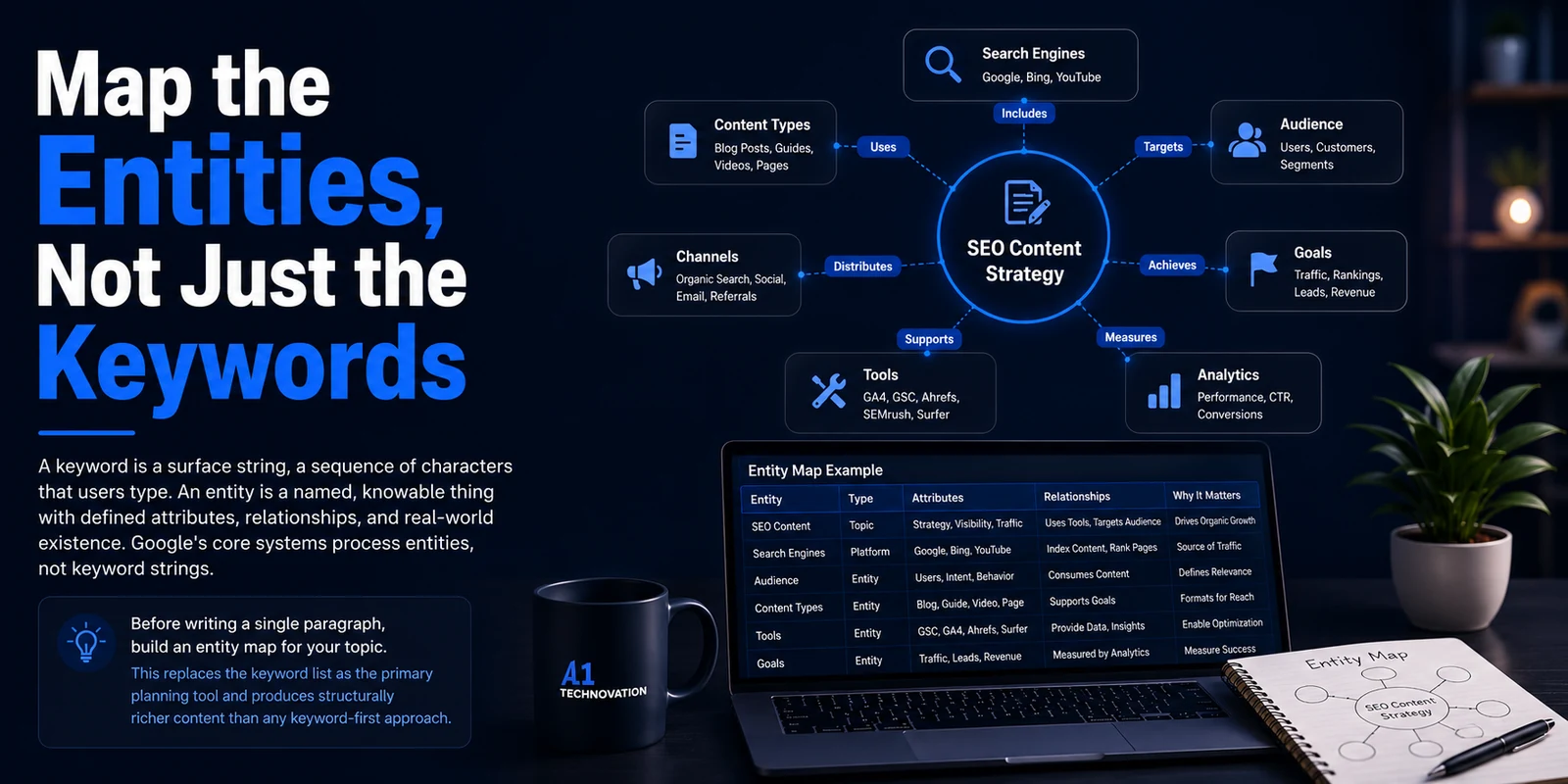
A keyword is a surface string, a sequence of characters that users type. An entity is a named, knowable thing with defined attributes, relationships, and real-world existence. Google's core systems process entities, not keyword strings.
Before writing a single paragraph, build an entity map for your topic. This replaces the keyword list as the primary planning tool and produces structurally richer content than any keyword-first approach.
Keywords vs Entities: The Writing Difference
Consider this example: the keyword is "title tag." The entity is a title tag, which is an HTML attribute that specifies the clickable headline displayed for a web page in search engine results pages. It serves as the primary on-page signal for informing Google about a page's topic.
The keyword tells you what phrase to include. The entity tells you what to cover: its function, its format requirements, its relationship to ranking, its interaction with H1 headings, its character limit, and its role in click-through rate. The entity map is the content coverage plan. The keyword is just the label.
The Entity-Attribute-Value Framework for Content Planning
The Entity-Attribute-Value model structures every topic as: what is the entity, what are its properties, and what are the valid values for each property. This model is how Google's Knowledge Graph stores information and how search parsers extract meaning from prose.
For the topic "SEO content writing," the EAV map looks like this:
| Entity | Attribute | Value Type |
|---|---|---|
| SEO content | search intent | Informational / Commercial / Transactional / Navigational |
| SEO content | word count target | Range: 500 to 8,000+ depending on type |
| SEO content | required on-page elements | Title tag, H1, meta description, internal links, schema |
| SEO content | quality signals | EEAT, Information Gain, entity density, passage indexability |
| SEO content | AI optimization layer | Passage engineering, FAQPage JSON-LD, Speakable schema |
| Content brief | required elements | 12 named elements (intent, entity map, query cluster, etc.) |
| EEAT | dimensions | Experience, Expertise, Authoritativeness, Trustworthiness |
This table becomes your content coverage checklist. Every row is a topic to address. Every gap is a potential competitor advantage.
Semantic Triple Writing: Replace Generic Verbs with Specific Predicates
The predicate, the verb connecting subject and object, determines how cleanly Google's parsers extract a semantic triple from your prose. Generic verbs produce ambiguous triples. Specific verbs produce clear, machine-readable relationships.
Compare these three sentences:
- Generic: "A title tag is important for SEO."
- Better: "A title tag determines the primary keyword signal on any given page."
- Best: "Google uses the title tag to assign topic context and displays it as the clickable headline in search results."
The third sentence contains two extractable triples with named entities and specific predicates. AI retrieval systems extract this type of sentence at a significantly higher rate than generic claims.
Replace "is," "has," "involves," and "includes" with: requires, enables, restricts, determines, generates, prevents, measures, links to, depends on, signals, and informs. Every section gets richer and more citable as a result.
Building Your Entity Map Before You Write
Before opening your document, list the central entity plus 10 to 15 related entities that must appear in the article. For "how to write SEO content," our entity map includes: search intent, keyword research, content brief, title tag, meta description, H1 heading, internal link, schema markup, EEAT, passage indexing, entity-attribute-value model, Information Gain, Speakable schema, and FAQPage JSON-LD.
Every entity on this list must appear in the article at least once, named specifically, with at least one attribute described. This practice alone raises entity density and topical coverage beyond what most competitors produce.

Step 3: Build Your Content Brief at the Semantic Level
A semantic content brief is the document that defines every structural, entity, and optimization requirement before writing begins. Most teams use a keyword-level brief: primary keyword, secondary keywords, approximate length, and a loose outline. The semantic brief goes four layers deeper.
A semantic content brief defines 12 elements: target URL, primary entity, primary keyword with secondary keyword cluster, search intent confirmation with SERP evidence, entity map, H-tag semantic outline, target SERP features, competitor gap list, question mapping, word count rationale by intent type, internal link map, schema type assignments, and CTA placement plan.
Keyword Brief vs Semantic Brief: Side-by-Side
| Element | Keyword Brief | Semantic Brief |
|---|---|---|
| Topic definition | "Target keyword: X" | Central entity + 12 related entities + EAV map |
| Research input | Keyword volume and difficulty | SERP analysis + competitor gap + PAA questions |
| Outline | Loose subtopic list | Semantic H-tag structure (entity-attribute hierarchy) |
| Internal links | 1-2 suggestions | Full inbound + outbound map with anchor text and predicate type |
| Schema | Not specified | Full schema stack per page type |
| EEAT plan | Not specified | Specific experience signals, data to cite, author credentials |
| AI optimization | Not included | Passage engineering + FAQPage + Speakable + robots.txt |
| CTA plan | "Add a CTA at the end" | Highest-intent moment identified, 2 placement points |
The semantic brief takes 30 to 45 minutes to complete. It saves 2 to 3 hours of rewriting caused by structural problems discovered after drafting.
Question Mapping: Mining Real User Language
The People Also Ask box, Related Searches, Reddit, and Quora reveal how real users phrase their questions. These are not just FAQ ideas. They are confirmed query variants that Google already associates with your target keyword.
Mine all four sources before finalizing your H3 structure and FAQ section. Questions from PAA become H3 headings within H2 sections. Questions from Reddit and Quora reveal the vocabulary your audience actually uses, which belongs in your body copy for WSD clarity and semantic depth.
Word Count Rationale by Content Type
Target word count derives from intent, not an arbitrary number. Padding content to hit a word count target does not improve rankings. It dilutes entity density and weakens the information gain score of every section.
Use these ranges as starting points:
- Transactional service pages: 600 to 1,200 words
- Definition and glossary pages: 400 to 800 words
- Informational how-to guides: 2,000 to 4,000 words
- Definitive guides and pillar content: 5,000 to 8,000 words
- Comparison and best-of pages: 1,500 to 3,000 words
Match the length to what the top 5 ranking pages for your query deliver. More important, match the depth. Cover every entity the top results cover, then add the entities they missed.

Step 4: Write the Opening 100 Words First
The first 100 words of your article carry more SEO weight than any other 100-word block. They contain the primary keyword, confirm the reader's intent, establish the hook, and serve as the most-cited passage for both Google's featured snippet system and AI retrieval tools.
Treat the opening 100 words as a distinct writing task with its own requirements, separate from the rest of the article.
The 3-Part Intro Formula
Every high-performing informational article opens with the same structure, regardless of topic:
- Hook (1 to 2 sentences): A specific, surprising, or counterintuitive fact that the reader immediately connects to their own experience. Not a definition. Not "In today's world." A real problem stated precisely.
- Problem (1 to 3 sentences): Expand the hook by naming the root cause. Keep it specific. "Most content teams write before confirming intent" is a problem. "Content strategy is hard" is not.
- Promise (1 to 2 sentences): Tell the reader what this article delivers and who it serves. Specific deliverables: "10 steps," "a checklist," "the exact process we use with clients." Generic promises like "a complete guide" produce higher bounce rates.
The Definition Sentence: Your Featured Snippet Target
Every informational article needs one definition sentence in the opening section. This sentence is the featured snippet target and the most-extracted passage by AI systems.
The format: "[Term] is [definition] that [outcome or function]."
Keep it 40 to 60 words. Name the central entity specifically. Use a specific predicate. Include at least one attribute. End with the real-world outcome the user cares about.
- Bad definition: "SEO content is content that is optimized for search engines."
- Good definition: "SEO content writing is the process of creating web content that ranks in search engines by matching search intent, covering a topic's central entity and its attributes completely, and applying on-page optimization signals including title tags, structured headings, internal links, and schema markup."
The 44.2% Rule: Front-Load Your Most Citable Material
Research on LLM citation patterns consistently shows that 44.2% of AI citations come from the first 30% of a page's content. AI retrieval systems do not read every word. They prioritize early, high-density passages.
Front-load the most factual, entity-rich, predicate-specific content in the opening sections. Definitions, frameworks, named processes, and specific data points belong in the first third. Supplementary detail, edge cases, and supporting examples belong in the middle and end.
Step 5: Structure Your Outline Around Sub-Entities
An outline built on topics produces a topic list. An outline built on sub-entities and their attributes produces a semantic map. The difference in ranking performance is significant because Google's parsers extract entity-attribute relationships, not topic labels.
The 3-Layer Context Model
The 3-Layer Context Model
Google evaluates every web page within three layers of context simultaneously:
- Macro context: The site-level category. For A1 Technovation, the macro context is "digital marketing agency."
- Meso context: The content cluster or section. For this article, the meso context is "content strategy."
- Micro context: The specific page topic. For this article, the micro context is "how to write SEO content."
All three layers must align. A page about SEO content writing on a digital marketing agency site within a content strategy cluster has strong alignment across all three layers. A page about SEO content writing on an unrelated niche site with no cluster context has weak alignment and ranks harder.
Building a Semantic H-Tag Hierarchy
Use this structure for every article:
- H1: Central entity + primary intent
- H2: Sub-entities and key attributes of the central entity
- H3: Sub-attributes, specific use cases, questions, or methods within that H2
A semantic outline names entity-attribute relationships rather than generic topic labels. Every H2 should clarify what part of the system the section is actually explaining.
The Self-Contained Section Rule
Every H2 section must make complete sense without the surrounding context of the article. A reader who lands directly on that section from a search or AI citation must receive a complete, useful answer.
This rule serves two purposes: it makes every section citation-ready for AI retrieval, and it maximizes featured snippet eligibility because Google extracts passage-level answers, not full-article summaries.
Semantic H-Tag Hierarchy in Practice
Step 6: Apply the Section Writing Formula to Every H2
The Section Writing Formula is A1 Technovation's standard structure for every H2 section in any guide or article. It maximizes entity density, passage indexability, and natural readability at the same time.
The Section Writing Formula
The formula has four parts, in this sequence:
- Direct Answer (40 to 60 words): Open the section with the answer to the implied question.
- Supporting Context (60 to 120 words): Expand on the direct answer with the mechanism, reasoning, or framework behind it.
- Example or Data (40 to 80 words): Make the point concrete with a specific example, a client result, or a named data point with a cited source.
- Internal Link (1 placement): Place one contextual internal link to a related resource in the body text.
Paragraph Length Discipline: The 40-80 Word Rule
Every body paragraph stays between 40 and 80 words. Paragraphs shorter than 40 words lack enough context to stand alone as passage-indexed content. Paragraphs longer than 80 words lose scannability and dilute entity density per sentence.
Natural Section Transitions
Connect sections with a bridge sentence that references the completed step and previews the next one. "Search intent confirms what format to write. The entity map determines what to cover inside that format." is the kind of transition that adds real meaning.
Step 7: Add On-Page SEO After the Draft, Not During

On-page SEO applied during writing degrades both tasks. Complete the draft first. Run on-page SEO as a separate pass.
Title Tags: Keyword Position Matters More Than Keyword Presence
The primary keyword belongs near the front of the title tag. "How to Write SEO Content That Ranks (2026 Guide)" places the keyword in positions 1-5. "The Complete 2026 Guide to How to Write SEO Content" buries it later.
Meta Descriptions: Write Them Like Ads
The meta description does not directly affect rankings. It drives click-through rate, which indirectly affects rankings through engagement signals. Write it as an ad: identify the problem, name the solution, state the benefit, and include a call to action.
Bad: "Learn how to write SEO content in this comprehensive guide for beginners and marketers."
Good: "A 10-step system for writing SEO content that ranks on Google and gets cited by AI. Covers search intent, entity mapping, EEAT, and AI retrieval."
H1, URL, and Alt Text: The Three Most Under-Optimized Elements
- H1: One per page, must match the primary search intent of the page.
- URL: Short, lowercase, hyphenated, keyword-inclusive, and no dates for evergreen content.
- Alt text: Use the format: "[entity] [attribute or action] [context]."
Internal Linking: The Reasonable Surfer Model
Google's Reasonable Surfer model gives more weight to links placed in relevant body copy than in headers, footers, or sidebars. The best internal links feel useful to the reader, not forced for SEO.
Anchor Text Diversity: The 50/30/20 Rule
Our recommended distribution:
- 50% semantic or LSI anchors: descriptive phrases that name the topic without exact-match repetition
- 30% branded or generic anchors: "A1 Technovation's guide," "our article," "this resource"
- 20% partial or exact-match anchors: used sparingly and never repeated to the same destination
On-Page SEO Verification Checklist (12 Points)
| # | Element | Target |
|---|---|---|
| 1 | Title tag | Under 60 chars, keyword near front |
| 2 | Meta description | Under 160 chars, problem + solution + CTA |
| 3 | H1 | Matches primary intent, differs from title tag |
| 4 | URL | Short, lowercase, hyphenated, keyword-inclusive |
| 5 | Primary keyword in first 100 words | Confirmed |
| 6 | Primary keyword in at least one H2 | Confirmed |
| 7 | Image alt text | All images |
| 8 | Internal links | 5 to 8 per article |
| 9 | Anchor text diversity | Verified |
| 10 | External citation links | 2 minimum |
| 11 | Schema types assigned | Article + HowTo + FAQPage + BreadcrumbList |
| 12 | Refresh date scheduled | Per decay table |
Step 8: Layer In EEAT Signals Before Publishing
E-E-A-T describes a cluster of quality signals that Google's quality raters use to evaluate content. These signals also influence algorithmic ranking, particularly for queries where users need to trust the source.
Most guides define EEAT. This section teaches you to demonstrate it with specific language patterns that Google's evaluators and AI retrievers both recognize.
Experience
First-hand proof that the advice comes from live implementation.
- First-person client examples with before and after outcomes.
- Named client type, industry, and the exact working context.
- Specific percentage lifts, conversion deltas, or measurable business results.
Expertise
Method-driven signals that show domain fluency, not generic advice.
- Named tools, frameworks, systems, and repeatable methodologies.
- Specific vocabulary that belongs to the topic and its real workflows.
- Measured results tied to timelines, scope, and implementation detail.
Trustworthiness
Signals that reduce doubt and make the content easier to believe and cite.
- Every statistic connected to a named source instead of vague references.
- Realistic timelines and claims without hype, shortcuts, or empty promises.
- Organization schema with verified sameAs links that ground the brand entity.
Experience: Specific, First-Person, Verifiable
Experience signals require first-person specificity. "Working with e-commerce clients at A1 Technovation, we found that content briefs with entity maps produced 40% faster draft approval than keyword-only briefs" is an experience signal. "Content briefs improve quality" is not.
Expertise: Named Tools, Methods, and Measurable Results
Expertise shows in the precision of your vocabulary and the specificity of your methods. Name the tool, name the method, and name the metric.
Authoritativeness: Author Schema and Third-Party Validation
Every article should carry a named author with credentials, a link to the author bio page, and Person JSON-LD schema with sameAs links connecting the author entity to LinkedIn, professional directories, and personal sites.
{
  "@context": "https://schema.org",
  "@type": "Person",
  "name": "Likhon Ahmed",
  "url": "https://a1technovation.com/pages/about.html",
  "jobTitle": "Founder & CEO, A1 Technovation",
  "sameAs": [
    "https://www.linkedin.com/in/likhonahmed",
    "https://a1technovation.com/"
  ]
}
Trustworthiness: Named Sources, Realistic Claims, No Hype
Every statistic in an article needs a named source. Realistic expectations also contribute to trustworthiness signals. State timelines that match the actual evidence.
EEAT Verification Checklist (12 Signals)
| # | Dimension | Signal to Verify |
|---|---|---|
| 1 | Experience | First-person client example included |
| 2 | Experience | Specific before/after result stated |
| 3 | Experience | Named client type and context |
| 4 | Expertise | Named methodology or framework |
| 5 | Expertise | Specific tools named with use cases |
| 6 | Expertise | Measurable result with timeframe |
| 7 | Authoritativeness | Named author with credentials |
| 8 | Authoritativeness | Person JSON-LD with sameAs array |
| 9 | Authoritativeness | External citation links (2 minimum) |
| 10 | Trustworthiness | Every statistic has a named source |
| 11 | Trustworthiness | No hype claims or unverifiable promises |
| 12 | Trustworthiness | Organization schema with sameAs array |
Step 9: Run the AEO and GEO Optimization Pass
Answer Engine Optimization and Generative Engine Optimization are not separate strategies from SEO. They are the same content engineered for a different extraction mechanism. Google AI Overviews, ChatGPT, Perplexity, and Gemini all pull answers from pages that are factual, structured, and entity-rich.

Passage Engineering: Write Every H2 for AI Extraction
AI retrieval systems pull passages, not full pages. Every H2 section must contain at least one extractable passage that starts with a direct answer, names at least two entities, and uses specific predicates.
Citation Hooks: Link to Sources AI Systems Trust
Add at least two external citation links per article pointing to named authoritative sources. Link to the official source for any statistic you cite and to Google Search Central documentation when referencing Google's ranking behavior.
FAQPage JSON-LD: Machine-Readable Answers
{
  "@context": "https://schema.org",
  "@type": "FAQPage",
  "mainEntity": [
    {
      "@type": "Question",
      "name": "What is SEO content writing?",
      "acceptedAnswer": {
        "@type": "Answer",
        "text": "SEO content writing is the process of creating web content that ranks in search engines by matching search intent, covering a topic's central entity and attributes completely, and applying on-page optimization signals including title tags, structured headings, internal links, and schema markup."
      }
    }
  ]
}
Speakable Schema: Mark Your Most Citable Passages
{
  "@context": "https://schema.org",
  "@type": "WebPage",
  "speakable": {
    "@type": "SpeakableSpecification",
    "cssSelector": [".article-definition", ".section-formula", ".eeat-checklist"]
  },
  "url": "https://a1technovation.com/blog/how-to-write-seo-content/"
}
Organization Schema + sameAs: Entity Grounding for AI Knowledge Bases
{
  "@context": "https://schema.org",
  "@type": "Organization",
  "name": "A1 Technovation",
  "url": "https://a1technovation.com",
  "description": "Full-stack digital marketing agency specializing in SEO, AEO, and GEO for small and mid-size businesses.",
  "foundingDate": "2018",
  "sameAs": [
    "https://www.linkedin.com/company/a1technovation",
    "https://www.facebook.com/a1technovation"
  ]
}
robots.txt AI Bot Permissions
User-agent: GPTBot
Allow: /

User-agent: PerplexityBot
Allow: /

User-agent: ClaudeBot
Allow: /
The AI search layer is where small businesses gain the fastest visibility advantage right now. At A1 Technovation, we have helped clients achieve Google AI Overview citations for local and niche queries within 60 days of content launch. Request a free AI search readiness audit to see where your site stands.
Step 10: Run the Information Gain Check, Then Refresh on Schedule
Information Gain is the principle behind Google's ability to distinguish original content from content that simply rephrases what already ranks. Content with high information gain adds facts, perspectives, data, or frameworks that the existing top results do not contain.

The Information Gain Principle in Practice
Every H2 section should contain at least one piece of information not found in the current top 5 results for your target query. One original data point, one named methodology, one client example, or one specific step competitors only describe vaguely.
The 3-Question Pre-Publish Information Gain Check
- Does this section contain at least one specific data point, named methodology, or perspective not found in the top 5 competitors?
- Can a reader find every claim in this article with a single Google search, or does at least some portion require your site specifically?
- Does the article include at least one A1 Technovation-specific insight that competitors structurally cannot replicate?
The 15-Minute Competitor Gap Analysis
Open the top 5 ranking pages for your target keyword. List every H2 heading from each page in a table and compare that list against your article outline before you publish.
Content Decay Table: Refresh Windows by Content Type
| Content Type | Refresh Window | Primary Trigger |
|---|---|---|
| News and trending posts | 30 to 90 days | GSC impression drop |
| Stats and data posts | 3 to 6 months | Source data updates |
| Tool comparison posts | 3 to 6 months | Product change or new market entrant |
| How-to guides | 6 to 12 months | SERP format shift or ranking drop |
| Evergreen and definitional | 12 to 18 months | Top-5 position drop or CTR drop over 20% |
| Local landing pages | 6 months | NAP change or review velocity drop |
Refresh Triggers: When to Update Before the Window Closes
- Ranking position drops more than 5 places within 30 days
- CTR drops more than 20% compared to the prior 30-day period
- A data point or statistic cited in the article is more than 12 months old
- A major algorithm update is confirmed and pages in your cluster see visibility changes
- A competitor publishes a new article that covers topics you missed
SEO Content Writing Checklist: 20 Points to Verify Before Publishing
| Phase | Checklist Item | Done? |
|---|---|---|
| Pre-Writing | Search intent confirmed from SERP signals | ☐ |
| Pre-Writing | Entity map built (10+ named entities) | ☐ |
| Pre-Writing | Semantic content brief completed (12 elements) | ☐ |
| Pre-Writing | Competitor gap list documented | ☐ |
| Pre-Writing | Question map built from PAA + Reddit + Quora | ☐ |
| Writing | Opening 100 words include primary keyword | ☐ |
| Writing | Every H2 opens with a 40-60 word direct answer | ☐ |
| Writing | Section Writing Formula applied to every H2 | ☐ |
| Writing | Paragraphs kept to 40-80 words | ☐ |
| On-Page | Title tag: keyword near front, under 60 chars | ☐ |
| On-Page | Meta description: problem + solution + CTA, under 160 chars | ☐ |
| On-Page | H1 matches primary intent (not title tag repeat) | ☐ |
| On-Page | URL: short, lowercase, hyphenated, keyword-inclusive | ☐ |
| On-Page | Alt text: entity declaration format on all images | ☐ |
| EEAT | First-person experience signal included | ☐ |
| EEAT | Every statistic has a named source | ☐ |
| EEAT | Author schema implemented | ☐ |
| AEO/GEO | FAQPage JSON-LD implemented | ☐ |
| AEO/GEO | Speakable schema applied to 2-3 key passages | ☐ |
| AEO/GEO | robots.txt AI bot permissions added | ☐ |
Old SEO Content vs New SEO Content: The Approach Has Changed
| Old Approach (Pre-2023) | New Approach (2026) |
|---|---|
| Write around a keyword | Build around an entity and its attributes |
| Hit a word count target | Match intent depth; never pad to reach a number |
| Keyword in title = optimized | Semantic H-tag hierarchy covering all sub-entities |
| Keywords placed naturally | Specific predicates in semantic triples |
| Generic intro paragraph | 3-part intro formula |
| Write it once and wait | Decay table + scheduled refresh cycle |
| Single topic focus | Topical cluster with a full internal link graph |
| EEAT as an afterthought | EEAT signals built into the brief before writing |
| No AI optimization layer | AEO pass: passage engineering + schema + robots.txt |
| Blog post published = done | 14-day check + refresh triggers + GSC monitoring |
| Internal links added randomly | Reasonable Surfer model + 50/30/20 anchor diversity |
| No information gain check | Pre-publish gap analysis vs top 5 competitors |
SEO Content Writing: At a Glance
The whole workflow, from intent validation to AI citation readiness, structured as one compact operating view.
- 1Confirm search intent from the live SERP before writing anything.
- 2Build the entity-attribute-value map around the topic.
- 3Write the 12-element semantic brief that guides the draft.
- 4Open with the hook, problem, promise intro formula.
- 5Structure the page around sub-entities instead of loose topics.
- 6Run the section formula: Answer → Context → Example → Link.
- 7Complete the on-page SEO pass across 12 checkpoints.
- 8Layer in EEAT signals with proof, methods, and attribution.
- 9-10Finish with AEO/GEO optimization and the information gain review.
Content Length by Search Intent
Match your word count to intent — never pad to hit an arbitrary number.
Frequently Asked Questions About SEO Content Writing
SEO Content Writing: The Core Definition
SEO content writing is the process of creating web content that ranks in search engines by matching search intent, covering a topic's central entity and its key attributes, and applying on-page optimization signals. These signals include title tags, structured headings, internal links, schema markup, and EEAT signals. Unlike general content writing, SEO content writing integrates entity mapping, passage engineering, and AI retrieval optimization as required steps, not optional additions.
The Right Length for SEO Content
Content length should match the intent and depth of the top-ranking pages for your query, not a universal target number. Transactional service pages perform at 600 to 1,200 words. Informational how-to guides perform at 2,000 to 4,000 words. Definitive pillar guides perform at 5,000 to 8,000 words. Padding content beyond what intent requires dilutes entity density and lowers the information gain score of every section.
SEO Content Writing Without Paid Tools
Google Search, Google Keyword Planner, Ahrefs Webmaster Tools free tier, and Google Search Console together cover most of the research process without cost.
The Difference Between SEO Writing and Regular Writing
SEO writing adds search intent confirmation, entity and attribute coverage planning, and on-page optimization implementation before and after the draft.
AI Tools and SEO Content
AI tools can accelerate drafting, but they still require an EEAT pass and an information gain pass before the content is ready to publish.
The Right Number of Keywords per SEO Article
Target one primary keyword, one to two secondary keywords, and a supporting vocabulary driven by the entity map rather than a stuffed keyword list.
SEO Content for Small Businesses vs Enterprise
The process is the same. The competition level, topic selection, and authority requirements differ.
Getting SEO Content Cited by AI Systems
Use passage engineering, FAQPage schema, Speakable schema, Organization schema, and clear bot permissions to improve the odds of AI citation.
Keep the writing system connected to the wider SEO stack
These companion guides help you connect content execution with on-page structure, search mechanics, and overall strategy.
Build Your SEO Content Program with A1 Technovation
You have the full system. The next step is execution: build it in-house or work with a team that already runs this process across live client campaigns.
At A1 Technovation, we help businesses turn strategy into output across the full stack: entity research, semantic briefs, writing, on-page SEO, EEAT integration, and AEO/GEO implementation.
Request a Free SEO Content AuditOr explore our content strategy services to see how we adapt this system to your market, competition level, and growth goals.