
SEO for HVAC companies is the process of optimizing your website, Google Business Profile, and online presence so homeowners find your business first when they search for heating and cooling services in your area. A well-executed HVAC SEO strategy covers five connected layers: technical SEO, local SEO, on-page content, off-page authority, and AI engine optimization. Get all five working together, and your HVAC business generates consistent inbound calls without depending entirely on paid ads.
This guide walks through every layer in the order you should tackle them. Skip around if you want, but the sequence matters. Technical problems left unfixed will undercut everything else you build on top.
The HVAC Search Landscape in 2026
How Homeowners Search for HVAC Services
Homeowners search for HVAC services in three distinct modes, and each one carries different intent, urgency, and conversion speed.
- Emergency mode: "AC not cooling," "heat not turning on," "furnace stopped working at night." These searches happen in real time, often from a phone, and the person making them wants a phone number within seconds. They are not browsing. They are buying.
- Seasonal mode: "furnace tune-up before winter," "AC maintenance spring checklist," "HVAC service before summer." These searches peak 6 to 8 weeks before each season. The person has time to compare options but is moving toward a decision.
- Research mode: "how long does an HVAC system last," "SEER rating explained," "heat pump vs furnace comparison." These are informational queries from homeowners planning a future purchase or trying to understand a problem. They rarely convert today, but they build trust and feed the top of your sales funnel.
Your site needs content targeting all three modes. Most HVAC websites only target the first. That gap is where your content strategy builds real separation from competitors.
Voice search adds a fourth pattern worth noting. Homeowners ask Google Assistant and Siri things like "best HVAC company near me open now" or "who does AC repair in [city] on weekends." These conversational queries reward businesses with complete Google Business Profiles, consistent operating hours, and structured data that surfaces emergency availability. If you need the technical foundation behind that setup, start with our technical SEO checklist.
The Three-Layer HVAC Search Result System
Most HVAC contractors treat Google search as a single competition. It is actually three separate competitions running at once.
The 3-Layer Search Result System
- Layer 1: The Google Map Pack. The three local results that appear with a map when someone searches "AC repair near me" or "HVAC contractor [city]." This is where the majority of emergency calls originate. Winning here depends on your Google Business Profile, reviews, and local SEO signals.
- Layer 2: Organic blue link results. The traditional 10 ranked web pages below the Map Pack. HVAC SEO service pages, location pages, and blog content compete here. This layer produces slower but more compounding traffic over time.
- Layer 3: AI Overviews and AI-generated answers. Google now places AI-generated summaries above organic results for a growing share of queries. ChatGPT, Perplexity, and Gemini also recommend local contractors directly. This layer is new, underoptimized by most HVAC companies, and growing fast.
A complete HVAC SEO strategy targets all three layers with different tactics for each. We cover all three in this guide.
The Paid Ads Problem That Makes Organic SEO Worth Building
Cost-per-click for top HVAC keywords runs $28 to $60 per click in competitive metro areas. "AC repair near me" regularly exceeds $50 per click in cities like Dallas, Phoenix, and Atlanta during peak season.
An HVAC company spending $8,000 per month on Google Ads to generate 160 clicks gets roughly 160 website visits. Stop paying and get zero. Every dollar spent on ads disappears the moment the campaign pauses.
SEO works differently. A page that ranks today keeps generating calls for months or years without ongoing spend. The effort compounds. That is the core economic argument for building an organic channel alongside paid ads, not instead of them.
HVAC Keyword Research: Finding the Searches That Generate Calls
The Five HVAC Keyword Categories
HVAC keyword research starts by sorting search terms into five categories. Each category requires a different content type and targets a different buyer stage. For the broader mapping process, our SEO strategy guide explains how to connect keywords to page types without creating overlap.
| Category | Example Queries | Intent | Best Content Type |
|---|---|---|---|
| Emergency | "AC not working," "heater broke overnight," "emergency HVAC repair" | Transactional | Service page with phone CTA above fold |
| Service-specific | "furnace installation cost," "duct cleaning near me," "heat pump repair" | Commercial | Dedicated service page per service |
| Seasonal | "AC tune-up before summer," "furnace check fall," "HVAC maintenance schedule" | Informational/Commercial | Blog post or seasonal landing page |
| Location-modified | "HVAC contractor Dallas TX," "AC repair near me," "heating company Chicago" | Transactional/Local | Location page + GBP optimization |
| Informational | "how long does HVAC last," "SEER rating explained," "heat pump vs furnace" | Informational | Blog post or FAQ page |
Emergency keywords carry the highest conversion rate and the highest CPC in paid search. Every organic ranking you earn for those terms is money you stop spending on ads.
How to Do HVAC Keyword Research Step by Step
- Step 1: Start with Google Autocomplete. Type your core service terms into Google without pressing enter. The dropdown suggestions are real searches from real homeowners. Type "AC repair" and Google shows you "AC repair near me," "AC repair cost," "AC repair vs replacement," and "AC repair same day." Each suggestion is a keyword opportunity.
- Step 2: Mine the "People Also Ask" boxes. Run a few of your core searches and capture every question in the PAA box. These questions map directly to blog content topics and FAQ sections. They also reveal what Google already understands as related to your core queries.
- Step 3: Check "Related Searches." At the bottom of every Google results page, you get 8 related searches. These typically include location modifiers, cost variants, and seasonal angles you might miss from autocomplete alone.
- Step 4: Use a keyword tool for volume and difficulty data. Ahrefs, SEMrush, and Moz all work well. Search your top service terms and filter by location. Look at monthly search volume and keyword difficulty side by side. Your target is high intent with manageable difficulty, not the highest volume term in the category.
- Step 5: Build a keyword map. Assign one primary keyword to each page on your site. Every service page owns one commercial keyword. Every location page owns one geo-modified keyword. Every blog post owns one informational keyword. This structure prevents keyword cannibalization and gives Google a clear signal about each page's purpose. Use the same intent discipline described in our on-page SEO guide when you write titles, headings, and internal anchors.
Keywords to Prioritize First
If you are starting from scratch, this is the priority order:
- "[Your primary service] [your city]": highest-value, fastest-converting local term
- "Emergency [service] [city]": captures urgent, same-day buyers
- "[Service] cost [city]": commercial investigation intent, strong conversion
- "[Service] near me": high local search volume across markets
- "[Service] [city] reviews": trust-seeking searchers close to a decision
Build these pages first. Add informational content once your commercial pages are live and indexed.
Technical SEO for HVAC Websites
The Five Most Common Technical Failures on HVAC Sites
In our audits of HVAC websites, over 70% have at least three of these five failures active. Each one costs rankings.
Thin service pages. A page with under 300 words on "AC repair" gives Google nothing to evaluate. Google has no evidence of expertise, no service details, no local signals. Thin pages do not rank. For a service-page example in the same niche, review the SEO services for HVAC companies page.
No schema markup. Without structured data, Google and AI platforms have to guess what your business does and where it operates. With schema, you tell them directly. This is particularly important for emergency service availability. An AI tool that can clearly confirm your after-hours service recommends you. One that cannot often skips you.
Slow mobile load speed. Over 60% of HVAC searches happen on mobile. An emergency searcher whose AC failed at 9pm is not waiting 6 seconds for your homepage to load. They are already calling the next result. Target under 2.5 seconds on mobile.
Poor site architecture. Cramming all services onto one "Services" page prevents you from ranking for any of them. Each service needs its own URL, its own keyword target, its own content.
Missing HTTPS. Every HVAC site needs an SSL certificate. It is a trust signal for visitors and a confirmed ranking factor for Google. Any site still running on HTTP in 2026 is losing rankings unnecessarily.
Site Architecture for HVAC Companies
Your URL structure should follow a clean hub-and-spoke model.
HVAC Website Architecture
Each service page links to the most relevant location pages. Each location page links back to all relevant service pages. The blog links to both. This internal linking structure distributes authority across the site and tells Google what each page covers.
Page Speed and Core Web Vitals
Google uses Core Web Vitals as a ranking factor. For HVAC sites, three metrics matter most.
- LCP (Largest Contentful Paint): The time it takes for the main content element to load. Target under 2.5 seconds. The most common culprit is a large, uncompressed hero image on the homepage.
- CLS (Cumulative Layout Shift): Measures how much the page jumps around as it loads. A page that shifts when ads or fonts load frustrates users. Target a score under 0.1.
- INP (Interaction to Next Paint): Replaced FID in March 2024. Measures how quickly the page responds to user clicks. Target under 200 milliseconds.
Run your site through Google PageSpeed Insights (free). Fix images first. Compress every image to under 150KB without visible quality loss. Then remove unused JavaScript and switch to a content delivery network (CDN) if you are not already using one.
Schema Markup for HVAC Businesses
Schema markup is structured code that tells Google and AI platforms exactly what your business is, what it does, where it operates, and when it is open. Without it, those systems have to guess. With it, you give them a direct, machine-readable answer.

These are the schema types every HVAC site needs:
| Schema Type | Purpose | Where to Add |
|---|---|---|
| LocalBusiness | Name, address, phone, hours, service area | Homepage, contact page |
| Service | Individual schema per HVAC service offered | Each service page |
| FAQPage | Feeds featured snippets and AI Overviews | FAQ sections, blog posts |
| Review | Displays star ratings in search results | Service pages with review data |
| BreadcrumbList | Clarifies site structure for Google | All pages |
| Speakable | Flags specific passages for voice search | Key service and FAQ pages |
LocalBusiness JSON-LD Example:
{
  "@context": "https://schema.org",
  "@type": "LocalBusiness",
  "name": "[Your HVAC Company Name]",
  "address": {
    "@type": "PostalAddress",
    "streetAddress": "[Street Address]",
    "addressLocality": "[City]",
    "addressRegion": "[State]",
    "postalCode": "[ZIP Code]"
  },
  "telephone": "[Your Phone Number]",
  "openingHours": [
    "Mo-Fr 07:00-19:00",
    "Sa 08:00-17:00"
  ],
  "areaServed": [
    {"@type": "City", "name": "[City 1]"},
    {"@type": "City", "name": "[City 2]"},
    {"@type": "City", "name": "[City 3]"}
  ],
  "url": "https://yourdomain.com",
  "priceRange": "$$",
  "hasOfferCatalog": {
    "@type": "OfferCatalog",
    "name": "HVAC Services",
    "itemListElement": [
      {
        "@type": "Offer",
        "itemOffered": {
          "@type": "Service",
          "name": "AC Repair"
        }
      },
      {
        "@type": "Offer",
        "itemOffered": {
          "@type": "Service",
          "name": "Furnace Installation"
        }
      }
    ]
  }
}
Validate every schema block in Google's Rich Results Test before publishing. Broken schema is worse than no schema and can trigger manual review flags.
On-Page SEO for HVAC Service Pages and Location Pages
The Anatomy of an HVAC Service Page That Ranks
Every dedicated service page needs these elements to compete for commercial keywords.
- Title tag: Under 60 characters, primary keyword near the front. "AC Repair in Dallas, TX | [Company Name]" works. "Welcome to Our Air Conditioning Services Page" does not.
- H1: Matches the title intent, includes the primary keyword. One H1 per page, always.
- Meta description: Action-oriented, under 160 characters, includes the primary keyword and a reason to click. "Affordable AC repair in Dallas with same-day service. Licensed technicians, upfront pricing. Call [phone] for a free estimate."
- First paragraph: Answers the search query directly in 2 to 3 sentences. No setup. No backstory. The homeowner landed on this page because their AC is not working. Get to the point.
- Body copy: 800 to 1,500 words minimum. Cover the service in detail: what it includes, how long it takes, what it costs on average, what signs indicate you need it, and how your company handles it. Thin pages do not compete.
- Real photos: Actual team photos and job photos. Not stock imagery. Google's Helpful Content system is getting better at detecting sites that look like templates with no real-world evidence.
- Trust signals: NATE certification badge, EPA 608 license, manufacturer authorizations, years in business, Better Business Bureau rating. Link the badges back to the issuing organization's site.
- CTAs: Phone number prominently placed at the top and bottom. Click-to-call on mobile. A short contact form for non-urgent requests. Keep the primary CTA visible without scrolling.
- Internal links: At minimum, 2 to 3 links from this page to related service pages and your most relevant location page.
Writing Content That Ranks and Converts
The most important structural rule for HVAC page copy: answer the question first. The first sentence of each section should directly state the answer to what that section promises. No wind-up, no context-setting paragraph before the information.
This rule serves two purposes. For human readers, it respects their time. For AI platforms, answer-first structure is exactly the format that gets extracted and cited in Google AI Overviews, featured snippets, and PAA boxes.
Use real technician language throughout. Homeowners trust specificity. "We check refrigerant levels, inspect electrical connections, clean the evaporator and condenser coils, and test system pressures" is more convincing than "we provide thorough AC maintenance." Specificity builds credibility without requiring a certification on the page.
Address the two questions every HVAC customer has before they call: "How much will this cost?" and "Do I repair or replace?" Pages that answer both directly convert better than pages that push visitors to call for a quote on every question.
Location Pages: Ranking in Every City You Serve
Every city in your service area needs its own page. One generic service area page does not rank for any city. Separate pages, each with unique content, give you a chance to rank for "[service] [city]" in every market you cover.
Each location page needs:
- A city-specific headline: "HVAC Repair in [City], [State]"
- Unique body content, not a copy-paste of another city page with the name swapped
- Local references: neighborhoods, landmarks, or climate-specific service notes
- Reviews from customers in that specific city
- A Google Maps embed showing your business location or service area
- LocalBusiness schema with city-level address or service area data
- Internal links up to the relevant service pages and across to other location pages
The city-specific content does not need to be long. Four to six well-written paragraphs with real local detail outperform 2,000 words of generic copy every time.
Local SEO for HVAC Contractors
Google Business Profile Optimization
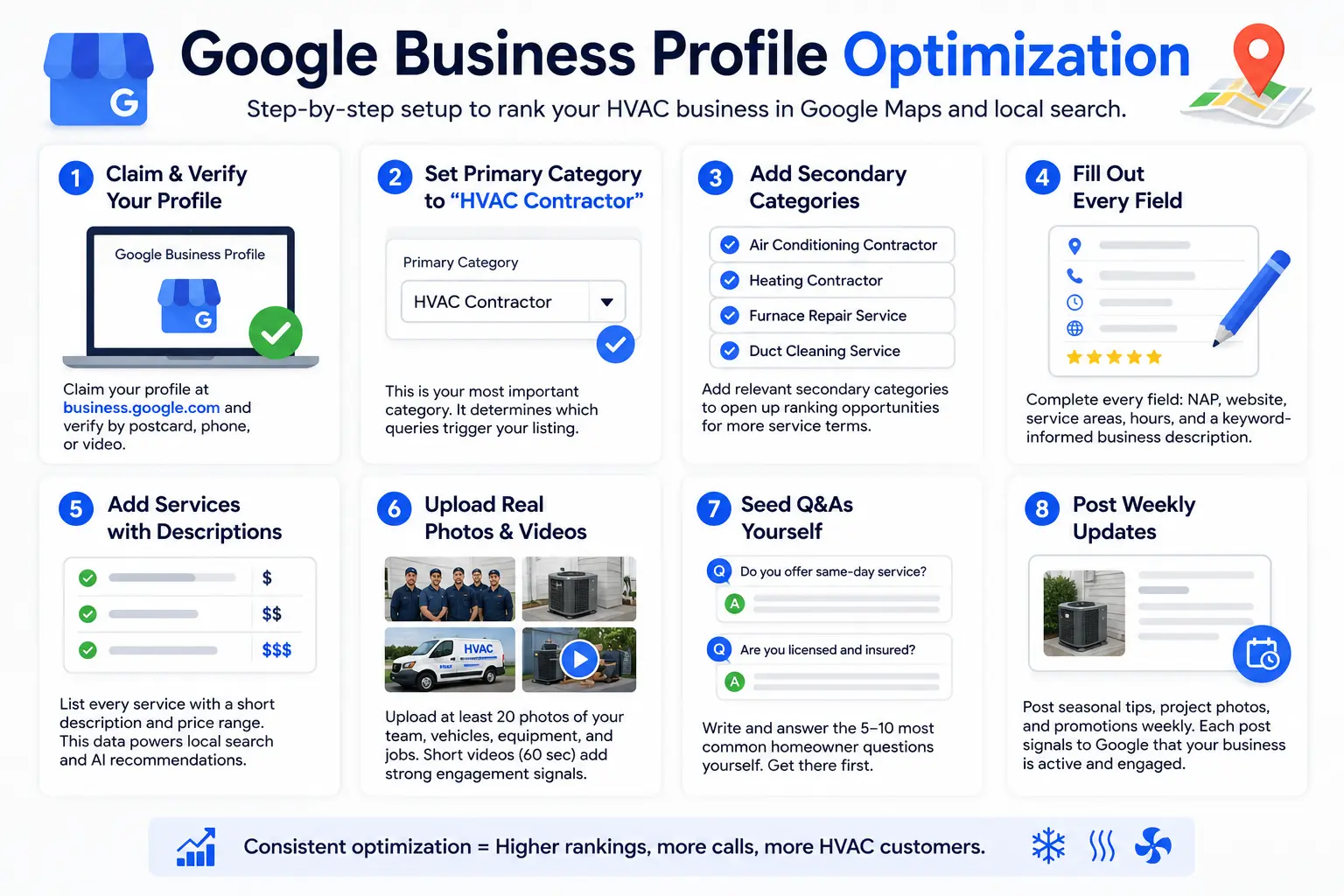
Your Google Business Profile (GBP) is the single most direct path to appearing in the Map Pack. Homeowners who search "AC repair near me" see three businesses on a map before they see any website. That map comes from GBP data.
Here is the step-by-step setup process:
- Step 1: Claim and verify your profile at business.google.com. If your business already exists, claim it. If not, create it. Verification happens by postcard, phone, or video, depending on your account history.
- Step 2: Set your primary category to "HVAC Contractor." This is your most important category selection. It determines which queries trigger your listing.
- Step 3: Add secondary categories. Each additional category opens up ranking opportunities for specific service terms. Add "Air Conditioning Contractor," "Heating Contractor," "Furnace Repair Service," and any other services you offer.
- Step 4: Fill out every field. Business name, address, phone number, website, service areas, hours of operation, holiday hours, and a keyword-informed business description. Incomplete profiles rank below complete ones.
- Step 5: Add services with descriptions. List every service you offer with a short description and, where possible, a price range. This data feeds directly into local search results and AI recommendations.
- Step 6: Upload real photos. Aim for at least 20 photos covering your team, vehicles, equipment, and completed jobs. In 2026, Google weights video content even more heavily. A short 60-second video of a completed installation or your team in the field adds strong engagement signals.
- Step 7: Seed Q&As yourself. The Q&A section on your GBP lets anyone ask questions. Get there first. Write and answer the 5 to 10 questions homeowners ask most: "Do you offer same-day service?" "Are you licensed and insured?" "Do you work on [brand name] units?"
- Step 8: Post weekly updates. Seasonal tips, completed project photos, limited-time promotions. Each post signals to Google that your business is active and engaged.
NAP Consistency: The Foundation of Local Rankings
NAP stands for Name, Address, and Phone number. Google cross-references your NAP data across dozens of websites to confirm your business is real, legitimate, and located where you say it is. Inconsistencies, even small formatting differences like "St." versus "Street," erode the confidence score Google assigns to your listing.
Audit every directory where your business appears and standardize the format. Use exactly the same name, address, and phone format everywhere. Include the same suite number format, the same state abbreviation, the same phone number format.
These are the core directories every HVAC business should claim and maintain:
- Tier 1 (required for every local business): Google Business Profile, Bing Places for Business, Apple Maps (Apple Maps Connect), Yelp, Facebook Business Page
- Tier 2 (industry and category relevant): YellowPages, BBB, Foursquare, TripAdvisor (hospitality and restaurants), Houzz (home improvement and contractors), Healthgrades, Zocdoc (medical and health), Avvo, Martindale (legal), G2, Clutch (B2B services and agencies)
- Tier 3 (data aggregators that feed hundreds of directories): Data Axle, Neustar Localeze, Foursquare for Business
Getting your NAP correct on Tier 3 aggregators multiplies your citation accuracy across dozens of downstream directories at once.
Review Generation and Velocity
Reviews are one of Google's strongest local ranking signals. Google evaluates four dimensions of your review profile: total count, average rating, recency, and the content of the review text.
Review velocity matters more than total count for ongoing Map Pack performance. A business adding 10 to 15 new reviews per month consistently outperforms one with 300 reviews that went quiet 18 months ago. Google reads recent activity as a sign the business is currently serving customers well.
Review content carries its own signal value. A review that says "Best HVAC company in Dallas, fixed our AC same day" is more valuable than "Great service!" It includes location context and service specificity that reinforces your local keyword signals.
Build a system, not a one-time push:
- Ask every customer verbally at job completion. A direct, personal ask works better than any automated message alone.
- Send a follow-up text within 2 hours with a direct link to your Google review page.
- Set an automated email follow-up for 48 hours after service for customers who did not respond to the text.
- Integrate the request workflow into your CRM or dispatching software (ServiceTitan, Housecall Pro, or similar).
- Respond to every review, positive or negative. For negative reviews: be brief, professional, and offer to resolve the issue offline. Never argue in public.
Off-Page SEO: Building Authority for HVAC Sites
Backlinks are votes of confidence from other websites. A site with strong links from relevant, authoritative sources ranks above a site with weak or irrelevant links. For HVAC businesses, local relevance matters as much as raw authority.
The Link Profile That Wins Local HVAC Rankings
| Link Source | Type | How to Get It |
|---|---|---|
| Manufacturer dealer pages | Industry authority | Apply as an authorized Carrier, Trane, Lennox, or Rheem dealer |
| Local Chamber of Commerce | Local authority | Join the chamber and request your profile listing |
| BBB membership | Trust signal | Paid membership includes a profile link |
| Local news outlets | High authority | Pitch seasonal HVAC story angles to local reporters |
| ACCA membership | Industry authority | Air Conditioning Contractors of America membership directory |
| ASHRAE | Professional authority | Industry association listing |
| Local home improvement blogs | Niche relevant | Expert quote or contributed guide |
| Supplier and distributor pages | Industry relevant | Ask your parts suppliers to list you as a local pro |
The HVAC industry has a structural link-building advantage most contractors ignore: manufacturer authorization programs. Carrier, Trane, Lennox, Rheem, Mitsubishi, and other major manufacturers list authorized dealers on their websites with a direct link. These are high-authority, industry-specific links that most competitors have not claimed.
Earning Local Press Links
Local news sites are among the highest-authority link sources available to any HVAC contractor. A link from your city's newspaper or local business journal carries more SEO weight than dozens of directory citations.
The key to earning press links is giving reporters something newsworthy. HVAC businesses have natural news angles throughout the year.
- Seasonal angles: During a heat wave, a local reporter writing about the surge in service calls will quote the HVAC contractor who reached out first. During a cold snap, the same opportunity exists on the heating side.
- Regulatory angles: The R-410A refrigerant phase-out is a live story in 2026. Homeowners with older systems need to understand what it means for their equipment. A contractor who can explain this clearly to a reporter becomes the local expert source.
- Community angles: Sponsoring a school fundraiser, donating a system to a family in need, or participating in a local charity event all create link opportunities from local organization websites and news coverage.
Reach out directly to the local business reporter or home/garden section editor by email. Offer to be a quote source, not a advertiser. The relationship you build from one press mention often leads to multiple future stories.
Link Building Practices to Avoid
White-hat link building takes time. These shortcuts feel faster but lead to Google penalties.
- Buying backlinks violates Google's spam policies. A manual penalty removes your site from rankings entirely. Recovery takes months.
- Reciprocal link exchanges (I link to you, you link to me) are detectable when done at scale. One or two natural co-promotions with local businesses are fine. A systematic exchange program is not.
- Keyword-stuffed anchor text (using "best HVAC company Dallas" as the anchor text on every inbound link) looks manipulated. Natural anchor text is varied: branded, generic, URL-format, and partial-match.
- Private blog networks (PBNs) are networks of sites built specifically to sell links. Google identifies and deindexes these regularly. The sites linking to you disappear and you lose the links you paid for.
Content Strategy for HVAC Companies
The Three Content Types That Drive HVAC Organic Growth
Service pages capture commercial and transactional searches from buyers ready to book. These are your money pages. Every HVAC service you offer needs its own dedicated page.
Location pages capture geo-modified searches from homeowners in specific cities or neighborhoods. One page per city you serve, with unique content for each.
Blog content captures informational searches from homeowners in the research phase. These pages build topical authority over time and feed Google's AI Overviews with citable content. They convert slower but compound strongly.
All three types support each other. Blog content links to service pages. Location pages link to service pages. Service pages link to related services and relevant blog posts. The internal link structure is what builds topical authority across the site.
The Seasonal HVAC Content Calendar
Publishing timing matters as much as the content itself. A furnace maintenance guide published in November misses the peak search window entirely. Homeowners search for furnace preparation content in September and October, before winter arrives.
Publish 6 to 8 weeks before each season's peak. Use Google Trends filtered by your state or metro area to confirm the exact timing for your market.
HVAC Seasonal Content Publication Windows
Specific Blog Topics That Build Topical Authority and Generate Traffic
Cost guides target commercial investigation intent and convert well. Titles like "How Much Does AC Installation Cost in [City]?" and "Furnace Replacement Cost: Complete Price Guide" pull homeowners who are ready to budget for a purchase.
Comparison guides target research-phase buyers making a decision. "Furnace vs Heat Pump: Which Is Better for [Climate]?" and "Single-Stage vs Two-Stage HVAC: Full Comparison" serve buyers choosing between options.
Troubleshooting guides capture emergency-adjacent searches. "AC Running But Not Cooling: 7 Causes and Fixes" and "Furnace Blowing Cold Air: Step-by-Step Diagnosis" rank for queries that lead directly to service calls.
Maintenance guides build trust and reduce churn. "HVAC Maintenance Checklist: 12 Tasks Homeowners Should Do Each Year" positions your business as an educator, not just a vendor.
Regulatory content captures a growing search segment. The R-410A refrigerant phase-out is actively driving homeowner searches in 2026. A comprehensive guide to the transition, what it means for existing systems, and what homeowners should plan for has almost no local-level competition. Most HVAC companies have not touched this topic yet.
AEO and GEO: Getting Your HVAC Business Cited by AI Engines
The Difference Between SEO, AEO, and GEO
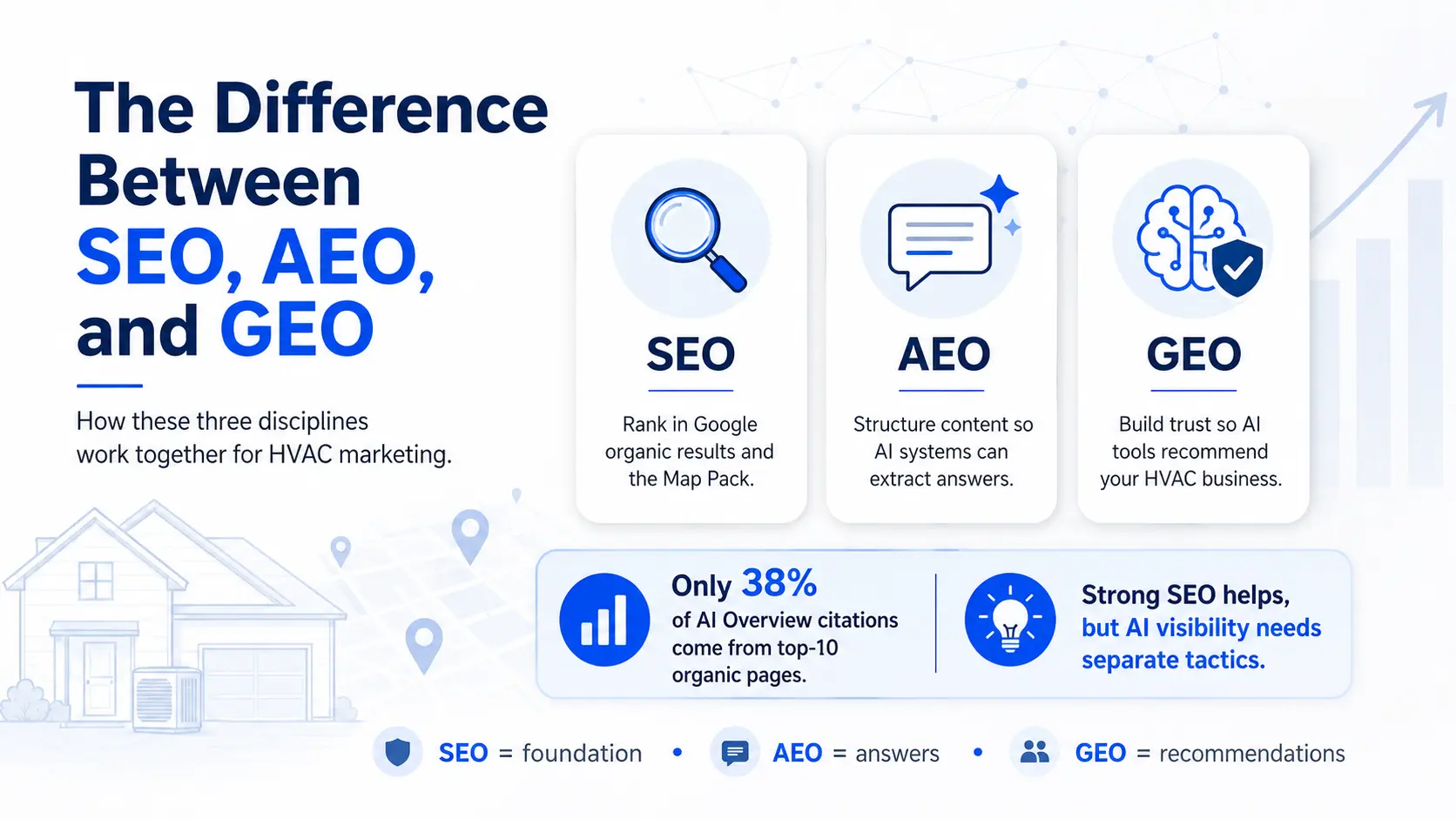
These three disciplines work together. Understanding what each one does helps you know where to focus.
- SEO (Search Engine Optimization) optimizes your website to rank in Google's organic results and the Map Pack. This is the foundation everything else builds on.
- AEO (Answer Engine Optimization) structures your content so AI systems extract and use it to answer questions. This feeds Google AI Overviews, featured snippets, and PAA boxes. The goal is to be the source an AI system pulls from when answering a homeowner's HVAC question.
- GEO (Generative Engine Optimization) builds the entity trust, review signals, and content authority that cause ChatGPT, Gemini, and Perplexity to name and recommend your specific HVAC business when a homeowner asks for a contractor recommendation.
Only about 38% of AI Overview citations come from pages in the top 10 organic results. Strong traditional SEO alone does not guarantee AI visibility. The two strategies overlap but require distinct tactics.
How AI Engines Decide Which HVAC Company to Recommend
AI platforms evaluate multiple signals before recommending a local contractor. These are the signals that matter most.
- Entity consistency. Your business name, address, phone number, and service area need to match across your website, GBP, and every directory listing. Conflicting information across platforms creates entity ambiguity. AI systems default to the business with the cleanest, most consistent entity data.
- Review content. Reviews that mention your business name alongside city names and service types (not just "great service!") reinforce your entity's association with specific geographic and service entities. A ChatGPT response recommending "HVAC contractors in Dallas" pulls from the same entity signals that fuel local SEO.
- Answer-first content structure. AI systems extract content at the passage level, not the page level. A passage that directly answers a question in its first sentence gets extracted. A passage buried under three introductory sentences does not.
- Schema markup. Structured data explicitly declares your business type, services, location, and hours in machine-readable format. Schema reduces the work AI platforms have to do to understand your content. Less guesswork for the AI means more citations for you.
- Multi-platform mentions. Being listed on Yelp, Angi, HomeAdvisor, BBB, your manufacturer's dealer directory, and your Chamber of Commerce creates a web of cross-references that makes your business entity easier for AI systems to locate and trust.
AEO Content Structure for AI Citations
How to Structure Content for AI Citation
These five structural rules increase the probability that AI systems extract and cite your content.
- Rule 1: Answer first. The first sentence of every section should directly state the answer to the section heading as a question. No setup. No preamble. This is the pattern that AI extraction systems favor. It is also the pattern that earns featured snippets and PAA placements.
- Rule 2: Use FAQPage schema. Structured question-and-answer markup directly feeds Google's AI Overview system. Every FAQ section you write should have FAQPage schema applied.
- Rule 3: Ground your content in specific facts. AI systems favor content with specific, verifiable claims. Costs, timelines, certifications, brand names, and model numbers all serve as factual anchors. Vague claims ("we provide excellent service") add no extraction value.
- Rule 4: Apply Speakable schema. This schema type flags specific passages as recommended for voice search extraction. Apply it to your most direct, answer-first passages on service and FAQ pages.
- Rule 5: Maintain entity consistency throughout. Name your business, city, certifications, and manufacturer partnerships explicitly in your content. Entity-grounded language helps AI systems connect your content to your business entity in their knowledge graph.
Platform-by-Platform AI Citation Strategy
Each AI platform pulls from slightly different sources. Tailoring your approach by platform increases citation probability.
- Google AI Overviews: AI Overviews appear at the top of search results for an increasing share of queries. They favor sites already ranking in the top 10 organically, with FAQPage schema and answer-first structure. Maintaining an active GBP with recent reviews and weekly posts reinforces the local business signals that inform AI Overviews for local service queries.
- ChatGPT: ChatGPT uses Bing's search index for real-time queries and draws from its training data for general knowledge. Consistent business mentions across the web build entity recognition. Manufacturer dealer listings, BBB profiles, and Yelp presence all contribute to the entity weight that influences ChatGPT recommendations. Answer-first long-form content on your site feeds ChatGPT's retrieval for question-based prompts.
- Perplexity: Perplexity pulls citations directly from search results, which means your organic search ranking still matters here. Well-organized content with clear headings, specific facts, and direct answers earns citations. Perplexity favors content with verifiable data over general claims.
- Gemini: Gemini pulls heavily from Google's index, GBP data, and local business directories. For local HVAC businesses, a complete and active GBP is the single most important Gemini citation signal. Gemini uses GBP data to answer queries like "who does AC repair in [city]" directly from local business profiles.
Make Sure AI Crawlers Can Access Your Site
Before AI systems can cite your content, they need to be able to read it. Some hosting configurations block AI crawlers without the site owner knowing.
Check your robots.txt file. These user agents should not appear in a Disallow rule:
- GPTBot (OpenAI/ChatGPT)
- Google-Extended (Google Gemini training)
- PerplexityBot (Perplexity)
- Applebot-Extended (Apple AI)
Cloudflare's bot protection settings sometimes block legitimate AI crawlers. Review your Cloudflare security settings and whitelist the above user agents if needed.
Consider adding an llms.txt file to your domain root. This structured file tells AI systems what your site covers, what your primary services are, and how to correctly interpret your content. It is an emerging standard that major AI platforms are beginning to respect.
EEAT Signals That Rank HVAC Sites
Experience
Google's Experience signal rewards content that demonstrates real, first-hand knowledge of the subject. For HVAC websites, this means visible proof of actual work.
Use real job photos throughout your service pages. Before-and-after installation photos, photos of your technicians on the job, images of the actual equipment you install. Stock photography of generic HVAC units does nothing for EEAT.
Write in case-style language where it fits naturally. "During a recent installation in Plano, we found the existing ductwork was undersized by about 30% for the new system's capacity. We resized the supply plenum before the install, which eliminated the airflow imbalance the homeowner had been living with for years." That sentence demonstrates experience. No generic claim matches it.
Expertise
HVAC is a licensed trade. Display that proof prominently.
List every certification your team holds: EPA 608 (refrigerant handling license), NATE certification (North American Technician Excellence), manufacturer-specific training from Carrier, Trane, Lennox, Rheem, Mitsubishi, or others. Link each certification badge back to the issuing organization's verification page.
Create technician bio pages with real names, credentials, years of experience, and a photo. Assign authorship to blog content. When a certified technician is identified as the author of a guide on furnace troubleshooting, that content carries more EEAT weight than anonymous, unattributed content.
Use accurate technical language. Correct SEER ratings, proper refrigerant type references (noting the R-410A to R-454B transition), accurate load calculation terminology. Technical precision signals expertise to both Google and to readers who know their HVAC systems.
Authority
Authority comes from what other credible sources say about you, not what you say about yourself.
Manufacturer dealer authorizations are one of the strongest authority signals in the HVAC industry. Being listed as an authorized Carrier or Trane dealer on the manufacturer's website tells Google and AI platforms that a major industry entity has verified your qualifications.
Industry association memberships signal authority within the trade. ACCA (Air Conditioning Contractors of America) and ASHRAE memberships both include directory listings that link back to your site.
Local press coverage builds authority at the community level. A quote in your local newspaper as the go-to HVAC expert for a seasonal weather story earns both a backlink and an authority signal that pure SEO tactics cannot replicate.
Trust
Trust signals reduce the friction between a search and a call. Every barrier you remove gets you closer to a booked job.
Display your physical address on every page, not just the contact page. A business with a visible address is less likely to disappear after taking a deposit.
Show your license number prominently on service pages. In most states, HVAC contractors are required to hold a state license. Displaying that number with a link to the state license lookup database lets skeptical homeowners verify your credentials in 30 seconds.
Publish real pricing ranges. "Our AC tune-up service runs $89 to $149 depending on system size and condition" is more trustworthy than "call for a quote." Transparency about pricing increases the probability that someone calls, because they already know the number will be reasonable.
Maintain HTTPS across every page. A browser warning on your website kills trust immediately.
HVAC SEO ROI: The Math That Justifies the Investment
HVAC SEO ROI Formula
The ROI Formula
The return on HVAC SEO comes down to three numbers: your monthly organic leads, your close rate, and your average job value.
Monthly ROI = (Monthly Organic Leads × Close Rate × Average Job Value) - Monthly SEO Cost
Worked example with realistic HVAC numbers:
- Monthly organic leads from a well-ranked site: 40
- Close rate (proportion of calls that become booked jobs): 35%
- Average job value (mix of repairs and installations): $3,200
- Monthly SEO investment: $2,000
Monthly revenue from organic: 40 × 0.35 × $3,200 = $44,800
Monthly ROI: $44,800 - $2,000 = $42,800
A single HVAC system replacement generates $5,000 to $15,000 in revenue. At a 35% close rate with 40 monthly organic leads, you need approximately 3 booked installation jobs per month to break even on a $2,000 SEO investment. Most established HVAC companies book that in the first week of peak season.
The real compounding effect happens in year two and three, when pages that took 6 months to rank start generating leads without any additional cost per lead.
Expected Timeline for HVAC SEO Results
SEO is not a quick-start channel. These are realistic timelines based on standard HVAC markets. Larger metro areas with more competition take longer on the high end.
| Milestone | Typical Timeline |
|---|---|
| Technical audit and fixes complete | Week 1 to 4 |
| GBP fully optimized and posting active | Week 1 to 2 |
| NAP consistent across all major directories | Week 2 to 4 |
| First Map Pack appearances (low-competition terms) | Month 2 to 3 |
| Service pages indexed and gaining impressions | Month 2 to 4 |
| Consistent page 1 organic rankings for target keywords | Month 4 to 6 |
| AI Overview citations appearing for key queries | Month 4 to 8 |
| Measurable lead volume increase from organic channel | Month 5 to 7 |
| Full compounding ROI from organic | Month 9 to 12 |
The 90-Day HVAC SEO Action Plan
Weeks 1 to 4: Foundation
- Run a full technical SEO audit using Screaming Frog or Ahrefs Site Audit. Fix crawl errors, broken links, missing meta tags, and redirect chains.
- Claim and complete your Google Business Profile. Add all services, upload 20+ photos, set service areas, and seed Q&As.
- Audit your NAP data across all directories using BrightLocal or Moz Local. Correct every mismatch.
- Install schema markup: LocalBusiness on your homepage and contact page, Service schema on every service page, FAQPage schema on any page with a Q&A section.
- Check robots.txt for blocked AI crawlers. Whitelist GPTBot, Google-Extended, PerplexityBot.
- Run Google PageSpeed Insights on your homepage and top service pages. Compress images and implement the highest-priority fixes, especially the Core Web Vitals issues that affect mobile users.
Weeks 5 to 8: Content and On-Page
- Rewrite or build a dedicated page for every core HVAC service you offer. Minimum 800 words per page, with answer-first structure.
- Build or upgrade location pages for every city in your service area. Unique content for each city.
- Publish your first two to three blog posts using the seasonal content calendar. Pick topics that align with the approaching season.
- Set up a review request workflow: text follow-up within 2 hours of job completion, email follow-up at 48 hours.
- Set up Google Search Console and Google Analytics 4. Establish baseline impressions, clicks, and average position data.
Weeks 9 to 12: Authority and AI Visibility
- Submit your business to your local Chamber of Commerce, BBB, and any relevant manufacturer dealer programs.
- Identify one seasonal press angle and pitch it to your local news reporter. Offer to be an expert source, not a story subject.
- Run your first AI citation check: search for your business category and city in ChatGPT, Perplexity, and Gemini. Document what comes up. This is your baseline.
- Add FAQPage schema to your top 5 performing pages based on GSC impressions data.
- Review your data and identify the next content gap to fill. Build a 6-month publication calendar.
- Establish a monthly KPI review: call volume, Map Pack position, organic traffic growth, and AI citation presence.
Frequently Asked Questions About HVAC SEO
How long does SEO take to work for an HVAC company?
Most HVAC companies see early Map Pack movement within 60 to 90 days for lower-competition local terms. Consistent page 1 organic rankings for high-value service keywords typically take 4 to 6 months. A measurable increase in organic lead volume usually shows up in month 5 to 7. Full compounding ROI builds over 9 to 12 months.
How much does HVAC SEO cost?
Professional HVAC SEO runs $1,500 to $5,000 per month depending on market competition, site size, and scope of work. Given that a single HVAC system installation generates $5,000 to $15,000 in revenue, a well-executed SEO engagement typically pays for itself within the first 2 to 4 booked installation jobs from organic traffic.
Can a small HVAC company compete with larger contractors using SEO?
Yes. Local SEO is one of the few channels where a focused small operator can outrank a larger company with a bigger budget. Strong GBP optimization, consistent reviews, and neighborhood-specific keyword targeting in areas the large companies ignore are proven paths for smaller HVAC businesses to rank above well-funded competitors.
Does HVAC SEO work differently for residential versus commercial HVAC?
The strategy differs by intent. Residential SEO targets emergency and seasonal keywords with fast-closing intent. Commercial HVAC SEO targets longer buying cycles, facilities managers, B2B search queries, and industry-specific terminology. Both need separate service pages and different content approaches.
Does every city I serve need its own page?
Yes. Each city needs its own page with unique, locally relevant content. Using copy-paste content with just the city name changed triggers a duplicate content issue and prevents any of those pages from ranking. Four to six paragraphs of genuinely local content per city page is enough to differentiate.
How many Google reviews does my HVAC business need to rank in the Map Pack?
There is no fixed number. Review velocity matters more than total count. A business generating 10 to 15 new reviews per month consistently outperforms one with 300 old reviews that went quiet 18 months ago. Build a sustainable monthly review generation system, not a one-time sprint.
Does schema markup really make a difference for HVAC businesses?
Yes, for two distinct reasons. First, schema helps Google extract and display your business information more accurately in search results, including star ratings, hours, and service types. Second, AI platforms like ChatGPT and Perplexity rely on structured data to identify and recommend specific businesses. Without schema, AI systems have to guess at your services and hours from unstructured text. That guesswork benefits competitors who have implemented schema correctly.
Do I need to optimize for AI search engines separately from Google?
The foundation is the same: strong content, consistent entity data, and answer-first structure all serve both Google and AI platforms. The additional steps for AI citation are schema markup (especially FAQPage and Speakable), AI crawler access in robots.txt, multi-platform presence, and an llms.txt file. These additions take a few hours to implement and open up a growing citation channel that most HVAC competitors have not touched yet.
Working With an SEO Agency on HVAC SEO
Most HVAC business owners have two options: hire in-house or work with a specialized agency. The trade-off is straightforward.
In-house works if you have someone on your team who can spend 8 to 10 hours per week on SEO consistently, month after month. That person needs keyword research skills, content writing ability, technical SEO knowledge, and link-building contacts. It is a broad skill set.
An agency makes sense when you want results faster, when the technical work exceeds your team's capacity, or when you want a dedicated team running an integrated strategy across all five layers at once.
The critical question when evaluating any SEO agency for your HVAC business is this: do they understand the HVAC search landscape specifically? Seasonal demand swings, emergency search behavior, manufacturer authorization opportunities, and the distinction between residential and commercial HVAC intent all require industry-specific knowledge. A general-purpose agency will produce general-purpose results.
We work with HVAC companies on full-stack SEO strategies covering technical SEO, local SEO, content production, link building, and AI citation. If you want the service-specific version of that offer, see our HVAC SEO services page.
Ready to build an organic lead channel for your HVAC business?
Request a free HVAC SEO audit and we will show you exactly where you stand and what it will take to rank.
Request a Free HVAC SEO Audit →